Blog Archives
SOLAR COASTER: The Untold Story of the Solar Industry and One Man’s Journey Leading with Soul


SOLAR COASTER by Jared Schoch is part business memoir, part history of the modern American solar industry, and part reflection on faith, purpose, and leadership. Schoch traces his path from an ambitious young professional in high tech and corporate energy to an early leader in solar, eventually helping build TurningPoint Energy. Along the way, he explains why the phrase “solar coaster” fits an industry shaped by changing tax credits, politics, utility rules, interest rates, supply chains, technology, and public opinion. What gives the book its personality, though, is that Schoch treats all of those professional twists as part of a larger personal journey. From the beginning, he connects business decisions with the question of what makes work meaningful and argues that purpose should sit at the center of a career.
Some of the most engaging sections for me come from Schoch’s years at SunEdison, where the young solar industry feels unpredictable, competitive, and full of possibility. He describes losing major deals, learning how utilities actually make decisions, developing relationships in rural communities, and eventually winning projects that changed his career. His stories give the reader a useful insider’s view of how solar projects come together through a complicated mix of finance, land, regulation, politics, community support, and persistence. His account of SunEdison’s later collapse also becomes one of the book’s strongest business lessons. After watching rapid expansion, excessive spending, and executive pride undermine the company, Schoch sums up what he took from the experience in five words: “Ego kills great companies.” That line captures Schoch’s larger belief that character and judgment matter just as much as strategy.
The story becomes more personal as Schoch moves through the difficult SOLON years and eventually starts TurningPoint Energy. Building the company becomes the clearest example of his ideas about resilience, disciplined risk, teamwork, and what he calls soul-driven leadership. He recounts putting his own money into projects, enduring years-long development processes, abandoning projects that no longer made sense, and learning how to build a company around talented people who could eventually operate without him. He’s also unusually open about how demanding that kind of life became. The pandemic and his midlife struggles force him to reconsider his health, family life, work habits, and priorities. Those chapters make the business successes feel more complete because Schoch is willing to examine what all that striving required from him personally.
Faith is the thread connecting nearly every part of SOLAR COASTER. Schoch talks openly about prayer, discernment, Jesuit spirituality, generosity, and his belief that God has guided the major turns in his life. His recurring prayer, “Give me the wisdom to see the path, and the courage to walk it,” works almost like a summary of the book’s philosophy. Schoch doesn’t keep spirituality in a separate compartment from business. He presents it as the moral framework behind decisions about employees, partners, money, philanthropy, risk, and eventually his own exit from TurningPoint Energy. The later chapters make that framework even more explicit, with discussions of strengthening the soul, surrounding yourself with “A+ players,” recognizing the importance of timing, and developing a company culture that can survive beyond its founder. His decision to step away at forty-eight, after years of succession planning, gives those ideas a practical conclusion.
What I liked most after reading SOLAR COASTER is how closely Schoch connects the growth of an industry with the growth of a person. The book covers more than two decades of solar development, from an emerging technology struggling for credibility to a major part of America’s energy system, while showing a career changing alongside it. Schoch clearly loves the solar business, including its maddening uncertainty, and his firsthand experience gives the industry sections energy and authority. At the same time, his final measure of success has less to do with megawatts, money, or titles than with whether his work helped other people and whether he followed the purpose he believed he was given. By the end, his exit from daily management, his renewed attention to family and spiritual life, and his continued concern about climate change all feel like natural extensions of the same question that drives the entire book: what should we do with the opportunities, talents, and time we’re given? SOLAR COASTER answers that question through the story of one career, but its real subject is how a person builds a life around work that feels worth doing.
Pages: 272 | ASIN : B0H8DYN9MB

My Last Day


My Last Day, by Michael J. Nohe, is an intimate, spiritually minded novel about Robert Sanctus, a brilliant and wealthy Wall Street trader who learns at thirty-four that he has only months to live. Determined to avoid a painful decline, Rob plans to end his life on his own terms after one final day in New York City. He records the experience in a candid journal filled with sharp observations, restless questions, and the gallows humor of a man trying to remain himself while facing the one problem he can’t outthink. Framed by a foreword and afterword from his accountant, the book reads like a personal document left behind by someone who needs to understand what happened before anyone else can.
Rob’s journey unfolds through a series of encounters that gradually pull him out of his private despair. A confrontation with a desperate young man becomes an opportunity for a second chance. A visit to a neighborhood bar uncovers an astonishing family connection. A mysterious conversation in a vanished church challenges Rob’s certainty about faith, control, and death. Later, his meeting with a homeless mother and her son gives his wealth a new and urgent purpose. Nohe builds the story around these human exchanges, letting each one widen Rob’s view of what a single day can hold and how quickly one compassionate decision can travel into other lives.
The book’s strongest quality is Rob’s voice. He’s intelligent, opinionated, funny, generous, skeptical, and sometimes frustratingly eager to wander down a side road. His digressions about finance, baseball, coffee, music, New York, and Rocky Road ice cream make the journal feel lived-in rather than polished into something distant. Beneath the humor is a serious meditation on mortality, suicide, regret, providence, and the difference between earning a fortune and putting it to meaningful use. The conversational style keeps those ideas accessible, while the recurring emphasis on second chances gives the story its emotional shape.
My Last Day is ultimately a story about a man who thinks he’s preparing to leave the world and discovers that he still has time to change it. Rob’s final acts connect families, restore hope, create a lasting refuge, and transform the legacy he’ll leave behind. The result is warm, reflective, and deeply sincere, with an ending that earns its emotion by showing how kindness becomes larger when it’s passed from one person to the next. My Last Day reminds us that a life’s true measure isn’t how long it lasts, but how much hope it leaves behind.
Pages: 114 | ASIN : B0FGJX5FTT
The Genre Holder

Ex-Mas Song follows a man who survives a suicide attempt and wakes to face his failures, toxic attachment, fractured family life, and desperate need for recovery. At what point did you know this would become a Christmas story?
This project began as a dare from my then second wife to write a meta-fiction story like the film Adaptation, directed by Spike Jonze and written by Charlie Kaufman (portrayed by Nicolas Cage in the movie), who writes about his problems scripting a non-fiction book into a metaphysical meta-mess of a comedy. My first thought was, “Well, what would I write about?” The answer became what was going on around me during Christmas. That became the starting point, but I spun my wheels on it until I came up with an idea for a structure: mimic A Christmas Carol. Since mental health, suicide ideation, addiction, and recovery play such a prominent role in my life’s history and experience, that became the idea, and A Christmas Carol became the genre holder, so to speak. “Cont;nue” became a subtheme for the book.
Faith is central to the novel, but the journey feels more like wrestling than preaching. Was that balance important to you?
My faith became the cornerstone that made my redemption possible. However, after it happens, it’s no longer about me, but about helping others. After I began to let God reshape my life, I began to serve others more. In order to serve, you have to talk to people and listen to their stories. The opportunity came to help lead a faith-based twelve-step program, which is about “walking the talk”, yielding oneself for service, or living out the Serenity Prayer. The Lord’s Prayer and the Serenity Prayer are my cornerstones to sobriety and sanity. There is no use in preaching those prayers. One must live them out for them to be of any use. Words are meaningless without being connected to action and the motives of the heart. When the right words match the right motives, miracles can happen!
The psychiatric ward is portrayed with both pain and humanity. How important was it to avoid stereotypes?
There were no stereotypes since most of it was based on first-hand experience; Grandpa’s Ghost, Boz, and the Merry Prankster were meta-add-ins from A Christmas Carol (Boz) structure. The closest literary experience that I have come across regarding a psychiatric ward would be One Flew Over the Cuckoo’s Nest, by Ken Kesey (the Merry Prankster), which I read after my own experience. I would like to add that some reviewers and readers have mixed reactions to Blair (which can translate to “battlefield”). Your review was very sympathetic. Hint: she represents the PAST, and as we all know, the Past Doesn’t Change: it’s a Dead End. The Serenity Prayer helps me to deal with the past and to focus on the here and now as I head toward the future.
What is the next book you are working on, and when will it be available?
I have two ongoing concerns. The older and longer project is a Mark Twain meets Jules Verne steam balloon adventure. A grandfather tinkerer makes a balloon for one last adventure, only to discover his granddaughter has stowed away, and shenanigans ensue. I am about three-fourths done with a draft, but since I revise as I go along, I doubt this will be finished and published in 2027.
The other ongoing project is my latest serial on Substack. Breaking Grin’s Law is a Gothic mystery, an alchemical comedy with an ensemble cast. Set in 1803 Heidelberg, Germany, two orphaned brothers, Sebastian and Karl Grin, work at a rare book store and attend University during the night, and solve bizarre occult mysteries at night. The serial comes out at the end of every month, covering the brothers’ adventure in the form of a principle that is experienced or discovered. I am halfway done with this project. The latest installment is June’s “Send in the Golem,” which is available here.
Once the serial is complete, it will form the next installment of the 13 short story collection, which I hope to publish sometime in 2027, so to speak. “Cont;nue” became a subtheme for the book.
Author Links: GoodReads | Facebook | Website | Amazon
Ex-Mas Song

Ex-Mas Song follows Justin R., a man who survives a suicide attempt during a snowstorm and wakes into a Christmas-haunted reckoning with his failures, his toxic attachment to Blair, his fractured family life, and his need for recovery. The novel moves through a psychiatric ward, painful memory, spiritual confrontation, and Dickensian visitations until Christmas becomes less a holiday than an autopsy of the heart, and, finally, a chance to choose life.
I found the book emotionally raw in a way that feels deliberately unpolished at the edges. Justin’s voice is funny, bitter, wounded, and frequently self-lacerating; he jokes because the alternative is to collapse. The Christmas references pile up almost like snowdrifts, songs, sweets, movies, scripture, old family rituals, and that abundance gives the novel its strange pulse. It can be messy, but the mess has intention. The story understands that despair is rarely neat, and recovery often begins in the least ceremonial places: an ER curtain, a locked ward, a stale room, a remembered plate of fudge.
I liked the way the book refuses to make healing sentimental. Blair isn’t simply a villain, Justin isn’t simply a victim, and the psychiatric ward is not merely a setting for misery. Everyone is carrying some private corrosion. The Christian framework is explicit and central, but the strongest moments are not sermons; they are moments of recognition, when Justin sees how much of his life has been governed by appetite, fear, resentment, and bad bargains. The prose can swing from comic riff to apocalyptic vision in a single breath, and while that tonal volatility may not suit every reader, it gives the book a feverish, singular energy.
This book is best for readers of Christian fiction, inspirational fiction, and contemporary spiritual drama, especially those who appreciate stories about suicide recovery, addiction, toxic relationships, forgiveness, and faith-based transformation. Readers who love A Christmas Carol will recognize the structure immediately, though this feels closer in grit and confession to a recovery-room answer to Dickens than a cozy retelling. Ex-Mas Song is a bruised Christmas carol for anyone who has mistaken survival for defeat.
Pages: 486 | ASIN : B0CNJKZJ3F
Musing Art for the Quantum Revolution!
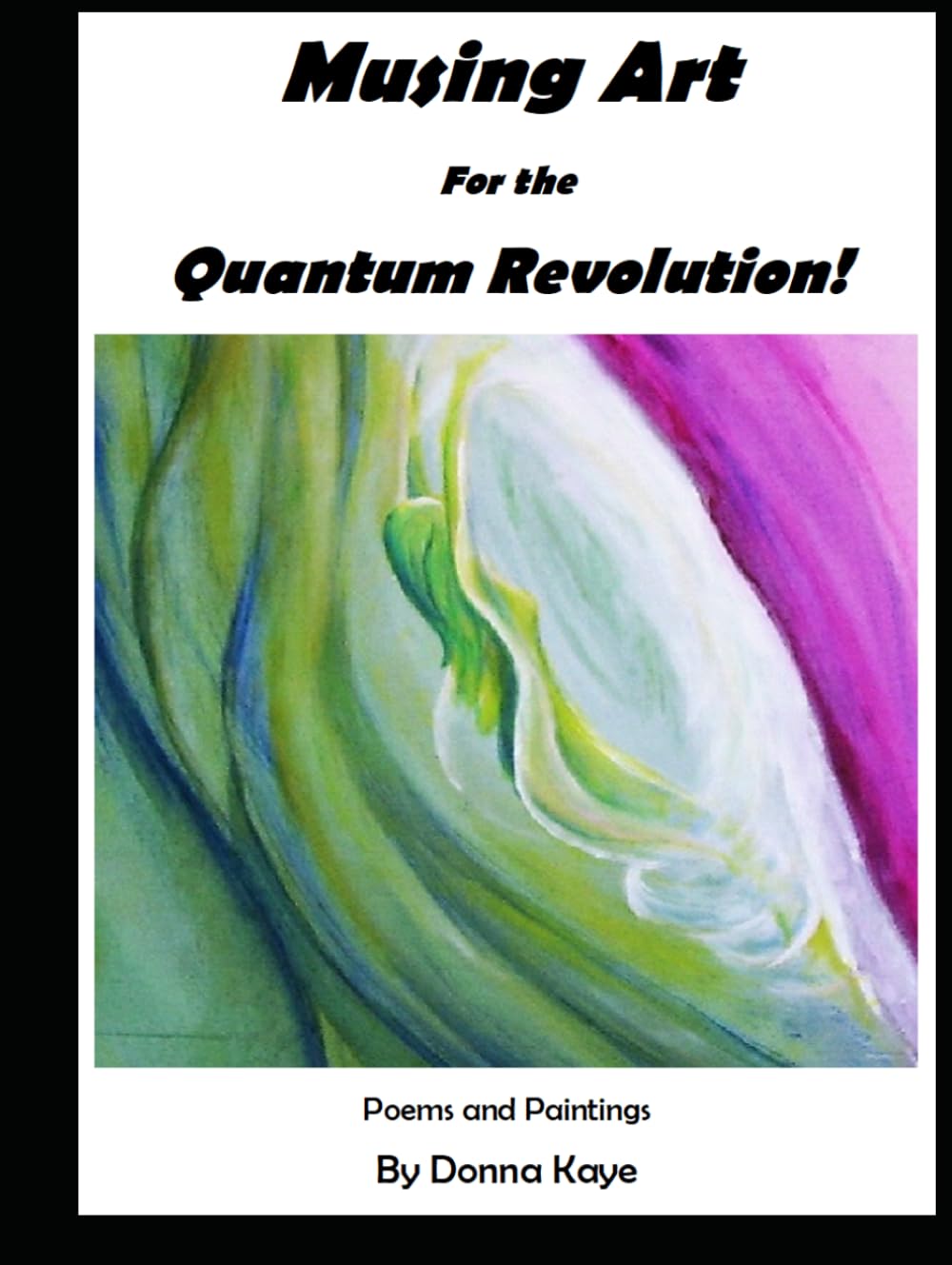
Musing Art for the Quantum Revolution! by Donna Kaye is a mixed collection of poems, spiritual reflections, political meditations, and original artwork centered on healing, freedom, human unity, and the idea that consciousness participates in shaping reality. The book moves from broad poems about war, fear, propaganda, poverty, and social control into more inward pieces about ego, anger, forgiveness, grief, and renewal, then closes with a short allegorical story about Freedom and several symbolic paintings that explain the author’s view of spirit, polarity, and illusion.
I read this less as a conventional poetry collection and more as an art journal with a clear moral compass. Donna returns often to the same core idea: the outer world won’t change unless the inner life changes first. That theme shows up in pieces like “Oh, Little Ego,” where the self is treated almost like a frightened child, and in “I Hate to Speak in Anger,” where anger isn’t dismissed but traced through the body, breath, words, and consequences. The poems are direct, sometimes chantlike, and often written as declarations rather than quiet observations.
What stood out to me most was the way the artwork and text talk to each other. The paintings use bright colors, cosmic imagery, figures, animals, symbols, and fractured shapes to make the book feel less linear and more like a sequence of meditations. Some sections, especially the Covid poems, are pointed and politically charged, so readers should expect the book’s worldview to be explicit rather than implied. Still, the book’s dominant movement is toward repair: peace over fear, sovereignty over compliance, love over division, and forgiveness as a practical act rather than a soft abstraction.
This book is best for readers interested in spiritual poetry, visionary art, metaphysical nonfiction, inspirational poetry, consciousness studies, healing, freedom, and social commentary. Readers who appreciate the aphoristic, devotional quality of Kahlil Gibran’s The Prophet may recognize a similar desire to turn private insight into public guidance, though Donna’s work is more contemporary, political, and visually esoteric. The Quantum Revolution is a candid, color-saturated appeal for personal healing as the first form of social change.
Pages: 86 | ASIN : B0H2JHTPYM
Our scientific capabilities must merge with the wisdom of the heart
if we are to survive our death spiral of war and aggression.
If we want a better world, we must heal our inner traumas and become better people.
Only then can we stand in the true power of compassion and effective change.
Thank you for letting me share my healing journey!
May we All find deep Healing, Peace and Love!
Sitting by the Windowsill of Life With a Spiritual Friend

Sitting by the Windowsill of Life With a Spiritual Friend is a meditative work of creative nonfiction that imagines George Harrison as a spiritual companion speaking across the veil, offering comfort, correction, tenderness, and occasional impatience to the reader. The book moves through 166 short reflections on love, grief, aging, humility, nature, creativity, forgiveness, and spiritual awakening, often returning to the same radiant center: we are here to love, to shed what no longer serves us, to listen more closely, and to live with greater reverence. Britwell frames life through candles, gardens, music, rainstorms, autumn leaves, old friendships, and the quiet ache of loss, making the book feel less like a conventional tribute and more like a long conversation beside a window, where the earthly and eternal keep touching hands.
What I liked most was the sincerity of the book. It’s not coy about its beliefs, and I appreciated that. Britwell writes from a place of open-hearted devotion, and the best passages have the feeling of someone speaking softly after learning things the hard way. I felt that especially in the reflections on grief, where death is treated not as an ending but as a painful separation held inside a larger mercy. The idea that the one who has passed is “closer in spirit than we were in life” could easily have felt sentimental, but in context it lands with real emotional weight because the book has already spent so much time building its vocabulary of presence: flickering candles, wind in trees, butterfly kisses, summer sounds at an open window. I also liked the repeated insistence on simple, embodied living. When the book turns from music to gardening, imagining hands that once strummed a guitar now tending soil, the image feels quietly profound. Creation doesn’t disappear; it changes instruments.
The writing is strongest when it slows down and trusts its images. A rainy day becomes a small sanctuary for journaling and introspection. Autumn leaves become a way to think about shedding old selves. Relationships become squares in a tapestry, and the comparison to a child’s beloved blanket gives the passage a tender, almost aching clarity. Words like light, love, soul, God, and awakening appear so frequently that they can blur together, especially across the longer middle stretches. Still, there’s an earnest rhythm here that I found disarming. It feels like a mantra, or like someone returning again and again to the only truths they believe will hold.
Its ideas are simple in the way deep things often are: live gently, forgive where you can, step away from ego, care for the Earth, stop worshiping noise, and don’t forget that love is the one thing worth carrying. The closing reflections, especially the image of setting out in an old car with beat-up suitcases and no real certainty except the decision to keep going, gave the book a fitting sense of motion. I’d recommend Sitting by the Windowsill of Life With a Spiritual Friend to readers drawn to spiritual reflection, George Harrison’s contemplative legacy, grief writing, and gentle books that feel like companionship during a season of change.
Pages: 247 | ASIN : B0H4BWTGJY
Where Fear Meets Faith: Heartfelt Stories of Connection, Surviving Cancer and Living Life
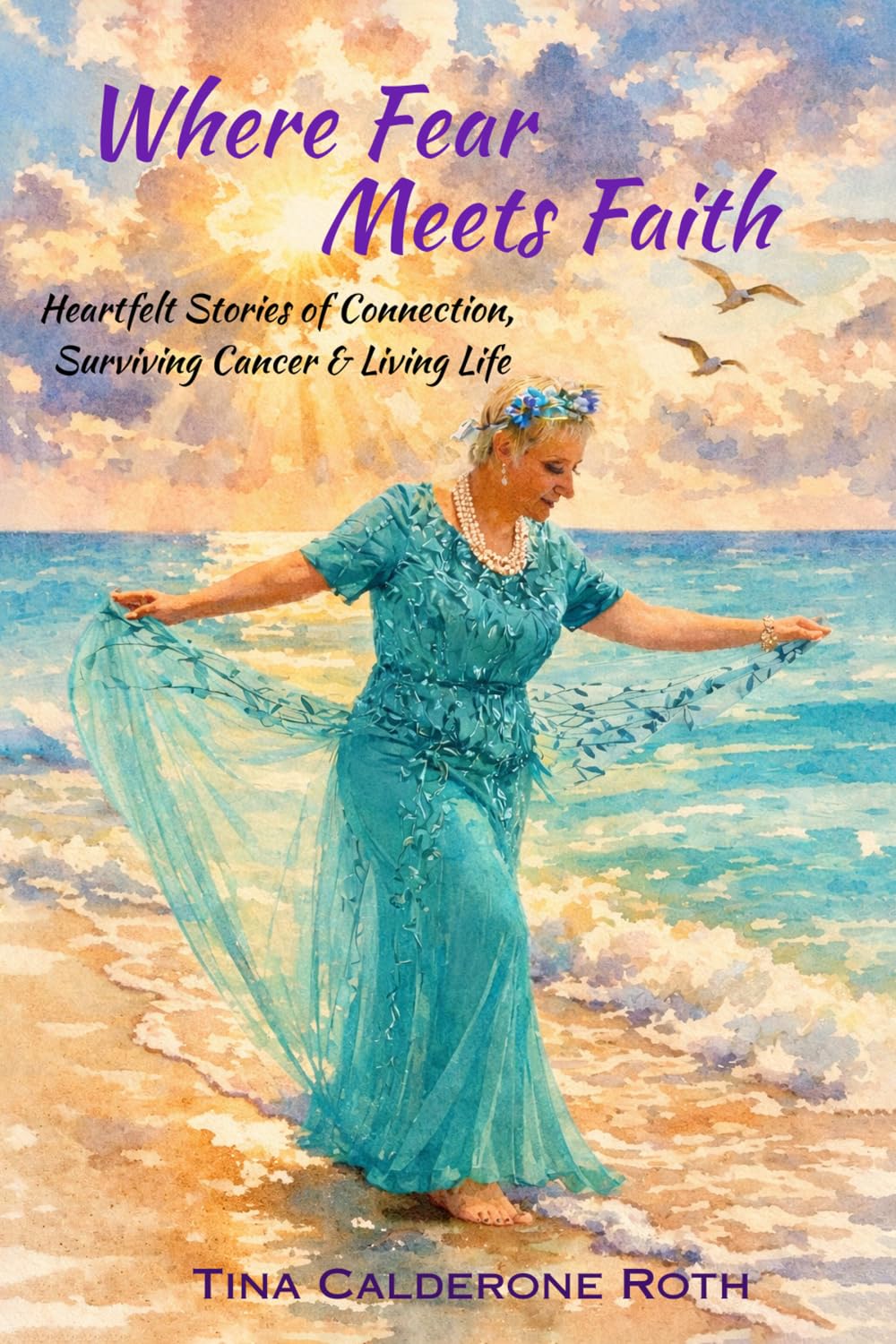
Where Fear Meets Faith, by Tina Calderone-Roth, is an inspirational memoir built from short personal essays about cancer, family, faith, gratitude, healing, and legacy. Calderone-Roth writes about her 2022 cancer diagnosis, her daughter Sarah’s medical challenges, the steady love of her husband Gary, the friends and caregivers who carried her through, and the small acts of kindness that became lifelines. The book is organized around Family, Gratitude, Healing, and Legacy, and each story ends with reflection questions meant to help readers think about connection in their own lives.
I liked how personal the book feels. It doesn’t try to turn cancer into a neat lesson. Calderone-Roth lets fear sit in the room. She talks about crying in cars, shaving her head, needing food trains, leaning on prayer, and trying to be both a patient and a mother at the same time. The writing is direct and heartfelt, sometimes almost like a journal shared across a kitchen table. That closeness gives the memoir its warmth. The prose circles back to gratitude, strength, and connection, and that choice gives the book a steady emotional rhythm. Those themes become anchors throughout the memoir, reminding the reader that healing isn’t one single moment but a return, again and again, to the people, beliefs, and small acts of care that help us keep going.
I was especially drawn to the author’s choice to focus less on medical detail and more on human presence. A nurse praying in a parking lot. A friend placing a prayer in the Western Wall. A teacher making lentils. A dog resting beside her after chemotherapy. These moments could have been sentimental, but they land because they are specific. You can feel the texture of ordinary care. I also liked that the book’s faith is sincere without feeling cold or preachy. It is faith as lived support, not just belief stated on the page. The reflection questions at the end of each piece make the book feel part memoir, part devotional, and part guided journal, which fits the genre well.
I recommend Where Fear Meets Faith to readers who appreciate inspirational memoirs, cancer-survivor narratives, faith-based reflections, and short essays about resilience. It will likely speak most strongly to people who have faced illness, caregiving, grief, or a season when they had to accept help even when it felt hard. This isn’t a detached literary memoir. It’s tender, open-hearted, and deeply grateful.
Pages: 111 | ASIN : B0GZD3PC27
The World’s Scariest Haunted Planes, Airships, Crews, & WW2 Airfields (True Encounters With Ghosts)

The World’s Scariest Haunted Planes, Airships, Crews, & WW2 Airfields is a tour of haunted aviation stories, from doomed airships and wartime runways to modern airports and lonely museum hangars. Each chapter features a different case, like the R101 airship crash, Eastern Air Lines Flight 401, the Tenerife disaster, Flight 19, the Cosford bomber, and even strange lights called “foo fighters” reported in World War II. Author Carol Nicholson mixes straight history with ghost lore, tying tragic wrecks, wartime stress, and eerie locations to reports of apparitions, phantom sounds, and odd glitches. The result reads like a mix of crash file, ghost tour, and campfire tale, all set in the sky and around airfields.
I found the ideas in the book surprisingly layered. On the surface, it’s a fun collection of spooky stories about planes that will not rest and airbases that seem to replay their worst days. Underneath, I felt a steady focus on loss, trauma, and how people try to make sense of violent events. The R101 chapter shows how pride and politics can push a project past safe limits, then moves into ghostly reports that feel like a lingering guilt hanging over the hangars. The story of Flight 401 hit me the hardest, with salvaged plane parts, haunted galleys, and a dead engineer who seems to warn crews about trouble. I liked that the book often nods toward rational explanations, then leaves space for doubt, so I could sit in that uneasy middle and decide what I wanted to believe.
The writing itself is clear, direct, and very easy to read. I could sense the author’s long history with paranormal work in the way she leans into atmosphere, with cold spots, strange footsteps, and that classic “hair standing on the back of your neck” moment. The casual, almost storyteller tone kept me turning pages. I liked how the book jumps around the world and through time, from wartime Britain to Antarctica to Denver Airport, although the quick pivots sometimes made the collection feel more like a bundle of articles than a single, flowing narrative.
I would recommend Nicholson’s book to readers who enjoy ghost stories, strange history, and aviation lore and who do not mind a blend of fact, legend, and speculation. If you like watching paranormal shows, swapping creepy stories late at night, or reading about famous crashes with an extra chill factor on top, this will feel right in your wheelhouse. Aviation buffs will enjoy the historical snapshots. I would hand this book to anyone who wants a fast, atmospheric read that they can dip into one chapter at a time.
Pages: 59 | ASIN : B0GGTWH4PN


