Blog Archives
Psychological Layers

In Delphi, a woman struggling to find balance between the past and present embarks on a journey of self-discovery, seeking the wisdom of an oracle. What was the inspiration for the setup of your story?
The seed was planted in the first novel Dancing the Labyrinth when one of the Minoan characters was bitten by serpents and saw her future as establishing the Oracle for Gaea at Delphi (500 years before Apollo). This is interwoven with a contemporary narrative. I wanted to use the main character Cressida as a sounding board for society’s expectations of women to fit patriarchal culture, especially in the entrenched institutions of marriage and finance. I didn’t anticipate deep diving into Cressida’s backstory and work through generational trauma. That evolved through the writing process. It makes sense though, that in making major decisions, we need to know ourselves – what is right for us. Cressida comes from a dysfunctional family and has no confidence in her choices, so she sets off to Delphi to seek the Oracle’s advice because of what is written on the temple of Apollo ‘Know thyself.’ She is unaware she is an integral part of a major plot being played out within a mythological timeframe. Inspiration for this component came from writing in situ. I have a felt-sense of place and when added to my research, compelling stories find their way to my page.
What is it that draws you to mythology?
When I was young, I was drawn to Greek mythology rather than fairy tales. I once read that there are only seven original stories and in all my creative work I have sought the corresponding Greek myth – whether or not I have incorporated it into the narrative. As an adult, I am interested in the psychological layers they offer, but I am also learning other versions of the same myths from archaeological research that do not necessarily confer with the known version, i.e. the voice of the occupier/conqueror. For example, the story of the Minotaur comes from Minoan history, not Greek/Mycenean. There is a stark difference between their accounts.
What was your writing process to ensure you captured the essence of the characters, specifically Cressida?
Because Delphi is a sequel, and Cressida was already my protagonist, she has a definitive voice. Four years on she is older and more confident with life, but she still responds to triggers – her fight/flight tendencies. She is in a process of healing and so to authenticate her life experiences I researched and read about healing from childhood wounds and trauma. I enjoy writing her and getting caught up with her impatience and frustrations. She is deeply flawed but (I think) likable.
I believe everything we create contains personal elements. My characters have specific attributes I recognise that can be explored in the context of plot to express their own nuances and idiosyncrasies, whether subtly or exaggerated. Many of the places, and some of the experiences mirror my own, but from another perspective that enhance my understanding but also adds an honesty to the work.
What is the next book you are working on, and when will it be available?
I am currently working on a travel memoir of when I lived in Crete for a year and wrote Dancing the Labyrinth. As I’d like to get Delphi translated into Greek and do a book tour through Greece next year, I’m planning for the memoir to be ready for release in 2026.
Recently, I released a quirky humorous nonfiction collation of illustrated memes and quotes called The Little Book of Red Flags. I’m planning to follow this up with The Little Book of Apologies (for those who find it so hard to say sorry).
Author Links: GoodReads | Website | Facebook | X (Twitter) | YouTube | Instagram | Threads | Amazon
With a rich tapestry of snakes and prophetic visions, and a captivating heroine in search of her own truth, Delphi offers a spellbinding exploration of the human spirit. Prepare to be swept away by a story that seamlessly weaves the threads of ancient lore with a young woman’s unyielding quest for understanding.
Delphi straddles history and mythology. Sequel to Dancing the Labyrinth, it can be enjoyed as a stand-alone novel. It is the third book in the thematic series Women Unveiled, which blends myth, history and imagination in the telling of (almost true) stories.
Wowing Modern Audiences
Gods and Monsters: Terra Solaris follows a young girl living in a realm where gods, monsters, and humans coexist who discovers she has a powerful ability to alter reality. What was the inspiration for the setup of your story?
The setup of the story was an exploration of the classic contradiction posed by Epicurus’ trilemma, “If God is unable to prevent evil, then he is not all-powerful. If God is not willing to prevent evil, then he is not all-good. If God is both willing and able to prevent evil, then why does evil exist?”
In Indo-European mythologies, it is a common trope for a god’s power to be embodied or represented by their wife. This dehumanizing portrayal of goddesses served as the setup for Terra’s existence as a source of great power that suffers from having her personhood submerged by the power-hungry gods around her who see her as a source of power and little else. This internalized dehumanization weighs heavily on the goddess’ mind and serves as a critique of the ancient objectification of women, both fictional and real.
Terra discovers that she possesses a remarkable power that can change the world, which prompts her to question her moral values and determine how she wants to utilize this power. What were the moral principles you aimed to convey through the development of your characters?
The moral principles I wanted to convey are best observed through the three men who at some point each wield Terra as a way to enforce their will. The god-king Zeus uses Terra to legitimize his regime and exploit the human race. The warrior-demon Typhon uses Terra’s power to conquer the entire Universe and plunge it into a never-ending age of bloodshed. The man of the people Hades wants to help the commoners but struggles with how exactly to do that while not using Terra as a tool.
With Terra as a central point, the other characters in her orbit exist as foils and alternate perspectives. Typhon, Zeus, and Hades, all know of Terra’s power and have rigid philosophies about how it should be applied. Each would wield Terra’s power in wildly different ways, each believing they best understand “good.” Terra either needs to decide whose will it is that she will surrender herself to… or finally regain the psychological fortitude required to take charge of her own life.
The story pretty obviously favors Hades’ approach and so morally condemns people who would use power selfishly like Zeus and Typhon: the monarch and the fascist. However, with Hades, a morally good character, he like Terra is stumped by how to most effectively use the power he has. Much of the story’s conflict is intertwined with the moral that using power responsibly is a difficult and complicated, yet nonetheless important problem that needs solving.
I find the world you created in this novel brimming with possibilities. Where did the inspiration for the setting come from, and how did it change as you were writing?
The idea was to create a world that could wow modern audiences. The world of Greek mythology which inspired Graia was impressive to an ancient audience, but rather mundane to a modern one. Since that ancient era, humanity has understood that the Universe is much larger than just the Earth. The scale and power required to be impressive in modern cosmology are beyond anything the Greek gods were capable of. My idea then was to make a modern setting that could have the same “Wow” factor that the ancient myths of the Greeks had on them. Foreign lands have been swapped out for distant planets or galaxies. The power to move mountains has been escalated to the power to blow up a star. It’s all wonderfully ridiculous and more importantly hits on a major theme of the story: this is far too much power to be in anyone’s hands. Being able to blow up a world is a more tangible metaphor for the undue political power wielded by the dictators and kings that serve as the book’s villains.
Some changes involved the inspiration of real-world Anthropology. Most notably, after learning from and consulting with the incredible Professor John Colarusso I gained a great understanding of Greek myth and its origins as a daughter culture of the original Indo-Europeans. Things like the caste system of holy people, warrior kings, and common producers became the three main factions in competition for the rule of the world embodied by holy Zeus, warlike Typhon, and populist Hades.
Any time I researched the ancient world, whether or not I found an answer, the setting of Graia was updated to gain further depth and history to explain its evolution into the nightmare kleptocracy it became during the events of the book.
Is this the first book in the series? If so, when is the next book coming out, and what can your fans expect in the next story?
This is the first book in a series, one that will be between 3 and 5 books depending on how I pace things out. Each story builds on the last but also focuses on a different character to allow their adventures to be at least somewhat self-contained.
Book one has focussed on Terra as a Holy Goddess and questions of how a god should act. Fittingly it is called Terra Solaris.
Book Two will focus on Zeus as the king of Graia and how power corrupts. It will also examine the use of power with similar themes and messages to book one but from a more villainous perspective. Unlike Terra who agonizes over how to best use her power morally, this story enjoys all the comically evil ways Zeus abuses his and how it later comes back to bite him. Fittingly it will be called Zeus Almighty.
Gods and Monsters: Zeus Almighty will be sprinkling such things into the more conventional myths more people will recognize. While Book One was mostly made up of all new and original stories by me, Book Two will focus more on adaptations of classic myths such as: the Story of King Midas, the 12 Labors of Heracles, and the Gigantomachy.
Author Links: GoodReads | Website
In “Gods and Monsters: Terra Solaris” by Jaiden Baynes, Terra, the formidable goddess of the world, faces a daunting challenge as she grapples with the consequences of her student Typhon’s betrayal.
With the fate of the Kosmos at stake, Terra embarks on a journey of redemption and revolution, confronting her inner demons and challenging the corrupt rule of Zeus-her own flesh and blood.
As Terra joins forces with Hades to defy Zeus’ tyranny and usher in a new era of democracy, the stage is set for an epic battle against the forces of darkness. From political intrigue to forbidden romance, “Gods and Monsters: Terra Solaris” weaves a tale of courage, sacrifice, and the enduring power of hope.
Will Terra and Hades prevail against the machinations of their enemies, or will Graia fall into chaos and despair?
Find out for yourself in this thrilling mythic fiction adventure that will leave you spellbound till the very end.
Gods and Monsters: Terra Solaris
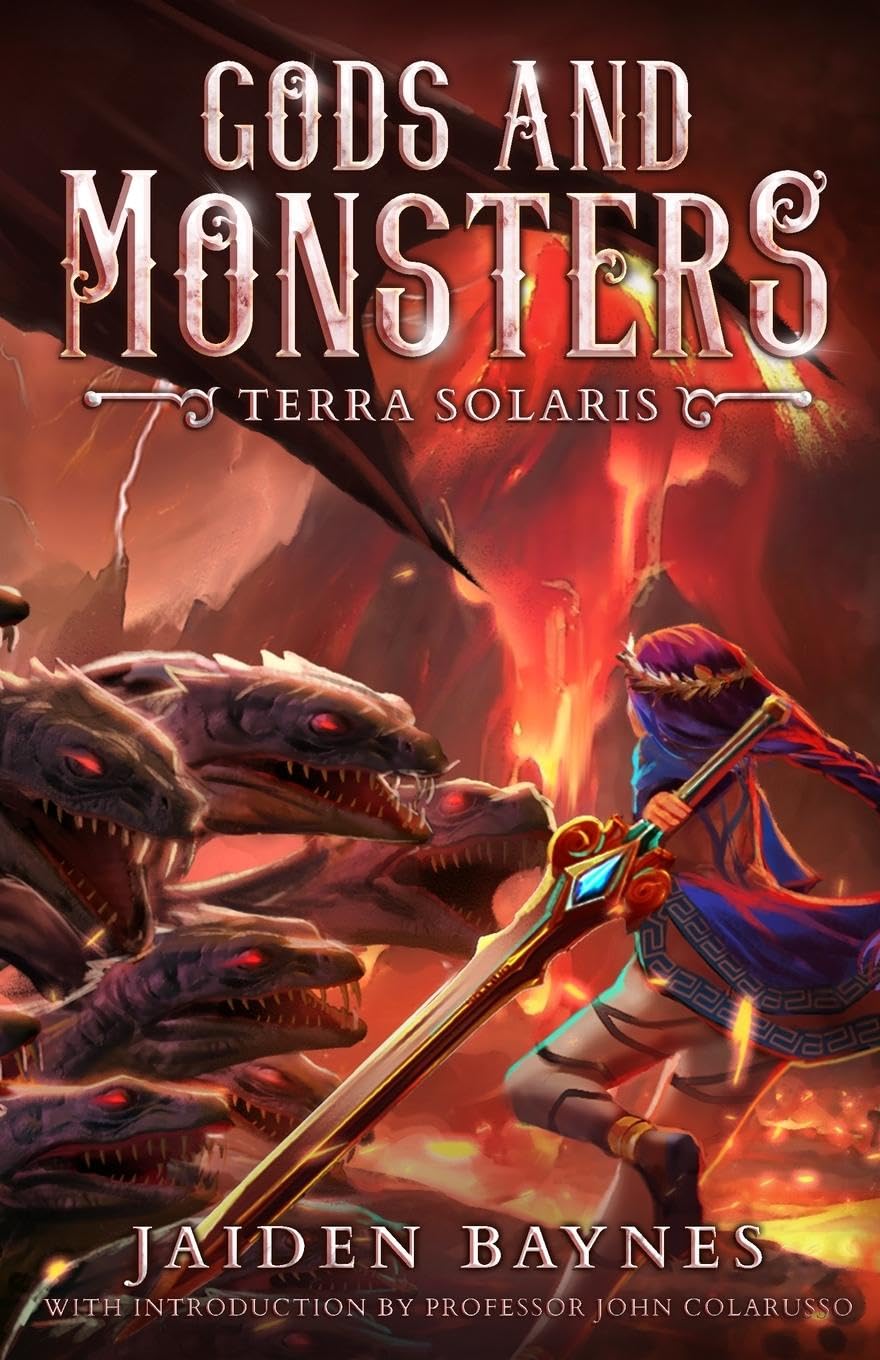

Gods and Monsters: Terra Solaris by Jaiden Baynes is a striking narrative combining fantasy and science fiction elements to reimagine Greek mythology. The story unfolds in Graia, a realm where gods, humans, and monsters coexist. The protagonist, Terra, a young girl with the immense power to alter reality, navigates a world of complex political dynamics and personal challenges.
The narrative is marked by a rhythmic flow that enhances the mystical elements of the plot, making the fantastical elements feel tangible and real. Baynes’ ability to paint pictures with words immerses the reader in the world of Graia, a place where the boundaries between reality and myth blur. The plot itself is a masterful blend of complexity and intrigue, weaving together the strands of Greek mythology with original elements to create a tapestry that is both familiar and refreshingly new.
As the protagonist, Terra is a well-crafted character whose journey is filled with challenges that test her physically and morally. Her development throughout the story is both believable and compelling. Baynes has a talent for bringing scenes to life, whether describing the grandeur of mythological landscapes or the subtleties of a character’s emotions. This attention to detail enriches the narrative and allows the reader to fully immerse themselves in the story.
The author skillfully combines various genres to create a compelling and multifaceted plot that keeps readers engaged from start to finish. The book is a fascinating read that delves into the intricacies of a complex world and characters, with vivid storytelling that brings each scene to life. Overall, Gods and Monsters: Terra Solaris is a remarkable piece of literature that showcases the author’s talent for blending genres, developing intricate plots, and crafting memorable characters that readers will not soon forget.
Pages: 374 | ISBN : 1998753271

Bellerophon and Pegasus
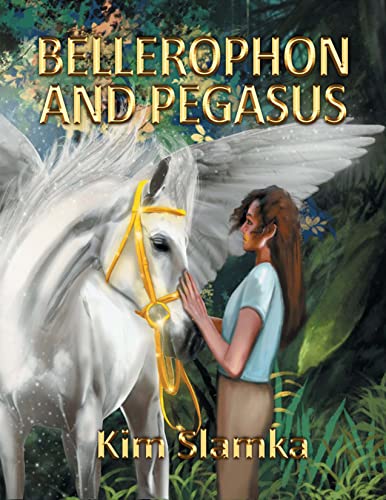
Bellerophon and Pegasus follow the Greek mythological story of Bellerophon, who had the rare gift of connecting with and healing horses, seeks help from Pegasus in a time of need. As the word of her talents spread across the land, she is asked to join the battle against the mythical beast plaguing the people, bringing destruction and death in his path. As a talented healer, she finds herself conflicted about how to help defeat it, and meeting what she perceives as a homeless man, she confides in him her struggles. The man, a light sorcerer, instructs her to sleep outside of Athenas to ask for help to bridle Pegasus to help defeat the beast “Chimera.”
Author Kim Slamka’s writing stands out amongst many other Greek Mythology stories I have read. The author has clearly done her research, and it shines through her flawless storytelling. The character development is one to commend as Bellerophon is a person that many can look up to as she is strong but also noble. I also enjoyed reading a story that contains a strong yet kind female protagonist. This is the significant difference in the retelling from the Greek tale of Bellerophon.
The book contains beautiful illustrations of the scenes taking place, and I was immediately captivated as they tell a story all on their own. The artwork looks like a painting and really gives readers an immersive experience when reading this awe-inspiring work. Even though this is a short read, this is one book you can read over and over while enjoying the marvelous art.
Bellerophon and Pegasus is a captivating read with a twist on Greek mythology. I highly recommend this beautifully written story to those who are looking to escape a few hours of their day to a mythical world. This would make a great introduction to Greek mythology for teachers as well.
Pages: 60 | ASIN : B09KYDQDQV
Traveler
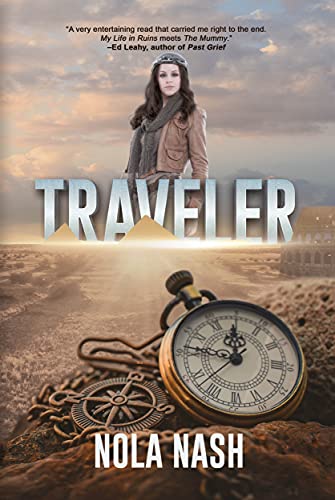
There’s another world out there and it’s full of gods, past lives, and destiny; the only problem is that Shelby Starling is right in the middle of it. A traveler by trade, Shelby wanders the world writing for Pioneer Tours, except this time she’s the one at the center of the story. Accompanied by a motley crew of Gods and Goddesses, with the addition of one gorgeous Roman, Shelby must work through the memories of her past lives. More of a watcher than anything else, our heroine must learn to overcome her fears of failing and get in the middle of a history that she’s only read about in textbooks.
Traveler by author Nola Nash brings fans of romance, adventure, and the paranormal on a time-traveling romance novel. The author does an excellent job at bringing to life some historic events and places. Readers will travel the world with Shelby experiencing exotic cultures and historical events through her eyes. The characters of Traveler are interesting and engaging. Readers will be able to get to know them and develop a connection from the beginning chapters. What I liked most was when Egyptian and Greek gods and goddesses enter the storyline because I felt like that is when things really started to get interesting.
Shelby is sarcastic, down-to-earth, and very relatable in her desire to just move forward and not dwell on the past, but as with most people, this will come back to haunt her. Traveling through time, Shelby discovers her past lives and sees that she is destined for greater things than just sitting on the sidelines writing about other people’s history. She may even learn to love someone in this experience.
Traveler excellently blends bravery, adventure, romance, fantasy, and some history into a story that readers will easily devour. This combination makes the novel a riveting read that fans of suspenseful time travel stories will find easy to enjoy. With this being the first novel in the series, readers can look forward to the future endeavors of Shelby Starling.
Pages: 274 | ASIN : B09HV7JVBK
The Dream Walker
The Dream Walker by K. J. Simmill is the account of the escape of Íkelos, the Father of Nightmares, from his centuries-long prison and how the Mystics, people throughout the various lands who hold special powers like those of prophecy and healing, worked together to save all the lands from his chaos and destruction. Some, like Zoella, have to learn what their powers are and how to use them, while others use their knowledge and understanding of the last time an event this disastrous happened to find a way of getting ahead of Íkelos. The most important powers seem to be those dealing with prophecy.
Author K. J. Simmill is an extraordinary story teller, creating a richly detailed world that will transport you into the book. K. J. Simmill thought of everything when developing her world providing details for every instance and immersing readers into her vision. This makes for an interesting read, especially for voracious readers of the epic fantasy genre, as they will not only understand what’s going on during the story, but also why things are working the way they are and why they’ve happened the way they have in the past and the present. The character development also shines in this novel which allows the reader to really relate to a specific character in the book. The reader really gets to see the characters develop throughout story.
The Dream Walker by K. J. Simmill is a riveting and powerful epic fantasy novel. Readers of science fiction and fantasy alike will find the story and characters memorable and engaging. From beginning to end, this is an entertaining sword and sorcery adventure that you won’t be able to put down.
Pages: 547 | ASIN: B08KXMTG87
Remedy

Rob is surrounded by darkness; a darkness that encompasses everything in its path. He cannot see, but he knows he is not alone. There is something approaching, of that he is certain. It does not seem possible, but the shadows about him continue to grow darker. As his fear begins to grow more intense, Rob realizes that the entity that pursues him is one he cannot face. Every sound around him heightens his ever-growing terror. Then, somewhere in the abyss, Rob recognizes what looks like the smallest hint of light. If only he can reach it in time.
Remedy: The Forgotten Legacies Series Book Three, by author K.J. Simmill, takes readers on the adventure of a lifetime with the book’s main character, Rob. Virtually every interaction he has and every problem he must solve on his way to his final success is fraught with danger and described with an incredible amount of detail. The imagery Simmill creates for science fiction fans is simply stunning.
The richly detailed dialogue enhances the story line allowing readers to be immersed in Rob’s plight, while not overwhelming readers with too much. Simmill uses dialogue in order to maintain the integrity of the story and enhance the readers’ ability to visualize dynamics between characters. The story’s narrative provides beautiful imagery while giving insight into how the character is developing and advancing the storyline.
The character of Taya will captivate readers while eliciting sympathy. This character endured things that gives the novel added elements of surprise and horror. Details given by Simmill are chilling and will keep readers on edge.
Remedy: The Forgotten Legacies Series Book Three, by K.J. Simmill has characters that are unique, strong-willed, and memorable. I highly recommend Simmill’s work to anyone looking to follow a new and promising author. Fantasy and science fiction fans alike will enjoy this swiftly-moving powerhouse of a novel.
Pages: 533 | ASIN : B074Y8GQXC
Heroic Fiction

Murray Lee Eiland Jr. Author Interview
Zurga’s Fire takes place in historical Greece and the rest of the Mediterranean and is broken up into four books filled with short tales of adventure. What was the inspiration for this third book in the Orfeo Saga?
The fictional universe laid out by Tolkien in Lord of the Rings was probably the series that got me thinking along the lines of an extended saga. I liked the way Tolkien used ancient sources to create heroic fiction. At the same time I wanted to be more historical like Robert Graves and his series I, Claudius. I wanted to write something that would not be fantastic, and which would not re-tread well known history. The Bronze Age offered scope to speculate. There are few written sources, but what there is offers scope to invent characters and place them in historical context.
Zurga’s Fire introduces the issue of nomads and how they impact civilization. I had been researching nomads for my other interest, Oriental carpets. Nomads were very effective warriors, and they could overwhelm sedentary societies. They did have one weakness, and that was leadership. Every group from that lead by Attila to Ghengis Khan eventually fell apart. A charismatic leader is essential for nomads. In Zurga’s Fire the leader of the nomads is eventually undone not so much by a face to face challenge, but by a crisis in leadership.
Why did you go with the format of short stories told as a collection?
This is a very good question. I really did not think about the format before I started writing the series. I wrote many short stories over a period of years that were never published. Looking back that was probably a good thing. I always liked reading short stories. I think I have a short attention span. The result is that I am quite comfortable writing short stories and I have structured my Orfeo Saga that way too. Many books in the Orfeo Saga are made up of two different stories which are divided into books. In contrast my other series about a Los Angeles based private eye (the Bart Northcote series) are entire novels.
I felt that the characters in this book were complex and well thought out. What was your favorite character to write for?
I think that the character I had the most fondness for was “Zurga.” I gave him a rather ridiculous name because the character went by many names. This name suggests that you cannot take the character seriously. Zurga likes to deceive people as to his true intentions, as well as build up a mythology around himself. Zurga realized early on that he would not be fully accepted. No one would ever select him as a leader. In contrast his protege Orfeo can become a leader. Again I was well aware of Orpheus in the Greek pantheon. While Orpheus was a gifted lute player, he is also credited introducing civilization to savages. My Orfeo character has some similarities with Orpheus, but I have taken all supernatural elements away.
I think of Zurga’s Fire as a historical adventure tale. Did you do any research to keep the setting and characters true?
I studied ancient and modern nomads for years. I read about them, their social structure, history, and particularly art. Many of my research trips were to see nomads making textiles, particularly Turkish speaking people. I knew that for the Bronze Age there were not good historical sources, so I filled in the blanks with what I understood from more modern nomadic groups. I tried to capture their lifestyle in the novel, without going into the nuts and bolts of their society. The interesting thing is that the Greeks had recently settled by the Bronze Age. In the novel they were well aware of the kind of enemy they faced. The same pattern repeats throughout history many times. A group settles and then the next group of nomads impinges on them. Every sedentary group has the same choice. They can fight or they can flee. For Zurga’s Fire I wanted to show how the nomads being horse riders and archers had an advantage. Sedentary society, with farmers, had fewer people who would naturally take on a warrior role. They could fortify cities to stop nomads, but that does not always work. That is the tension I wanted to accentuate in the book.
What does the next book in the Orfeo Saga take readers?
The next book is also divided into two main parts. The first part takes the characters to the New World. There has been a huge amount of scholarly speculation about the contacts between the Old and New Worlds. I think that there must have been limited contact between these two areas, but I am not sure that it occurred as early as the European Bronze Age. However, there was likely early contact. There was a report that a scientist had found traces of cocaine as well as nicotine in Egyptian mummies as early as 1000 BC. I think it is important to look at evidence with an open mind but have a healthy skepticism about big claims.The Orfeo Saga volume 4 has a bit more humor in it than other books in the series. I also thought it was important for Orfeo to take a greater role in his own fate. His teacher disappears during this story.
Part II of the book deals with the rise of Sparta. This is not as far-fetched as some people think. Archaeology is pushing the date for Spartan civilization further back in time. I try to post interesting links to the archaeology on my Facebook page.
Author Links: GoodReads | Facebook | Website
The Getae inhabited the region on either side of the Lower Danube River, in what is today northern Bulgaria and southern Romania. They were in contact with ancient Greeks from an early date. Herodotus – writing in the 5th century BC – extols their martial spirit: “…when it lightens and thunders, they aim their arrows at the sky, uttering threats against the god; and they do not believe that there is any god but their own.”
They ruthlessly incorporate conquered people into their society through enslavement, and are prepared to kill those who are not useful to their plans. They have no need for the luxuries of city life. Fighting in troops of mounted archers, they mock individual heroes. Getae have a long history of reducing enemies in deadly hails of arrows while not getting close enough to lose warriors in single combat. Here Orfeo and his warriors must deal with an expanding Getae empire during the heroic age of Greece. Vastly outnumbered, can they stop an invasion that threatens not only their lives, but also their entire culture?




 LITERARY TITAN