Blog Archives
Healthy Minds, Healthy Nation: How Meditation, Shamanism, and Indigenous Healing Can Tap into Your Light Within and Change the World
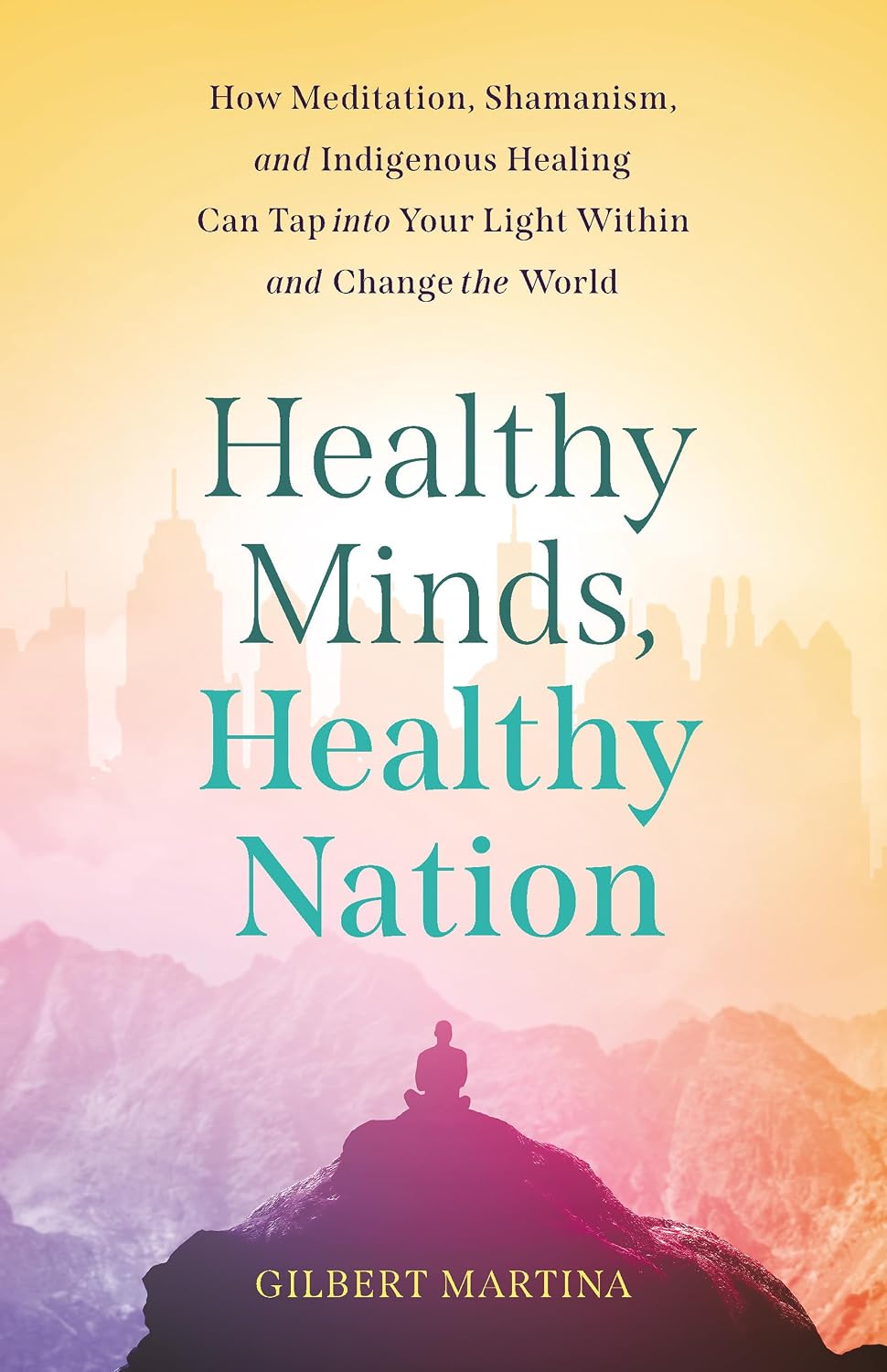

Healthy Minds, Healthy Nation, by Gilbert Martina, is a personal, spiritual, and socially minded exploration of the idea that healthier societies begin with healthier individuals. Martina builds the book around his own experiences with grief, chronic pain, professional pressure, family trauma, and leadership in Curaçao, then connects those experiences to larger questions about consciousness, morality, and collective well-being. The book moves through four broad stages: establishing the foundations of a healthy mind, examining how trauma can affect whole societies, describing spiritual awakening, and introducing practices such as Transcendental Meditation, shamanism, and Indigenous healing. What makes the book especially personal is that Martina rarely presents these ideas from a distance. His parents, marriage, career, physical pain, and Curaçaoan heritage are woven directly into his argument, so the book reads partly as memoir, partly as a guide to spiritual development, and partly as a reflection on leadership.
One thing that was most interesting to me was the way Martina moves between individual trauma and national history. His discussion of Curaçao gives the book a strong sense of place, particularly when he considers slavery, colonialism, discrimination, political power, and the long psychological effects of historical wounds. He argues that unresolved trauma can shape not only individual behavior but also relationships, institutions, leadership, and entire communities. That argument becomes more compelling when Martina connects it to his own life, including his mother’s fight against discrimination, his professional battles over integrity, and his struggle to separate what he calls the ego from the true self. The Papiamentu sayings passed down by his mother are especially memorable because they turn abstract ideas such as honesty, discipline, humility, resilience, and responsibility into something lived and specific.
The book becomes more explicitly spiritual as it progresses, especially in its treatment of meditation, energy healing, shamanic practice, chakras, ancestral trauma, vision quests, and ayahuasca. Martina treats neuroscience, psychosomatic medicine, spiritual experience, and Indigenous healing as parts of a connected picture of human health. That gives the book a distinctive confidence and makes his worldview easy to understand, even when some of the scientific and spiritual claims are presented with different kinds of supporting evidence. His strongest material tends to come when he describes what these practices have meant in his own life. Still, the central thread remains clear: healing requires attention to mind, body, relationships, history, and spirit, and personal transformation matters because it changes the way a person acts in the world. By the final chapter, Martina turns that idea toward moral courage, arguing that an awakened person should be willing to speak up against injustice and choose principle over fear, status, or money.
I recommend Healthy Minds, Healthy Nation to readers who are interested in spirituality, meditation, holistic approaches to healing, personal transformation, and values-based leadership. It will also have particular appeal for readers interested in Curaçao and the Caribbean, especially those thinking about how colonial history and inherited trauma continue to shape modern communities. Martina writes with the conviction of someone trying to make sense of his own life while also offering that meaning to others, and the book’s warmth comes from that personal investment. By the conclusion, his message has become both intimate and ambitious: quiet the mind, care for the body and soul, loosen the hold of ego, heal what has been carried from the past, and let that inner work influence families, communities, and nations. Readers who enjoy books that bring memoir, spirituality, leadership, cultural history, and self-development into the same conversation are likely to appreciate it most.
Pages: 246 | ASIN : B0GP4Y8JF2

The Octopus Analogy – The Soul’s Endless Dance Across the Web of Creation


The Soul Octopus Analogy is a brief but expansive spiritual meditation that uses the image of an octopus to rethink the soul, reincarnation, the afterlife, free will, soulmates, past lives, and the mystery of human suffering. Bud Megargee imagines the soul not as a single traveler moving neatly from one lifetime to the next, but as a vast, many-limbed consciousness whose tentacles may live, learn, wound, heal, and remember across different times and dimensions. The book moves through that idea with a kind of dreamy insistence, from the “Chamber of Threads,” where a soul reviews love, fear, peace, hate, divine intention, karmic events, and the overseer, to later reflections on soul guides, time slips, near-death experiences, and the strange mercy of beginning again.
The octopus metaphor could have felt gimmicky in less sincere hands, but here it becomes a surprisingly elastic vessel for questions that are difficult to hold in ordinary language. I found the sections on the blueprint of a life and free will especially affecting because they give pain a shape without reducing it to punishment. The example of abandonment as a wound that might lead someone toward bitterness, therapy, or healing work felt emotionally honest to me. I don’t need to accept every metaphysical claim literally to appreciate the compassion inside the idea. The book keeps returning to the possibility that our lives are not random debris, but neither are they locked scripts.
The writing is at its best when it leans into image and atmosphere. I liked the way Megargee asks the reader to “pack light but pack deep,” to bring questions rather than answers, and to imagine the afterlife as an ocean rather than a fortress. There’s a lyrical, almost trance-like quality to those passages, and the recurring language of tides, threads, vibrations, and chambers gives the book a distinct inner weather. The discussion of evil as unintegrated pain is moving and humane, but I wanted a deeper wrestling with the real brutality of suffering. Still, I admired the book’s willingness to be strange. It doesn’t apologize for its mysticism, and that gives it a certain fragile courage.
I came away from The Soul Octopus Analogy feeling both challenged and quietly soothed. It’s rewarding for readers willing to sit with metaphor as a doorway into reflection. Its conclusion leaves the soul feeling less like a fixed object and more like a living current, unfinished, porous, and deeply connected to others in ways we may only sense in flashes. I’d recommend it to spiritually curious readers, seekers drawn to reincarnation and afterlife speculation, and anyone who enjoys reflective books that treat mystery not as a problem to solve, but as a companion to walk beside.
Pages: 92 | ASIN : B0H1PFXZ1H
Life After Fall

Life After Fall, by B. Dozier Singletary, is a reflective, faith-centered story about Eli, a man who spends much of his life mistaking control for peace. The book follows him from a childhood shaped by volatility and fear into adulthood, where success, marriage, discipline, and outdoor escape all become ways of holding himself together. What makes the story engaging is how personal it feels without feeling rushed. It’s not just about one fall from stability. It’s about the slow recognition that survival skills can become emotional walls.
Eli’s inner life is the heart of the book. His childhood with an abusive, addicted father gives him a deep need to be competent, admired, and untouchable, and the book does a strong job of showing how those instincts follow him into his marriage with Rachel. Their relationship is written with sadness and complexity, especially as both of them carry pain in ways that hurt the other. The line “Tragedy hadn’t ruined him. It had stopped him.” captures the book’s central movement well. Eli’s loss doesn’t simply break him; it forces him to finally sit still long enough to see himself clearly.
The book is also very much an outdoor story. Rivers, hunting, golf, motorcycles, and eventually Alaska all give Eli places where he can wrestle with fear, humility, and faith without turning the story into a sermon. The Denali section widens the book in a satisfying way, not because the mountain magically fixes him, but because the journey north lets him meet people who model truth, kindness, courage, and presence in practical ways. Those encounters give the later chapters a grounded warmth.
Faith runs through Life After Fall in a quiet but steady way. Eli’s name, his prayers, the Eucharist, and his search for God all matter, but the book’s spiritual insight feels most convincing when it’s simple. “God had never been hiding” is one of the clearest expressions of what Eli comes to understand. The story suggests that healing isn’t found in dramatic revelation as much as in honesty, patience, forgiveness, and the willingness to stop performing.
What Life After Fall offers is a thoughtful portrait of a man learning how to live after the life he built comes apart. It’s part redemption story, part travel narrative, part meditation on masculinity, grief, and grace. The tone is earnest and introspective, and readers who connect with stories about rebuilding after divorce, confronting childhood wounds, and finding faith in ordinary moments will find a lot to sit with here. It’s a book about losing the version of yourself you thought you needed, then discovering that the quieter version may be the truer one.
Pages: 176 | ASIN : B0GZLJMB82
5 Steps You Must Take to Win the Battle of the Mind

5 Steps You Must Take to Win the Battle of the Mind, by Joe Roach, is a Christian guide to confronting fear, anxiety, doubt, racing thoughts, and depression through the lens of spiritual warfare. Roach frames the mind as a contested place where lies must be recognized, resisted, and replaced with biblical truth. The book moves through five steps: understanding the battle, acknowledging troubling thoughts, identifying the enemy’s lies, guarding the mind with Scripture and gratitude, and building a disciplined daily rhythm of prayer, meditation, devotion, and thought inventory. Along the way, it folds in biblical stories, practical exercises, a “Power in Your Pocket” section of truth cards, and a thirty-day devotional meant to help readers carry the teaching into ordinary mornings, anxious nights, and repeated inner struggles.
I appreciated the book’s insistence that thought patterns matter deeply, not in a vague self-help sense, but as part of a spiritual and emotional life that requires attention, honesty, and practice. Roach is at his strongest when he gets close to the lived experience of mental battle: waking with racing thoughts, feeling accused by old labels, or needing something steadier than willpower when fear starts circling the room at night. The suggestion to write down looping lies, replace them with Scripture, and keep truth close in tangible form, even on simple 3×5 cards, has a humble practicality I found moving because it’s usable. There’s also a welcome generosity in the chapter on medication, where the book avoids treating medical support as a failure of faith and instead allows room for God to work through professionals, treatment, prayer, and slow healing together.
The writing is earnest and direct. The Q&A sections are useful, especially for readers new to spiritual warfare. There’s sincerity here that’s hard to dismiss. Roach writes like someone who wants readers to stop being bullied by their own inner darkness, and that urgency gives the book its pulse.
I came away from Win the Battle of the Mind with respect for its pastoral seriousness and its belief that freedom is cultivated through daily surrender, not dramatic shortcuts. Its best moments are practical, compassionate, and bracingly clear: identify the lie, speak the truth, return again tomorrow. I’d recommend it especially to Christian readers who want a Scripture-centered, action-oriented approach to anxiety, negative thinking, and spiritual discipline, particularly those who find comfort in devotionals, guided routines, and concrete tools they can use throughout the day. This is a book for believers who don’t merely want to understand the battle of the mind but want to begin fighting it with steadier hands and renewed hope.
Pages: 209 | ASIN : B0G5261VHZ
Come, Find Space With God

Come, Find Space With God, by Leoma Gilley and Carol Mullen, is a contemplative guide to Christian spiritual formation, written especially for readers moving into adulthood, responsibility, uncertainty, and spiritual self-awareness. The book walks through practices such as stillness, Scripture meditation, prayer, examen, discernment, surrender, sacred community, service, and a rule of life, pairing biblical reflection with personal stories and practical exercises. Its central invitation is simple but searching: make room for God not as another obligation, but as the One who can reshape fear, hurry, wounded thinking, and restless striving into a steadier life of trust.
What I found most affecting was the book’s refusal to treat spiritual growth as tidy or abstract. Leoma’s stories give the material weight: her prayer counseling in England, where a first-grade memory still carried the sting of shame; her long argument with God about Africa; her years caring for her mother; her decision to welcome Ben, Sara, and John into her home even when hospitality became costly and inconvenient. These moments keep the book from floating into devotional softness. The ideas here are deeply pastoral. “Space” is not presented as a pretty metaphor. It becomes a house opened to someone in need, a schedule interrupted, an ambition surrendered, a harsh inner voice confronted, a grief carried honestly before God.
The writing is warm, direct, and companionable, with a rhythm that feels suited to reflection. I appreciated how the authors blend story, Scripture, music, journaling prompts, and spiritual practices without making the reader feel rushed or managed. The structure can feel instructional, especially when the chapters move from story into exercises and group questions, but that same structure is also part of the book’s usefulness. I was especially drawn to the chapters on discernment, negative self-talk, and service because they press into the places where faith becomes concrete: what we do with fear, how we interpret our own failures, and whether we can serve without needing to fix people.
Come, Find Space With God speaks with the calm authority of people who have been formed by long obedience, real disappointment, and repeated redirection. The concluding emphasis on a rule of life gives the book a fitting sense of movement, as though all the earlier practices are gathering into a sustainable pattern rather than a burst of temporary inspiration. I’d recommend this book to Christians in seasons of transition, especially young adults, small groups, spiritual direction groups, and readers who feel crowded by anxiety, decision fatigue, or spiritual noise and want a grounded way to begin listening again.
Pages: 129 | ASIN : B0GX2XNR2T
Ego Degradation: Pulling Back the Veil of Illusion to See Your Mind’s Programming

Ego Degradation: Pulling Back the Veil of Illusion to See Your Mind’s Programming by Alexx Shaw is a spiritual self-help book that blends psychology, neuroscience, philosophy, trauma language, and metaphysical ideas to explain what Shaw calls “ego degradation,” a painful but potentially clarifying breakdown of the mind’s old programming. The book argues that the ego creates our perceived reality through duality, judgment, expectation, and control, and that awakening begins when we learn to see those patterns instead of blindly living through them.
The writing has a direct, almost coaching-like energy, and at times it feels less like reading a quiet guide and more like sitting across from someone who is trying to shake you awake. I appreciated that intensity, especially when the book talks about trauma, attachment, and the way people mistake old coping habits for identity. Some claims stretch into spiritual territory. The book wants to give language to experiences that can feel frightening, private, and impossible to explain.
Shaw moves between Freud, Eastern religion, brain regions, karmic lessons, mindfulness, and non-attachment, which makes the book feel wide-reaching and ambitious. Sometimes that range is energizing. The central idea kept pulling me back: what if the stories I tell myself are not facts, but programs I keep running because they once helped me survive? That is the strongest part of the book for me. Under the spiritual vocabulary, there is a very human question: how much of my suffering comes from reality, and how much comes from my grip on reality?
I would recommend this book to readers who already enjoy spiritual self-help, consciousness writing, shadow work, trauma reflection, or books that mix personal growth with metaphysical thinking. For readers who are open to inner excavation and a genre that treats healing as both emotional and spiritual work, Ego Degradation offers a challenging, candid, and sometimes bracing invitation to look more closely at the mind behind the curtain.
Pages: 264 | ISBN : 1917704607
Emotional & Intuitive

Sacred Geometry for Healing presents a collection of mandalas devoted to the deeply renewing experience of meditation. Why was this an important book for you to write?
The intention of Sacred Geometry for Healing began as the expression of myself as an artist. My goal as an artist was to find my essence, my true nature, and I began to discover myself as a mandala artist. My spirit would move me, and I would create mandalas with the synchronicity of numbers, 4 – 6 – 8 – 12 – 24 (sacred geometry), and so on. As my artwork manifested, I began to hand tool the mandalas in copper. A process known as copper repoussé. Copper is a healer and spiritual conductor. I presented my work in galleries and art shows and co-founded an art gallery collective.
Many, many beautiful mandalas were too intricate to tool in copper as 18 or 24 intricacies in the circle. And that emotionally pained me that they were being left behind. In 2019, when the gallery I was managing was closed temporarily due to the pandemic, the mandalas left behind began to call to me! I realized they were destined to be compiled into a book & Sacred Geometry for Healing: Art on a Mission was born and published!
My mission was to help healing through the observation of art. To create my book to facilitate the practice of deeply viewing and concentrating (meditating) on each of my artworks and their deep collective subconscious and consciously titled meaning. And thus instigating a way for the viewer to receive healing. This was a concept I evolved in sympathy with the tradition that relates mandalas with meditation in different aspects. From 2019 to 2025, a little knock in my solar plexus would keep telling me my book was unfinished. In 2025, after expanding the narrative and republishing my memoir, I had a revelation. Mantras! Mantras were speaking inside me to be written as corresponding healers in synchronicity with the visual and title meanings of each mandala in the original edition. 51 mantras flowed from me next to each mandala, and I knew the entire truth of my artist’s healing mission had come to fruition – Sacred Geometry for Healing: MANTRAS AND MANDALAS FOR MEDITATION.
How do you hope readers engage with the imagery—analytically, emotionally, or intuitively?
My approach to the creation of sacred geometry mandalas was natural, emotional & intuitive. The artworks manifested from me and spoke to me. After I created them, I felt their meaning as if they were communicating to me, and titled each work as I discovered its embodied meaning. They came from a deep connection with nature and creation. I feel the natural connection for the viewer is personal, and I hope each mandala conveys a universally accessible experience, whether by emotion, intuition, or analysis.
Do you see sacred geometry as something rooted in belief, or as something that can be experienced regardless of belief?
I see sacred geometry as something we experience every day naturally in nature, as a seashell or a snowflake. My mandalas, I hope, feel natural and accessible to everyone as nature is to all humanity, regardless of our individuality, beliefs, etcetera.
If a reader takes just one thing from this book, what do you hope it is?
I hope each reader receives something personal, as an artist feels when their art is viewed at an exhibit. I hope they are moved and receive from experiencing my artworks, deep meanings, and personal mantra expressions. And can relate them for themselves in any way they choose.
Author Links: GoodReads | Website | Amazon
Mantras and Mandalas Guide for Meditations – Each mandala in this book has a universal and personal meaning. Each title and aura blue print image embodies the spirit of what has been experienced in the collective consciousness of human experience, connecting to the divine. As god experiences, we experience.
Choose your mandala for the moment by either concentrating and opening the book and finding your spirit guided selection or browse the titles and choose what resonates with your heart at the moment. Remember you are not alone, what you are facing and experiencing from joy to despair has been faced by those who came before you and by those that are here with you now. Focus your meditation on your selected mandala and read the corresponding mantra. You can repeat it out loud during you meditation or remain silent.
“The artworks are resonating as a blueprint of human – god emotions and you
can feel the unseen universal – the sacred geometry blueprint of life experience.”
Bio- Originally upon graduation with a BFA in dance and choreography—I was a member of two contemporary dance companies and a producer for a cable tv station, before I was isolated from the world. Upon my return a decade ago, I am now an accomplished artist in galleries and shows. I am a member of an artists association and am the co-founder of an art gallery collective.
Adria: The Artist.
Live a More Informed & Enriched Life

Down to Earth: Demystify Intuition to Upgrade Your Life is a thoughtful blend of personal stories, practical exercises, and scientific studies showing readers that intuition is not a mystical talent, but an everyday skill that can be honed. Why was this an important book for you to write?
I am convinced that tapping into intuition can help us live more informed and enriched lives. I developed simple ways to tap into intuition and wanted to share these with as many people as possible. Intuition always held a special place in my life, and became more important after a life-altering event that brought moments of deep mental and emotional peace. I talk about this in the Introduction of my book. I often came up with creative ideas and solutions to long-standing problems while I was in this mentally and emotionally calm state which activated my intuition. Curious about this process, I began researching intuition. I studied with various teachers, completed an apprenticeship, and read every book and scientific study on intuition I could find. I started offering intuitive guidance sessions and eventually developed my own approach to help clients access their intuition more effectively. As more people joined as students, I created a curriculum that later became the foundation of my book, Down to Earth: Demystify Intuition to Upgrade Your Life, published on September 15, 2025.
What is a common misconception you feel people have about intuition and a person’s ability to develop it as a life skill?
Some people think that intuition is a special skill that only highly intuitive people have. In reality, it is a readily available skill that we all have and even use without realizing it. Intuition is a form of knowing or a sensation we get about something or someone without any prior conscious thought process. It draws on the knowledge and experiences we accumulate throughout our lives. There are many activities that we engage in without consciously thinking about every move and every step such as playing a sport or cooking. There may be some parts of these activities that require conscious analysis but for the most part, we just go with what we sense and muscle memory. We also use our intuition a lot socially. We sense if someone is tense or relaxed just by noticing their posture or the pace of their breath. All of this is intuition in action. It gives us useful information that can help guide our decisions and actions when we learn how to interpret and combine it with logic and other inputs such as research for due diligence.
I loved that you used neuroscience and psychology research as well as provided readers with examples and exercises to gain a better understanding of intuition. Did you find anything in your research of this book that surprised you?
In many cases, my exercises and guided meditations were inspired by students and clients based on what they needed to figure out. I tried these exercises with others, and if they worked, I included them in my book. I also used slow intuition. This type of intuition is activated when you take a break from trying to solve a problem and do something that calms your mind and emotions. Researchers such as Kenneth Gilhooly have described how nonconscious processing occurs during these break periods as intuition gets activated. It was surprising for me to learn that stepping away for such a break right after being introduced to a problem results in more creative solutions compared to working on the problem for a while then taking such a break when you get stuck. For example, you look at what the problem is, then go for a quiet walk in nature even before making your first attempt at solving it. I talk about this in the last chapter of my book.
What is one thing that you hope readers take away from Down to Earth?
I hope that readers discover ways to tap into intuition that work well for them and combine their intuition with logic and other inputs to make more grounded decisions, improve relationships, and take better care of themselves. As people connect more with their intuition, they can understand themselves and each other more deeply. This can cultivate greater compassion for themselves and others making the world a better place for all of us.
Author Links: GoodReads | Facebook | Website
If you’ve ever wondered how to harness your intuition to make better, more informed decisions, this is the practical guide you need. In Down to Earth, intuition teacher Nil Demircubuk guides you in understanding how to distinguish your conscious thoughts from your intuition, then intentionally combine it with your intellect for everyday decision-making and personal growth.
The book introduces “priming,” a method for tapping into intuition by achieving mental and emotional calmness, offering several techniques tailored to different learning styles. As you practice reaching this state and tuning in, you’ll also learn what makes your intuition come alive through a non-conscious process.
Through easy-to-follow exercises, real-life applications, and client stories, Down to Earth helps you use your intuition to make better decisions, improve relationships, navigate challenges, and enhance self-care.


