Blog Archives
Gratitude to My Teachers

In Figure Drawing: Rhythm and Language of the Human Form, you provide anecdotes, technical instruction, and the fundamentals involved in figure drawing. Why was this an important book for you to write?
Drawing the figure has been a transformative activity and experience in my life. Although I drew other things and forms as a child, almost forty years ago, figure drawing sessions sparked my interest and passion for drawing live models. I loved the challenge of capturing the human form from many possible angles and vantage points, with different lighting, and so on. Then, more recently, I realized that hundreds of drawing hours and the resulting drawings represent my learnings, technical and otherwise, and the inspiration of this art form imbued in me. The book originates in gratitude to my teachers and is a personal legacy. Anecdotes, drawing fundamentals, and technical drawing aspects meld in it for that reason. I hope the book inspires those desiring to draw the figure to follow their dreams.
What inspired you to combine storytelling and exposition within your book?
The technical aspects of drawing the figure can be dry. Some might even consider them boring. There is a lot to pay attention to and much to know and to practice. By weaving in storytelling, I aim to ease the technical aspects, considerations, and instructions of life drawing. The book considers master draftsmen and -women as a way for readers to dig deeper and find their own starting points.
What is one thing you hope readers take away from your experience?
The experience I’d love for readers to take away from my experience is how transformative, beautiful, fun, and fulfilling drawing the human figure can be.
What will Volume 2 offer readers? When can we expect to see it released?
Volume 2 offers an expanded Settings and Materials section and other resources. The book focuses on drawing exercises that provide instruction about fundamental and basic drawing exercises and exercises specific to figure drawing. The drawing exercises are both timed and untimed, depending on how users wish to apply them. Drawing anything can be a joyous, yet time-consuming activity. Many readers may have busy schedules, so the book provides them options for short or long drawing spurts.
This volume is an accompaniment to Volume 1 and comes out at the same time: on December 20th, 2024.
I’v included links for the Workbook (Volume 2) as well.
Author Links: GoodReads | Website | Volume 1 Draft2Digital | Volume 2 Draft2Digital | Volume 1 Kobo | Volume 2 Kobo | Amazon
The body is a dance, and what it shows for those willing and trained to see are internal and external factors: structure, rhythm, motion, emotion, and more.
Whether you are a novice, intermediate or advanced artist, this book covers a range of figure drawing topics to learn and improve your skills to capture the human form.
Learn to draw the figure with ease
Master the basics and improve your skills
Enhance your understanding of the human form and anatomy
Capture the essence of movement and emotion in your drawings
Avoid common mistakes and perfect your technique
Gain insight from the author’s extensive figure drawing experience
Access helpful resources and references
And much more…
Figure Drawing: Rhythm and Language of the Human Form, Volume 1
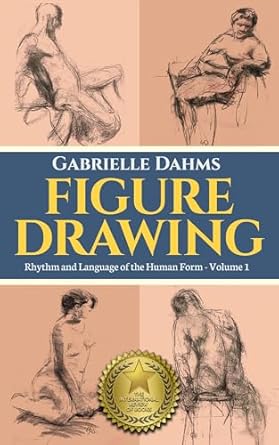

Gabrielle Dahms’ Figure Drawing: Rhythm and Language of the Human Form is an insightful guide for aspiring and seasoned artists alike, diving deeply into the intricate art of capturing the human figure. The book weaves together technical instruction, personal anecdotes, and artistic philosophy, emphasizing both the fundamentals and the expressive possibilities of figure drawing. From understanding proportions and anatomy to mastering gesture and rhythm, Dahms frames drawing as a discipline that blends observation, skill, and creativity.
The author’s writing is earnest and passionate, often reflective. I appreciated how she shared her own struggles as a novice artist, particularly her initial impatience and desire for praise. This vulnerability makes the book relatable, transforming it from a mere instructional manual into a personal narrative about artistic growth. Her storytelling, such as returning repeatedly to a Rembrandt painting over decades, adds a poignant layer to the technical advice. Dahms excels in breaking down complex concepts into approachable lessons. The section on foreshortening is particularly helpful, guiding readers through the challenges of perspective with practical steps and vivid descriptions. Her advice to “abstract forms into geometric shapes” before layering detail is a game-changer for simplifying seemingly daunting tasks.
What truly stood out to me was her emphasis on the emotional and spiritual aspects of drawing. Her perspective that figure drawing is “observation in action” and a “meditation about life” resonates deeply. In discussing live versus photo-based drawing, she beautifully argues that “anything alive has something messy about it,” celebrating the imperfection and energy that live models bring to art. This poetic view of artmaking injects inspiration into the otherwise technical material.
Figure Drawing: Rhythm and Language of the Human Form, by Gabrielle Dahms, is a rich, thought-provoking guide for artists who crave both practical techniques and a deeper connection to their craft. I’d recommend it to art students eager to learn the nuances of drawing or experienced artists looking to refine their skills and philosophies. This book isn’t just a tutorial; it’s a call to see the world and oneself through the eyes of an artist.
Pages: 112 | ASIN : B0DNNR8GB4

Using Japanese Paper for Digital Printing of Photographs
You may never understand the beauty of photography until you read Using Japanese Paper for Digital Printing of Photographs by Carl-Evert Jonsson. Carl-Evert Jonsson writes extensively on photography, focusing on Japanese paper for the digital printing of photographs. The author is intentional in his explanations and describes every detail for those not familiar with Washi.
The images in Carl-Evert Jonsson’s book tell a compelling story. The pictures are stunning, distinct, and aesthetically pleasing. The photos are classed into four groups; Places, Persons, Varia, and Mixed. Each of these categories tells a unique story that the reader connects with. I loved going through the images under Persons as one can see the different features in humans and how individual people are. Images of places are striking because of the locations the author drew his inspiration from. Varia and Mixed pictures are also eye-catching and impactful.
One of the best things about this book is that the author uses few words in the description and leaves the reader to form an opinion on the images without being influenced. Under the Mixed category, the image displaying the Notre Dame de Paris and the Vehicle. Brown ochre, primary blue was my favorite. Varia had a lot of impressive figures, but the image displayed Egg oil x1. Underneath: yellow ochre subjects were my best. The sense of illusion when one looks at the picture is satisfying. It feels authentic for a minute, then one feels a certain sense of imagination the next minute.
Carl-Evert Jonsson shares a personal touch throughout the book. Anyone reading this book will appreciate the author more as they keep flipping the pages. I loved reading the preface as the author gives a little background information about himself and the book. Carl-Evert Jonsson’s story is fascinating and increases one’s interest in photography. The author also enlightens the reader on techniques for digitally printing photographs on Japanese paper in the introduction. The short text was helpful, especially to readers that may not have been familiar with different photography techniques. The modest way of expounding on concepts and creativity displayed by the author is inspiring enough for one to delve into photography and related subjects.
Using Japanese Paper for Digital Printing of Photographs is a captivating book that photography students, lovers of nature, and individuals who fancy capturing objects and printing them will love. Any photography enthusiast will appreciate this work, especially the content under Places and Persons. Every image under this category was unique in its own way.
Pages: 54 | ASIN : B0998MKMTD
The Day That A Ran Away
![The Day That A Ran Away by [Fegan, B.C.R.]](https://images-na.ssl-images-amazon.com/images/I/51Rs%2B3rXL%2BL._SX260_.jpg) The Day that A Ran Away is an adorably witty story about the letters of the alphabet just deciding not to report for duty one day. Master Jet is trying to write the alphabet and he just can’t do it with all the letters on holiday. Each letter has either decided not to show up or has had something that prevented it from showing up. Understandably, it’s hard to write the alphabet without even one of the letters. Master Jet may think he is fooling his teacher, but Mrs. May is way too smart to fall for his creative tricks.
The Day that A Ran Away is an adorably witty story about the letters of the alphabet just deciding not to report for duty one day. Master Jet is trying to write the alphabet and he just can’t do it with all the letters on holiday. Each letter has either decided not to show up or has had something that prevented it from showing up. Understandably, it’s hard to write the alphabet without even one of the letters. Master Jet may think he is fooling his teacher, but Mrs. May is way too smart to fall for his creative tricks.
My kids are much older now, but they would have loved this book when they were little. The writing is catchy and flows well for reading aloud. The rhymes are cute. The colors are bright and eye-catching. This was especially always a hit with my own children. The illustrations are beautiful. It is very visually pleasing. It is also funny. It made me laugh a couple of times. I actually think it would be fun to read aloud. Any parent who has had to read the same book one hundred times can tell you how important it is to have a story that flows well verbally.
My favorite part of the book is the beautiful illustrations. They are by Lenny Wen. As with most children’s books, the illustrations are a huge part of whether the book is a hit or not. Since most kids are being read to at this stage, the illustrations have to really appeal to them. A nice touch was adding a few “hidden” images within each letter’s page—having the kids match the letter with the object. My kids would have loved trying to find these little gems. Overall, the artwork is beautifully done.
Together B.C.R. Fegan and Lenny Wen have created a catchy, appealing story for little kids and their parents. I really enjoyed it. I believe kids and parents everywhere would enjoy it as well.
Pages: 33 | ASIN: B07DMN4VVP

We Have Known Some Wild People

Roxanne Burkey & Charles Breakfield Author Interview
In The Enigma Rising R Group is hired to find a missing heiress. They must learn to work together to uncover intelligence in the underworld of cyber crime as they confront drug traffickers turned money launderers. This is a thrilling setup to a suspenseful novel. What was your inspiration for the setup to this book?
It’s not hard to be inspired when you have lived and loved throughout your life. We are fortunate to have a venue to crystallize those moments, with those people who have rotated through our lives, and make it a compelling story. We have known some wild people.
I found the novel to be a clever thriller story. How did you balance quick action with intelligent story telling to give the book a quick tempo?
Practice! We want to be known as great story tellers and so you must be able to “wordsmith” not only the dialog and the characters but the story line itself. We spent a lot of time polishing the dialog, the story, and the characters to get the proper flavor for our goal of a good techno-thriller. Our beta readers and editor helped challenge us to make a better product at every opportunity.
Again, there is a host of intriguing characters in this novel. What was your favorite character to write for this time around?
We really got into our “bad boy” characters Juan and Carlos. These are the Bad Boys, mom’s warn their daughters about. And as the phrase goes “their characters grew legs and took off”.
How do you see the Enigma series evolving in the future?
Actually we have built a character universe of over 150 characters for use throughout the series. By the time the reader hits the 9th book (just getting ready to release) you will be able to answer that question for yourself. But as a comment to be a teaser, readers can expect the series to have different theme’s per book that include, identity theft and dark net (#1), high tech battlefield communications using nano-technology & Drones (#3), a virulent Ghost Code launched by two nefarious types code named Mephisto and Callisto (#4), predicting the future using supercomputers linked together (#5), genetic engineering of humans to live 1,000 years (#6), gamification and smart cities being held hostage (first CATS book) (#7), world commodity manipulations to crush corporations and countries (#8), and a team of analog information mules that drive shady corporate profits across the Dark Net (2nd CATS books (#9). We don’t think you’ll be disappointed in these grown up stories.
Author Links: GoodReads | Twitter | Facebook | Website
The R-Group is the single most advanced information-gathering organization on the planet, providing services to the intelligence community on a contract basis. Their cutting-edge application of technology keeps their ability to gather, analyze, and use information well ahead of most major governments.
Carlos and Juan are entrepreneurs, although even the most generous observer would question the legality of their business model. The two brothers have discovered a way to covertly access satellite communications. Mostly, they’re putting their skills to work relocating drug lords targeted by the authorities, along with their cash, gold, artwork, and other assets—for a modest fee, of course.
When a valued private client hires the R-Group to track down a missing heiress, chance circumstance brings the technology leaders into contact with Carlos and Juan’s fly-by-night operation. The two brothers have skills the R-Group can use, so they offer them a chance to go legit. Presuming, of course, the brothers can rein in their contempt for societal rules.
A sequel to Breakfield and Burkey’s The Enigma Factor, The Enigma Rising continues their exploration of the high-stakes and high-tech world of information brokering as an engaging thriller of lost and found, loving and growing, and despicable greed.



 LITERARY TITAN