Blog Archives
In the Face of the Foe


In the Face of the Foe brings together three wartime tales that follow British prisoners of war and the strange mix of fear, grit, and shaky hope that shapes their survival. The story opens inside Stalag XXA, where boredom and danger sit side by side. Men spar, argue, dream, and stumble into choices that could kill them or free them, sometimes on the same night. The early chapters move from camp politics to tense missions beyond the wire, and the book keeps piling on moral knots that force each character to decide what they are willing to risk and who they want to be.
As I moved through the book, I felt myself leaning in, drawn by the rough humor and the raw strain between the men. The writing feels direct and sharp. It never hides the ugliness of fear. It also never forgets that soldiers can be petty and foolish and brave all at once. I liked how the author gives room for small moments that say more than the big ones. A quiet exchange over stolen cherries, the sting of a bad joke, the uneasy pause when a guard appears in the dark. These details felt honest, and they gave me a sense of standing right there in the mud with them. The dialogue sometimes slips into playful banter, and I found that mix of light and dark strangely comforting. It felt real in a way that polished war stories often miss.
The book kept raising questions without preaching. What does loyalty look like when every man is starving? What does courage mean when the cost falls on someone else? Some choices hit hard. One scene with a child had me holding my breath because the moment felt too close to the edge. The tension built slowly, then snapped tight. The writing does not tidy up the mess afterward, and I appreciated that honesty.
It is a story for readers who enjoy wartime fiction that focuses more on people than battlefields. Anyone who likes character-driven plots, moral puzzles, and a close look at the fragile ties that hold people together will find a lot here. I would recommend it to readers who want grit without glamor and heart without sentiment.
Pages: 508 | ASIN : B0G1K6GG7F

Johnny’s War – Volume Two – Storm Clouds Over Africa


Johnny’s War – Volume 2 picks up where the first left off, following the ever-changing and ever-challenging journey of Johnny Pink, a young RAF officer during World War II. The book dives deep into his evolving experience, from the highs of promotion and love to the brutal lows of combat and loss. We follow Johnny as he boards a Sunderland flying boat bound for North Africa, reconnects with old friends, and gradually descends into the heart of war’s emotional chaos. It’s not just a tale of battles and bombers, though. It’s a story about growing up too fast, about finding courage in the unlikeliest places, and about the lasting scars—visible or not—that war carves into people.
Reading this was like being dropped straight into the 1940s, with all its smoke, salt, fear, and tea. The writing is unapologetically immersive. That first vivid attack on the Sunderland—my stomach actually turned. What caught me most, though, were the quiet in-between moments: Johnny’s chats with his mates, his unspoken grief, his longing for home. The author doesn’t just want us to know the facts of war. They want us to feel it. The fear, the camaraderie, the occasional absurdity of army life—it all came through loud and clear.
At times, the pacing slowed with heavy detail, especially in technical sections, but then it would slam you with a gut-punch of emotion or action that left you breathless. And I felt Johnny’s emotional shifts, while often believable, occasionally moved too quickly without enough inner reflection. But those are small things. What really stayed with me was how the war slowly changed him, not in a dramatic, movie-style way, but in that creeping, quiet erosion of innocence. It’s those little truths, told plainly, that make this book more than just historical fiction. It becomes personal.
Johnny’s War – Volume 2 is not just for military history buffs or fans of wartime dramas. It’s for anyone who wants to understand the human side of war—what it costs, how it twists people, and how, sometimes, even in the darkest places, you find light. I’d recommend this book to readers who love character-driven narratives, rich historical detail, and emotional truth. It’s not a page-turner in the thriller sense, but it sticks to your bones.
Pages: 325 | ASIN : B0F9X715VC
Johnny’s War Volume one
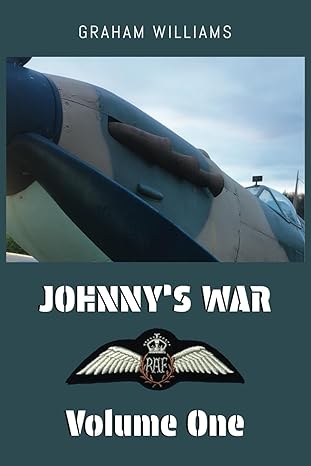
Graham Williams’ Johnny’s War: Volume One is a heartfelt and immersive account of a young man’s journey from the peaceful English countryside into the skies of World War II Britain as a trainee RAF pilot. Told through a blend of personal letters, vividly detailed scenes, and nostalgic reflection, the story follows John “Johnny” Pink from his family home to the RAF training grounds. Along the way, readers are introduced to a cast of fellow cadets, the unbreakable bond between friends, and the anxieties of wartime youth. It’s a story that doesn’t glorify war—it personalizes it, through the eyes of a son, a friend, and a hopeful pilot.
Reading this book was an emotional ride. I was struck right away by the authenticity of the writing—it didn’t feel like fiction. The dialogue between characters, especially Johnny and his friend Tommy, was real and warm, full of that particular blend of courage and awkwardness you’d expect from young men stepping into war. I appreciated how the author didn’t rush anything. Scenes breathed. Letters home from Johnny gave the book its soul. And the flying scenes were genuinely thrilling. The writing is simple and tender, almost old-fashioned in tone, which fits perfectly with the 1940s setting. The pacing is gentle, but it suits the story’s reflective nature.
What really hit me was the depth of care in the relationships. Johnny’s bond with his father had me choked up more than once. There’s such dignity in the way George keeps his hope alive, reading letters, tending the grave of his wife, and waiting. It’s a slow burn emotionally, but the ending caught me off guard. The buildup to Johnny’s solo flight was incredibly satisfying, both nerve-wracking and beautiful. And the quiet mystery of the boy with the apple added just the right amount of eerie wonder. This isn’t a flashy book—it’s thoughtful, steady, and often poignant. And that’s its strength.
If you love character-driven tales, historical settings done with care, and stories that tug at your heart more than your adrenaline, you’ll really like Johnny’s War. It’s a book for history lovers, romantics, and anyone who’s ever missed someone. I’d recommend it to readers who appreciate Band of Brothers for its humanity more than its action, or fans of heartfelt war dramas like Testament of Youth.
Pages: 364 | ASIN : B0F5Z2VXQT

History Does Repeat Itself

In Aftermath Boy, the son of Holocaust survivors battles a life of antisemitism and poor life decisions and is accused of interfering with the 2024 presidential election. What was the inspiration for the setup of your story?
The story evolved over a number of years. I went to the Holocaust Museum in D.C. in 2019 to see the testimonies my two surviving aunts had provided to Spielberg’s SHOAH Foundation. I took pages of notes, and for the next months devoted time to filling in holes in their testimonies with research. Then I began to write a narrative that captured their stories. I didn’t see any point in writing another Holocaust book. But in my research, I uncovered a vein scholarship devoted to ‘transfer post-traumatic stress disorder.’ The notion of writing about how many parents’ experiences riding the waves of history might have influenced me germinated into a concept of how a family rides the waves of history from one generation to the next. So, I began to write a Roman clef that explored how the horrors of the Holocaust resulted in critical family dysfunction among survivors between survivors and their offspring. As I wrote and rewrote the narrative, the evident parallels between current events and the rise of fascism in the 1920s and 30s became poignantly evident. The cultish adoration for a leader, the use of propaganda, doublespeak, and lies, the undermining of the judiciary and the rule of law, the wedge politics dividing ‘us vs. them’ established a third element for a novel making it significant and relevant.
What were some of the emotional and moral guidelines you followed when developing your characters?
My mother and her younger sister could not have survived the concentration camps without each other. They’re liberation and continued survival depended upon the support and efforts of many others. The love and bonds the three sisters have for each other, however, unravel as they build their own separate lives and families after the war. I wanted to ensure that readers didn’t find one-dimensional heroes and villains, but discover the challenge of understanding how perspectives form, diverge, and clash despite the strength of family bonds. Rozsa is a workhorse, a force of nature, focused and determined, but she still relies on random chance that preserves or destroys human life. Billy, well-intentioned, and loving, has to outgrow the fantasy world he constructs protectively as a child. He tries to remain true to unattainable ideals but makes his family miserable in the process. As an elderly man, he finds himself ashore facing an historical tsunami.
What were some themes that were important for you to explore in this book?
First, that we’re subject to waves of history, however unaware of it we are as it unfolds. And history does repeat itself as millions neglect to study and understand the past.
Second, that we draw our identities from our families in many ways, but as Jorge Luis Borges insisted, who we are changes as we progress through life and external circumstances take hold. Rozsa and Billy live in different spectrums of reality that sometimes overlap but fundamentally diverge.
Third, governments play a fundamental role in developing or destroying lives when people choose to be ruled by despots who become increasingly malevolent over time. With mass media in its infancy, fascists used this new technology to deceive, manipulate, and control. Contemporary technology enhances such misuse exponentially.
Fourth, however flawed we may be–and Billy certainly is a poster boy of flaws–and however frightened we may feel, standing up to bullies is the key to survival along with human connections that provide mutual support and make it possible to overcome overwhelming odds.
What is one thing you hope readers take away from Aftermath Boy?
The Aftermath Boy caught up in his mother’s Holocaust history shaping his own, faces the consequences of his mistakes as he finds himself in the crucible of history with democracy hanging in the balance in 2024.
Author Links: GoodReads | Facebook | Website | Amazon
An Approximation of the Objective Truth
John Richard Spencer Author Interview
Brownout – 666 follows Rick in the midst of a struggle to find a way to live a normal life in a dark and unforgiving world. What was the inspiration for the setup to this intriguing novel?
My inspiration for the setup behind this novel primarily came from my sojourn in the Philippines spread over several years. I always told people that one day I would write a book about the country, its people and its culture and that I would call it “Brownout.” I added the “666” moniker to the title as any search under “Brownout” brought up thousands of books about electricity. As large portions of my novel were based on real events and people I could have written a nonfiction work instead. However, I didn’t want the potential for libel suits hanging over me so I chose fiction. The American and Australian settings of the novel came about as I wished to explore the socio-political ethos of those nations and their relationships to the bases of world power. I introduced the American setting as a subplot that tied up with the central one at the end.
Rick Daly is an interesting character that faces many challenges in life. What were some driving ideals behind his character development?
Some of the driving ideals behind the central character, Rick Daly, were related to sexuality and its abusive and non-abusive forms. As he matures Rick learns to become less selfish and earns some degree of redemption. Rick has been confused about Right and Wrong and gradually arrives at what he calls “the fair thing principle.” Rick grew up in the seventies and eighties in an Australia with a fairly aggressive sexual culture. An example of looking back at this culture from the standpoint of the present day is the internationally well-known podcast, “The Teacher’s Pet,” by Hedley Thomas of the newspaper, The Australian. Apart from examining a cold case disappearance and probable murder, the podcast looks into alleged teacher/schoolgirl sex rings at several high schools on Sydney’s northern beaches, one of which I taught at (Cromer High School). Rick loathes hypocrisy, the stupidity and gross unfairness of many authorities. Governments and courts often seem overly influenced by cultural and political fashion.
This novel expertly uses history to tell an engrossing story. Was history an important aspect for you in this novel or did this develop organically while writing?
As a former English and History teacher I have always been fascinated by History and its links to the present day. The changing attitudes to sexuality throughout historical and contemporary periods necessarily came to the fore as Rick becomes caught up in them.
I have long been a student of the Holocaust and the Third Reich and, as history is always written by the winners, I appreciate how difficult it is to arrive at even an approximation of the objective truth. While in no way do I condone the many crimes of the Third Reich I find myself bemused at how any attempt to examine this era can so easily be shouted down if it differs ever so little from the official version. The Holocaust was a terrible event but it is no more sacred than are the other mass killings or genocides that occurred before it or since.
What is the next book that you are working on and when will it be available?
In addition to this novel, I also have a published work of non-fiction about child loss and grief. It is called, “Waiting for a Miracle – Life in the Dead Zone.” As for my next book, I haven’t decided whether to work on another novel or non-fiction piece. In either case it won’t be available until next year at the earliest.
Author Links: GoodReads | Twitter | Facebook | Website
![Brownout - 666: Are we Slaves To Our Symbols? by [Spencer, Mr John Richard]](https://images-na.ssl-images-amazon.com/images/I/51okLjIEtAL.jpg)
In the land of flaunted sex, money, and flexible rules, an ambitious but lonely Rick Daly faces his demons.
Rick Daly has established a business in the exotic surroundings of the Philippines, while simultaneously discovering Marilyn Delgado, the woman of his dreams.
However, a clash of cultures and his own naiveté lead to disaster. Falsely accused of a sexual crime, Rick loses both his freedom and his business. To add insult to injury, a prison escape merely amounts to switching jails.
In a world where the rich prosper, honest individuals are forced to the wall, and a cynical disregard for all but the dollar is destroying society from within, crime soon follows punishment for Rick. Close to losing his soul, will Rick’s ultimate success in drug and arms dealing finally lead him to face up to reality?
Brownout – 666
![Brownout - 666: OR THE REAL MEANING OF THE SWASTIKA by [Spencer, Mr John Richard]](https://images-na.ssl-images-amazon.com/images/I/51okLjIEtAL._SY346_.jpg)
Rick Daly is in the midst of multiple battles–the least of which is the struggle to finally find a way to be happy, settled, and live a normal life. Working and trying to establish a business of his own in the Philippines, Rick Daly meets and unwittingly falls head over heels in love with the young woman he hires to be his secretary and sidekick. When he realizes he loves Marilyn and wants to change his wild ways, he finds that his past is looming closely and threatens his relationship as it tests his loyalty to Marilyn and their, now uncertain, future.
John Spencer, author of Brownout, is clearly a fan of world history. His novel featuring Rick Daly is woven intricately in and out of historical truths. In addition, Spencer even tackles the controversial issue of the Holocaust and the doubt surrounding its existence. Spencer covers a broad range of events and drops his characters and their various subplots strategically into these events from the book’s beginning to its surprising finale.
Brownout incorporates numerous storylines which are, at times, difficult to follow. The bulk of the novel is based on Rick Daly’s life in the Philippines and his relationship with Marilyn, a woman who strives to remain true to herself and her beliefs but sends Rick many a mixed message during the course of their relationship. Spencer’s writing relies heavily on the reader’s penchant for sexual situations as these scenes are prevalent throughout the book, giving the overall book as much the feel of a romance novel as a work of historical fiction.
I feel it’s worth mentioning that the intimate aspect of the relationship portrayed between Rick and Marilyn is complicated at best. As much as Marilyn maintains that she will remain a virgin until she is married, she feels torn between keeping her word and satisfying Rick. I was quite taken aback at Rick taking advantage of Marilyn and violating her trust.
The parallel storyline involving Chris, Rick’s uncle, and his children is a tragic one and is more engaging and engrossing than Rick’s plot. I found that my attention was held much more readily while reading of Chris’s heart-wrenching loss and the immense struggle he faces with each of his children. As I read, I continued to anticipate that Chris would be a more prominent part of the book’s overarching plot and was disappointed that his family’s drama was not more fully explored.
While Brownout is exceptionally well-written, I felt that the subplots were somewhat disjointed. Each of Rick’s subsequent and fleeting relationships added depth to the story but simultaneously added an air of confusion. While all of Spencer’s characters are rich and well-developed, the connections between them seem lacking. The historical accuracies are spot-on and related via Spencer’s characters in a way that makes them conversational and engaging. Readers who appreciate historical fiction and seek an element of romance will find Brownout to their liking.
Pages: 503 | ASIN: B07GGYBJY1
The Butcher’s Daughter: A Memoir
![The Butcher's Daughter: A Memoir by [Grende, Florence]](https://images-na.ssl-images-amazon.com/images/I/51rD%2Bkt6PyL.jpg)
Florence Grende’s parents survived the Holocaust and managed to settle in New York City to provide a new life for their children. The horrors of their past, however, never leave them and infiltrate every aspect of their lives in the United States. Florence, their daughter, grows up watching her parents keep their demons at bay as she learns as much about her family’s haunting past as she learns about herself. Grende’s questions about her mother’s outbursts and her father’s deep, dark sadness lead her to answers she is afraid she already knows but is not willing to admit.
The Butcher’s Daughter is Florence Grende’s own recollection of her life in New York City and her struggle to come to terms with her parents’ own battle with the memories of their lives in Germany during the Holocaust. Grende’s memoir is written in a unique and gripping style. Her words flow from page to page in the most poetic fashion with emphasis placed on short, striking bits of text highlighting especially difficult memories.
Grende pulls her memoir together with short chapters, each focusing on specific situations, distinct memories, and her own analyses of events from her childhood and teenage years. I looked for the memoir style to follow a sequential order but, in Grende’s case, the random scattering of memories and the jumps she makes from one time period backwards and then forward again works well. Her own confusion and the turbulence dictating her life as a result of her family’s past is reflected effectively in the style of writing chosen by the author. Short bursts of memories are easy to read, engaging, and incite the reader’s curiosity.
It is not often readers are afforded a look into the author’s own experiences. Grende gives readers a particularly vivid picture of the trauma and the lasting impact the Holocaust had on the ensuing generations. Her father’s behavior and neediness are sad in a way I find it almost impossible to describe. She underscores the way he seems to emotionally cling to her in a markedly poetic chapter in the second of the book’s three sections. Never is her father’s tragic past more clearly defined than in his sadness and desperation at losing her to her new husband.
Closure being the goal for Florence Grende, I felt relief for her as she details her journey for answers and the meeting which brings her face to face with people on all sides of the Holocaust. Her writing experience begins with her trip to Berlin and the diary that starts it all. I felt the tension as I read of Grende’s meetings with fellow survivors and descendants of Nazis. The horror stories flow, and Grende, at last, shares her own with those who can, not only relate, but wish for the same closure as the author herself. Grende writes of these meetings with raw emotion and does more to help readers absorb the truth of history than is ever possible with any textbook.
Florence Grende has bared her soul and shown readers a perspective on history that most of us will never fully grasp. She walks readers eloquently through a minefield of emotions and tackles the savagery of the Holocaust with truth, directness, and poetic prose.
Pages: 148 | ASIN: B01M751TN4
Translate Statistics into Individual People
Jason Hensley Author Interview
Part of the Family examines the experiences of the children who came to England from the Kindertransport during the Holocaust. I believe you delivered a compassionate view of this dark time in history. Why was this an important book for you to write?
Before this book, there was one document that attempted to set out in detail the Christadelphian involvement in the Kindertransport––and that was Dr. Chana Kotzin’s thesis that evaluated the reaction of a handful of Christian groups to the Jewish refugees in the 1930s. She was able to go through a lot of the correspondence that took place and really examine the refugee committee side of the Christadelphian involvement––but she was not able to look into the individual stories themselves and how the children lived when they eventually did come to a family. When I attended the Belfer Conference in 2015 at the United States Holocaust Memorial and Museum, the instructors emphasized 10 methodological principles when teaching about the Holocaust, and one of those standards very much resonated with me: translate statistics into individual people. History is not simply about statistics and generalities, but is rather about the lives of individual people. We constantly hear about the six million, and yet so often, the number loses its meaning, not simply because it is such a huge number, but because it is not focused on the individual. When the six million Jews who perished in the Holocaust is mentioned, it should be remembered that these people were fathers, mothers, brothers, sisters, sons, and daughters. When we realize the individuality of the people that we are learning about, it makes them much more relatable and the lessons from their experiences become much more relevant and powerful for us. This was huge for me, and being a writer, lecturer, and teacher, I very much feel a responsibility to tell their stories. A number of the stories told in this book have not been recorded in any way before. As I interviewed the “children,” one of the major things that stood out to me was that they constantly used the phrase “I was part of the family.” Over and over, they emphasized to me that they felt loved and cherished. There were certainly exceptions, as there always will be––but I was amazed at the things that I heard from them. One man, whose story will hopefully be included in volume 2, when I asked him what he would say to the family that had housed him, if he could say one final thing to them, without hesitation, said “I love you.” Though he had not seen them for decades, he still felt that feeling very acutely and strongly––he had become part of the family. Thus, I began to ask myself why these people had such experiences–and the answer came out very clearly, as you mentioned in your review. The Christadelphian families did this and cared for these children because they felt a kinship and a love for the Jewish people. Their beliefs brought them to action––and for me, that was a very powerful statement about the importance of beliefs. In today’s world, it feels as though beliefs are often downplayed and that many are trying to put our the statement that doctrines and beliefs don’t matter––as long as someone is good. While I certainly stand for the idea of tolerance, I think that in attempting to all get along, we cannot lose the lesson that beliefs really do make an impact, and that they can influence us for good or for ill. Therefore, I hope that this book will not only inspire others to help one another, but will also encourage all of us to look at our own beliefs and ask ourselves what kind of influence our beliefs have on our own actions.
The Christadelphians were a small christian group who helped many children during this time. Do you think their compassion and determination were reflective of their religion or their personal moral character?
I think that the answer is certainly both. Recently I had the privilege of interviewing a woman who had come to England from Germany––and who had actually lived with two different families after coming to England. I think her story helps to explain the way in which the Christadelphians acted both based off of their strong beliefs about the Jewish people, and also personal moral character: This woman told me that when she first came to England, she was chosen by a family and completely ignored. This was not a Christadelphian family––and the woman didn’t know what religion they were, if any. But, they brought her to their house, put her in her room, and never spoke with her. Eventually, she said, she went hysterical. She started screaming, banging on the floors, banging on the walls––because she had no interaction with anyone. Because of that experience, the Jewish refugee committee was contacted, and she was removed from that family. From there, she went to live with a Christadelphian family in Birmingham. She stated that the first day that she met them, they had a German/English dictionary and tried to talk with her.
When she got to the house, they tried to help her learn English––pointing at their dog and saying “Billy” (subsequently, she thought that all dogs were Billys…).
She stated that she felt like part of the family. I think that the dichotomy between her two experiences can show what life with Christadelphians could have been like if they had acted simply out of a belief that they should help the Jews. When the Jewish children came to England and lived with the Christadelphian families, they did not have to treat them like family members. They did not have to try to learn German. They did not have to tell them bedtime stories. They did not have to try to correspond with the child’s parents back in mainland Europe. But they did. I think that housing the children and in that sense “saving them” could have been considered enough to say “I helped the Jews.” But, the Christadelphian families, for the most part, out of their moral character, attempted not only to help the children, but to give them the best life that they could provide––just as they did with their own children. We were privileged enough to get together with a professional videographer and put together brief interviews (5 minutes each) with Mrs. Ursula Meyer and Mrs. Rella Adler. Both of them share how the treatment that they were given was as though they were daughters:
Ursula
https://www.youtube.com/watch?v=XsxFaBBwyeU
Rella
https://www.youtube.com/watch?v=5G7iXMkyPT0
Part of the Family is not only well written but it’s also well researched. How much research did you undertake for this book and how much time did it take to put it all together?
Oddly enough, I began the research for this book last December. I was simply blown away at how well things came together. Ursula Meyer was the first person that I was able to contact, and we conducted our interview on January 19th. From there, the project just came alive. I had Christadelphian families from all over the world contacting me to tell me that a Jewish refugee had lived with them throughout the war. One of my major rules, however, is that I don’t write about someone and publish it unless I can get their approval for what I have written. And thus, hearing about all of these Jewish children that had lived with Christadelphians presented a problem––how to contact them? A number of Christadelphian families had kept in contact with the Jewish children, and so they could actually get me in touch with them, but in other cases, once the Christadelphian parents passed away, and sometimes the children, the younger generation only knew that their family had housed a refugee, but sometimes didn’t even know their name. Attempting to find the refugees and interview them about their experiences was simply amazing. I’ve called all over the United States, Canada, and the United Kingdom. I’ve had conversations with people in Israel, Australia, Spain, and Sweden. Yet, perhaps one of the most exciting experiences was when I was presenting on the Christadelphians at a meeting of Kindertransport survivors, and one of the men seated at my table explained that he come to this very meeting because he had lived at Elpis Lodge, the hostel set up in Birmingham by Christadelphians! I had no idea––and here I had been having lunch with him! This book came together in a matter of months––something which still astonishes me. Yet at the same time, as things kept coming together, I found myself working at it all the time––often getting up at 4:30, just because I was so excited that another survivor had emailed me, and so I couldn’t sleep anymore.
Part of the Family is the first volume in a series. What will the next volume be about and what will the whole series encompass?
Lord willing, I hope to have the second volume finished this December, as well as an audiobook for this first volume at the end of August. The goal of the entire series is to tell the individual stories––and thus, my hope is that I can keep contacting survivors and their families to tell about their experiences when they were saved from Hitler by coming to England and living with Christadelphians. Thus, volume 2 will be more stories, and so will volume 3. I currently have about 35 testimonies that I would like to write!
Author Links: GoodReads | Facebook | Webite
In 1938 and 1939, via a movement known as the Kindertransport, thousands of Jewish children were taken from Nazi-occupied territories to safety in Great Britain. They came to a new family, a new country, and a new life. Approximately 250 of these children were sponsored by Christadelphians, a small Christian group. Often the Holocaust is considered in terms of statistics: how many perished and how many were affected, so much so that at times the individual stories are lost in the numbers. This series examines the experiences of the individuals who came to England as children, and lived with Christadelphians. Ten of these child survivors, and their families, participated in the effort to bring about this first volume. These are their stories.



 LITERARY TITAN