Blog Archives
If Only


If Only, by Manmohan Sadana, is a wide-ranging collection of stories, poems, dramatic scenes, and reflective pieces that move through love, faith, memory, grief, service, and human dignity. The book feels like a gathering place for many Indian voices and landscapes: Punjab’s mustard fields, Delhi homes and streets, Madurai’s temple life, Kolkata’s Durga Puja, Partition memories, Sikh traditions, Buddhist reflection, and everyday people trying to live with kindness. It’s built less around one plot and more around a shared emotional current, where each piece asks the reader to look a little more closely at compassion.
One of the strongest threads in the book is its attention to people who are often made to feel invisible. “Born under the same Silence” opens with Zainab and Meher, two hijra characters who meet in a world that wounds them but also slowly makes room for hope. When Meher tells a tea vendor, “The way is wide enough for all of us,” the line becomes more than a reply. It captures the book’s larger belief that dignity doesn’t need permission. That same spirit carries into stories about disability, speech, blindness, old age, poverty, and loneliness, where the characters aren’t treated as symbols so much as people who want to be seen clearly.
Sadana’s writing is deeply drawn to tenderness in ordinary life. In “Every Day I Meet You for the First Time,” love becomes an act of daily renewal as Aarav keeps meeting Maya after she forgets him each morning. In “Loving Son,” a beagle named Prince becomes the most devoted child in a house marked by absence. In “The Stuttering Heart,” patience becomes romance. These pieces work because they understand love as attention, repetition, and care. One line from the book puts this beautifully: “Hope is not tied to breath.” That idea keeps returning, whether the story is about soldiers, parents, lovers, teachers, servants, or strangers.
The collection also has a strong spiritual pulse. Sadana writes about Bulleh Shah, Sikh symbols, Buddha, Vishnu’s avatars, the months of the year, and the moral imagination behind Indian traditions. These sections don’t just explain belief systems; they place them beside lived experience. The book’s spirituality is practical and human, rooted in service, humility, forgiveness, and respect. Even when the writing becomes poetic or devotional, it keeps circling back to how people treat one another. In that sense, faith here isn’t distant or abstract. It’s found in a shared roof, a returned wallet, a held hand, a patient listener, or a person who refuses to abandon someone in pain.
What makes If Only memorable is its emotional range. It can move from a battlefield trench to a wedding night, from a five-hundred-rupee note’s journey to a Partition survivor’s household, from mythic reflection to a simple conversation between two people learning trust. The book is sincere, expansive, and openly compassionate. It invites readers to slow down and notice the quiet forms of courage that often go unnamed. More than anything, If Only is a book about human connection: how it survives loss, how it grows through patience, and how it becomes a kind of prayer when people choose kindness first.
Pages: 210 | ASIN : B0GTJS4LVN

Ramayana Through Ikebana
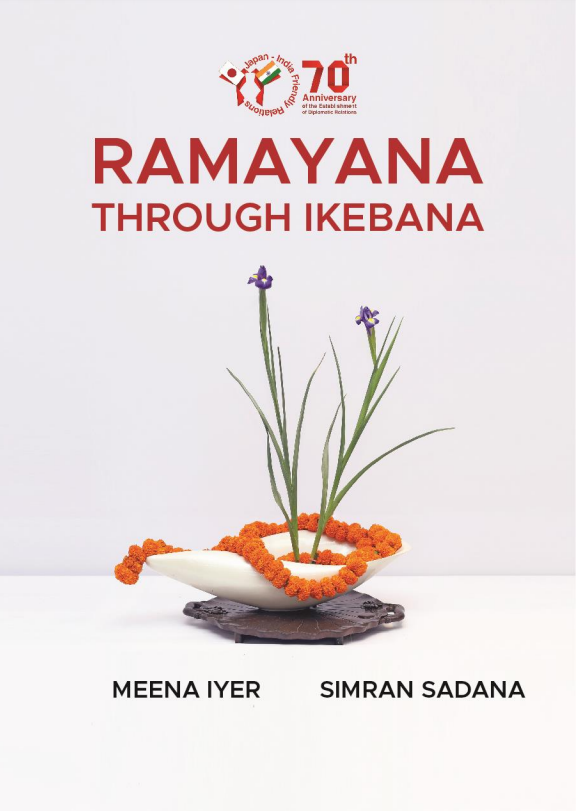

Ikebana, the ancient art of arranging flowers, is deeply rooted in Buddhism and Japanese traditions. Over the centuries, it has developed as an art form all its own, garnering popularity and leading to the development of schools dedicated to teaching this art form. A few things set Ikebana apart from traditional flower arranging. Those who practice this art know that it is based on minimalism, a focus on space, its unique materials, and asymmetry. Another amazing tradition is that of India’s Ramayan, a tale describing both love and honor. When the art of Ikebana meets Ramayana, something truly beautiful emerges.
Ramayana Through Ikebana, by Meena Iyer and Simran Sadana, is a unique combination of mythology and explanations of how Ikebana has been used to depict various sequential scenes from Ramayana. With attention to color, shape, position, and texture, each arrangement in the book’s photos tells the story in the most stunning fashion. The authors have taken great care to caption each photograph, listing the materials and the rationale for the arrangement for each as it relates to the storyline.
I found it amazing that I could actually picture the story’s scenes when I looked at the arrangements. Iyer and Sadana have managed to pull together for readers two exceptional art forms and present them in a way they will both appreciate and at which they will marvel. Ramayana is beautifully told throughout the book and carries with it both amazing symbolism and life lessons that readers will enjoy.
I can see Iyer and Sadana’s work as being beneficial in both literary arts and visual arts. The Indian story itself is a wonderful representation of both culture and tradition while the vivid descriptions of Ikebana throughout the book benefit those who are studying flower arranging. The authors have gifted readers with a true thing of beauty–on many levels.
I was pleasantly surprised at the way the two art forms meld seamlessly to convey a timeless tale. I highly recommend Ramayana Through Ikebana to anyone interested in exploring other cultures, those who are curious about the history and significance of Ikebana, and any fan of mythology. Iyer and Sadan’s work is a lovely presentation of two cultures united in one work of literature.
An Emotional Story

A Rift That Lies Between Us explores the deep connection two people share and the obstacles they face. What was the inspiration for the setup to this story?
As a Bangladeshi-American, I have personally witnessed and experienced intercultural intricacies, as illustrated in my novel. These experiences and observations served the inspiration for this story. In a world where we need more immigrant family stories, A Rift That Lies Between Us has a set of diverse characters and tells an emotional story that is not necessarily focused on the plight of the immigrant, but rather focuses on a first-generation American story.
Caiden and Farisa are intriguing and well developed characters. What were some driving ideals behind their character development?
I wanted to portray Caiden’s and Farisa’s vast differences through their personalities, hobbies, and backgrounds in this story. Farisa is artsy, indoorsy, and reserved, while Caiden is an engineering student, outdoorsy, gregarious, and adventurous. Despite their differences, my goal was to tie them together with the common theme of family and religion. Both Caiden and Farisa are tired of their families trying to control them. Caiden has already found some freedom, while Farisa attempts to break away during college and after her graduation.
This novel explores many family and cultural issues. What were some themes you wanted to focus on in this story?
This story puts the readers inside the conflicts found in cross-cultural romances, as Farisa and Caiden must choose between their tradition-minded families and new-found loves. In an era where divisions among races, cultures, and religions are highlighted more than ever, this story can illustrate how true love can bridge those gaps. It can also show how blind adherence to tradition can cost those adherents their relationships, their careers, and their happiness.
What is the next book that you are working on and when will it be available?
No plans for a new book yet, but maybe there will be in the future.
Author Links: GoodReads | Website
Caiden and Farisa are two college students from different cultures and religions. Caiden is American and a recovering Christian, while Farisa is from a Bangladeshi family and Muslim. When a class project throws them together, they establish a soul-deep connection. Graduation causes them to go their separate ways, but Caiden never leaves Farisa’s mind. And when Caiden experiences a sudden heartbreak, his thoughts soon drift back to Farisa as well. They both begin to wonder…was their friendship meant to be something more? An unanticipated text message leads the two to pick up where they left off, as they reminisce about the time they spent together in college. They are touched to discover that their bond remains, even with hundreds of miles separating them. But is their connection strong enough to withstand all of the obstacles thrown in their path? Will they find a way to follow their hearts and bridge the rift between them?
MAYA: Lifting the Veil


Maya: Lifting the Veil by Amar B. Singh is a though-provoking piece of literature that is written in verse. The book contemplates the human experience, life and our desire to understand how and why life works. It philosophizes on the immense task of knowing God and what his intentions might be. With this idea, the story follows Krishna and Arjuna who meet on the battlefield of Kurukshetra. They are two spirited and valiant warriors, but stand helpless against nature and set out to search for fundamental answers from the Creator.
The most exceptional aspect about this book is how it utilizes enthralling poetic verse to relay a captivating story. It’s a gripping piece of epic poetry that creatively uses philosophy to explore questions we all have and answers we may never have. The story is told through a conversation that Arjun is having, which reminds me of how ancient Roman philosophers would often write their own philosophical books.
Arjun’s family meets a disastrous fate along their journey home. Arjun is distraught and in this moment we get to empathize with him. He questions God, his pain, and the meaning of life. The emotion is palpable and is amplified by the stirring poetic verses that Amar B. Singh expertly uses. Krishna is able to explain the cycle of life and goes on to wax philosophical about life, the human condition, and the world.
I enjoyed the peppering of eastern philosophy found throughout Maya: Lifting the Veil. You can think of this as a long form poem that artfully portrays one mans suffering through the lens of thoughtful reflection. This is a spiritual journey I think many readers will enjoy.
Pages: 77 | ASIN: B087C56K4B

The Gift of the Seer
![The Gift of the Seer by [Laugheed, K.B.]](https://i0.wp.com/images-na.ssl-images-amazon.com/images/I/51jGcqsJFGL.jpg?resize=294%2C434&ssl=1) When you tire of the overload of digital and technology tools within our 2019 era, K.B. Laugheed’s The Gift of the Seer will expedite time travel back with you, and this author will have you writing with a feathered quill by the end of this literary journey! Put on your cultural anthropologist boots and allow this novel to cleverly weave historical yet fantastical plot elements, interestingly complex characters, and a rugged setting that will definitely transport and immerse readers. You will face cultural nuances, norms, spiritual beliefs, worldviews, philosophies, goals, life lessons, conflicts, natural connections, romances, and myriads of adventures via an Indian perspective. Our protagonist, Katie, provides uncensored reflections and stories spanning from the years 1748-1778. Yet Katie, the book’s protagonist, is not the docile, silent, subjugated, stereotypical, domesticated wife and mother that many heroines from her time era typically portray. Instead, she is a literary and cultural badass-think Katniss from The Hunger Games -but Katie encompasses more maturity, carnal pleasures, and complexities as a woman struggling to survive among different cultures, determined to sustain her love for her husband against all odds, and abandoning the feelings of guilt and condemnation based on her feeling that she’s living a big lie!
When you tire of the overload of digital and technology tools within our 2019 era, K.B. Laugheed’s The Gift of the Seer will expedite time travel back with you, and this author will have you writing with a feathered quill by the end of this literary journey! Put on your cultural anthropologist boots and allow this novel to cleverly weave historical yet fantastical plot elements, interestingly complex characters, and a rugged setting that will definitely transport and immerse readers. You will face cultural nuances, norms, spiritual beliefs, worldviews, philosophies, goals, life lessons, conflicts, natural connections, romances, and myriads of adventures via an Indian perspective. Our protagonist, Katie, provides uncensored reflections and stories spanning from the years 1748-1778. Yet Katie, the book’s protagonist, is not the docile, silent, subjugated, stereotypical, domesticated wife and mother that many heroines from her time era typically portray. Instead, she is a literary and cultural badass-think Katniss from The Hunger Games -but Katie encompasses more maturity, carnal pleasures, and complexities as a woman struggling to survive among different cultures, determined to sustain her love for her husband against all odds, and abandoning the feelings of guilt and condemnation based on her feeling that she’s living a big lie!
In short, adventures, dangers, thrills, and chills will bombard you on every page. Yet instead of feeling defeated and exhausted, you will experience the triumphs and evolution, right alongside Katie, as if you were a passenger in her canoe! The book is brilliant in terms of its vivid, sensory details that paint a no-nonsense picture of life during this era. The characters also conjure feelings of fables and folk tales via the author’s unique, authentic style. At times, I noticed hints of magical realism, which further add pizazz to this riveting book. While there are so many positive qualities about this book, especially the way in which the author develops her vast array of characters and executes her dramatic dialogue, all with cultural relevance and sensitivity, I was a bit overwhelmed with the plethora of social, historical, political, cultural, marital problems and themes that she tries to address all at once. At times it was slightly too ambitious for me to keep track of all the family members, neighbors, friends, and foes. Although they are important, especially to comprehend the larger scope of the historical fiction milieu, some of the symbols were slightly perplexing and some plot events were mentioned but not fully explained.
All in all, because readers can sense the imminent danger on every page, as evident from the great use of foreshadowing and cautionary notes to build suspense throughout the text, as in “til the ocean wave of Colonists comes crashing down upon us—then we will see which of us is right,” We not only learn cultural and historical information through characters with real vulnerability and authenticity, but we also find solace in our own journeys about how to fit into this world and all its challenges! We obtain a true sense of empowerment within this challenging piece of art. Try this time travelling and cultural anthropological plight by K.B. Laugheed in The Gift of the Seer!
Pages: 308 | ASIN: B07L7FHTFC
Amazing Experiences

M. P. Prabhakaran Author Interview
An Indian Goes Around the World – II recounts your travels through Europe and shares the amazing experiences you had along the way. When you first set out on your journey were you expecting to encounter so many interesting people?
No. It was those “amazing experiences,” as you put it, which I had in the early stage, that made decide that I must travel to as many countries as I can before I kick the bucket.
You come from a teaching an journalism background. How has your professional background helped you write this book?
My thirst for learning is attributable to the two professions I straddled. Whatever writing skill I have is attributable to my background in journalism. English is not my mother tongue. So to survive in journalism in the English language, I had to put in extra efforts to learn the finer points in English. I realize that I will have to continue those efforts until my dying day.
You state in the book that traveling has opened your mind. Do you think that everyone should undertake such traveling?
Yes, it opens your mind to many things you were blissfully ignorant of until then. When you travel to a new place and interact with the people there, you learn to your surprise that many of the notions you had about both were false. So traveling is not anly a learning experience, bout also a correcting process, in life.
What is the next book that you are working on and when will it be available?
It is a collection of some of the political and social commentaries I published on the online monthly I edit. It is expected to be out in about six months. Side by side, I am also working on my third book in the “An Indian Goes Around the World” series.
Author Links: Amazon | GoodReads
![An Indian Goes Around the World â Ii: What I Learned from My Thirty-Day European Odyssey by [Prabhakaran, M.P.]](https://i0.wp.com/images-na.ssl-images-amazon.com/images/I/51aY1g4hq2L.jpg?resize=304%2C455&ssl=1)
This is the second book by M.P. Prabhakaran on his world-trotting experience. The first one, Capitalism Comes to Maos Mausoleum, was published three years ago. This book is devoted exclusively to the 30-day tour he undertook through 10 countries of Europe in the summer of 2009.
If academic qualifications are a measure of ones learning experience, Prabhakaran says in the Preface to the fi rst book, he has a string of them, including a Ph.D. in Political Science from The New School for Social Research, New York. But, he hastens to add, what I learned from this prestigious American institution and, before that, from various academic institutions in India is no match for what I did from my travels around the world.
In describing what he felt at the end of the 2009 European tour, he goes a step further. The more I travel, he says, the more I discover my ignorance. He admits that his description is a
mangled version of poet Shelleys immortal words: The more we study, the more we discover our ignorance. But, he adds, he could not find a better way to express his enlightening experience.
The tour of 10 European countries, he says in the Preface to this book, opened his mind to various aspects of European cultures he had been quite ignorant of. Through the subsequent pages of the book, he shares with readers the knowledge he gained from conversations with people and from events and objects he got exposed to during that tour.
Beloved Mother


Beloved Mother by Laura Hunter is a saga that follows the lives of several members of the Parsons, a poor coal-mining family. The story begins in Covington, Virginia in 1923 when thirteen-year-old Mona Parsons is taken away to Carolina by Jackson Slocomb. He abuses her, and she’s rescued by a Native American man named Walks in Tall Corn. He takes her in and raises her son, Briar, as his own. Ten years later, Tall Corn is injured in a farming accident and his wound becomes infected. He dies and Mona (River of Two Tears) returns to Covington, but her father doesn’t welcome her. She and her son end up in a coal mining town, Breakline Mining Camp. Mona’s younger sister, Anna, runs away with Clint, and they end up in in the coal mining town, too. But although Two Tears and Anna interact and live in close proximity to each other for many years, they never realized that the other is their sister. Told from a number of different points of view, this book spans generations and decades, even going back in time to earlier generations.
I enjoyed the author’s writing style, and her vivid descriptions drew me into the story. I liked the bits of history that the author added throughout the book. The story touched on a number of different time periods, from the great depression and World War II to the mid 1800’s.
I enjoyed the Native American aspect of the book–the Great Spirit, Sister Sun and Brother Moon, and the Cherokee medicine woman (called a Beloved Mother). It added an interesting element to the story that I would have loved to read more of. The characters lives were hard, as they struggled to scrape by, but I felt that most were selfish, thinking of their own wants and needs, in desires to get ahead. There is a lot of colorful, and questionable relationships, from adulterous affairs to a twenty-six-year-old man married to a thirteen-year-old girl, and an older man with romantic feelings for his young half-sister–though he was unaware of their connection. This made it hard for me to relate to, although I certainly appreciated, the characters.
Overall, this is an emotional story that pulls at your heart. I would have enjoyed a more uplifting theme, if not a few moments. There were a number of deaths, and very few characters were still alive by the end of the story, but I suppose… such is life.
ISBN: 9781949711097

Caught in a Conundrum

Richa Gupta Author Interview
Skeins follows a group of Indian woman as they travel through Europe learning something about life, each other, and themselves. What served as your inspiration for this uplifting novel?
Both my novels relate to a world well-known to me: urban educated India. I have been travelling a great deal for the past 14 years and I undertake at least one group tour overseas each year. Though the itinerary for the tour described in Skeins is similar to that of a group tour I undertook with Cosmos© in 2015, the similarity ends there as the tourists in the latter included men and women of varied nationalities. Also, when I had traveled to Ireland in 2016, my suitcase had not been transferred in time to the connecting flight by the airline staff at Munich airport during transit. These experiences sparked off my imagination, which led to the birth of Skeins.
There is a great collection of women from several generations in this group. Who was your favorite character to write for?
It’s like asking someone who is your favourite child. Each woman character is alive in my imagination with her own distinct personality, dreams and circumstances. They are all resilient as I don’t sympathize with whiners. I like women who get back on their feet after a hard tumble and find their own path in life without seeking sympathy or support. However, I particularly empathized with the characters Sandra D’Souza and Vidya Rao who are caught in a conundrum and need to make tough decisions.
I enjoyed how the characters each had their own story that contributed to the depth of their character. What were some themes you wanted to capture in this book?
Though the novel is a breezy read, it deals with serious societal issues related to women. I feel very strongly about the thwarting of women’s emotional, professional and intellectual independence and expression by a patriarchal society and a dominant partner who limit her role to that of a mother and a comfort provider. The novel also depicts the generic issues of social hierarchy, aspirational lifestyles, the violence within and without our homes, loneliness and dementia.
What is the next novel that you are working on and when will it be available?
I have a few ideas that I am exploring. When that creative spark is ignited, I know I will not take longer than two months to pen the story and edit it.
Author Links: GoodReads | Facebook
 What happens when the skeins of life of 16 diverse Indian women, aged 25 to 67, get entwined when they travel to Spain and Portugal in an all-women’s tour?
With a galaxy of identifiable characters from modern urban India depicted with light-hearted mirth in a travel environment, the novel explores serious issues, such as the quest for an independent identity and economic independence, the violence within and outside our homes, the loneliness of old age and the need for constructive channelization of youthful energy. Spanning events across a little more than a year, Skeins depicts how self-expression and a supportive environment trigger a cataclysmic effect and stimulate the women to realize their dreams.


