Blog Archives
A Sacred Hunger

Two Hearts Within One Soul, Volume 2 follows a woman in her fifties whose quiet life in Hampshire opens into love, grief, faith, and self-discovery after her connection with a man she meets over a book changes how she sees herself. What was the inspiration for the setup of your story?
Layla was inspired by the transformative power of an unforgettable courtship. I wanted to explore the moment someone truly loves you enough to mirror your own worth back to you before you even recognize it yourself. This story is about being introduced to a world of passion and purpose—a world that encourages you to reclaim your identity rather than letting it be consumed by the rules and standards of society.
Your book is as much about Layla reclaiming her own worth as it is about the romance with Mate’O. How do you write a love story where the most important relationship is the one the protagonist has with herself?
Layla represents the many souls who have endured loss and simply surrendered to the life they were given. I wrote her journey to show that when a love is truly pure, it acts as a catalyst. Mate’O doesn’t just offer romance; he challenges the status quo of her heart. Being “in love” creates a sacred hunger for more—more growth, more understanding, and more life. Her relationship with herself changes because his love gives her the courage to explore the parts of her soul she didn’t know existed.
The invisible red thread is the book’s central symbol. Where did that image come from, and how did you develop it?
The image is a bridge between East and West. It draws from the Southeast Asian legend of the “Red Thread of Fate,” which may stretch or tangle but can never break. I wove this together with the Greek myth of the original “split soul”—the idea that we were once whole and are now destined to find our other half. Across the series, the thread evolves from a mere symbol into a living, mathematical heartbeat. It is the literal weaving of a mirror soul searching for its counterpart across time and geography.
The book treats love almost as a sacred force. What does “soul recognition” mean to you as a storyteller?
To me, soul recognition is the ultimate cosmic memory. It is the moment two souls, bound across every lifetime, fulfill the promise to meet again with the same depth, passion, and desire. As a storyteller, it is the most haunting theme I can explore: the idea that if these two do not find one another, the soul will continue to yearn with a “cosmic ache” until breath finally departs from flesh and bone.
Author Links: GoodReads | Website | Amazon
After World War II, Layla, an orphan and former maid in Versailles, France, lives a quiet life in a Tudor cottage in Hampshire, England. In her early fifties, she has made peace with a solitary life-until fate intervenes.
In the quiet corners of an old bookstore, Layla’s fingers brush a weathered Jane Austen novel and the hand of Mate’O Conti Amatto. A man of high society, hazel eyes, and Italian good looks, Mate’O awakens an echo of lifetimes lived, a love long destined. That brief encounter shakes Layla to her core, unraveling everything she thought she knew about love, destiny, and herself.
Mate’O may lie silent, but the invisible red thread connecting their souls tightens, pulling her toward a deeper truth in a story not of second chances, but of remembering, of love that transcends time and a woman who dares to rise from heartbreak to reclaim her worth.
Would you stay in the safety of what’s known-or pull the thread?
Pressure-Reduced Outlets

Kyle and His Pal Jake: What a Duo These Two Make! follows a young boy into adulthood as he rediscovers the joy of ventriloquism and uses it to reach his students. What was the inspiration for the setup of your story?
This story is semi-autobiographical. When I was ten, I received a ventriloquist puppet that looked like Paul Winchell’s dummy, Jerry Mahoney (which I still have to this day). It came with an LP record that taught me ventriloquism. And, yes, I put on shows for my friends in my garage with a stage my Papa had made for me.
As an elementary school teacher, I would have the kids make their own puppets based on characters in the stories we had been reading. Then, in groups, they presented the stories to the class. I also taught them ventriloquism.
Kyle’s embarrassment in middle school feels very relatable. Was it important to show how quickly children can hide something they love when they feel judged?
Oh, yes. Young people don’t like to be ridiculed and judged for having unique hobbies or interests. As a teacher, we celebrated our varying interests in my classroom.
What role do you think creativity plays in helping children feel emotionally safe?
It is my belief that creative activities provide relaxed, pressure-reduced outlets where children can process and express their feelings.
If a child reading the book sees something of themselves in Kyle, what do you hope they feel by the last page?
It’s okay to have interests and talents that differ from others, whether it is academically or intellectually, athletically, or theatrically.
Author Links: GoodReads | Facebook | Instagram | Amazon
Now a third-grade teacher, Kyle is always looking for ways to reach his students, especially Wendy, a shy, silent girl. An answer arrives in a package from his mom. In it are items from his youth, his baseball glove, his favorite chapter books, a model airplane, and Jake.
As he removes Jake from the box, Kyle comes up with a plan on how he can use Jake in his classroom and help Wendy come out of her shell.
Metaphor for the Good Things
Altamara’s Gift follows a gifted southpaw who finds refuge in baseball as a child and whose adulthood is marred by the Vietnam War. What was the inspiration for the setup of your story?
I am a Vietnam veteran, and I never really cared for how vets were often depicted in films and on television. I wanted to write something that to me felt true and genuine. Most of the guys I served with were skinny 18- and 19-year-old kids thrown into a war they didn’t fully understand. Many were draftees just out of high school, and seemingly went from being the kid you sat next to in your English class, to young soldiers living like cavemen armed with automatic weapons. They missed their moms, girlfriends, and families. These valiant young men formed an unlikely and unshakeable brotherhood that allowed them to seemingly endure every hardship. However, they carried that war the rest of their lives. Combat is what I attempted to write about. There were long moments of boredom punctuated by seconds of sheer terror. They survived on letters from home, profane humor, their brotherhood, and, in Altamara’s case, memories of baseball.
I enlisted when I was 18 and served in the US Army from 1967-1971, spending most of my tours in combat units in the Central Highlands. Altamara’s Gift is the first part of a trilogy that follows many of the same cast of characters from age 18 and how they navigate life after they survive combat and try to return to normal lives.
Why did baseball feel like the right counterpoint to war — not just as subject matter, but as emotional language?
Baseball is simply a metaphor for the good things in life for Sergeant Lefty Altamara. Despite the fear, chaos, and death around him in Vietnam, Altamara always drifts back to baseball as his safe place.
Altamara is a paratrooper placed in charge of the recon platoon. However, his closest friendship is with the company medic Doc Hood, a former Duke Divinity student who failed to gain “conscientious objector status” and was drafted. They form an unlikely alliance trying to save the men of Delta-Double-Deuce.
Doc’s girlfriend, Kate, back home in North Carolina literally writes to him every day. She is the light and the hope of his life. However, Altamara gets very little mail from home except a weekly edition of the Sporting News (baseball), which he reads religiously. While the other men are resting and trying to stay out of the heat back at base camp after missions, Altamara has 5 worn baseballs that he fires repeatedly into sagging sandbags near their fortress. Baseball and the art of throwing them represent Lefty’s salvation.
I was an anchor, writer, and reporter for close to four decades, covering Major League Baseball for NBC, ESPN, and ABC. Baseball and what it represents to so many people all played an underlying theme in the novel.
Did you think of the book as partly about survivor’s guilt, or was redemption the deeper center?
The deeper center of the novel is about endurance. The core of the book is about the men and how they endure brutal conditions, the possibility of death, the loss of friends, and the hope and dream of returning home. The combat wears everyone down, but somehow, they still maintain a sense of humor. The expression they all use and say to each other is “WETSU.” An acronym that stands for “We Eat This Shit Up.” The men maintain a gallows sense of humor that they can take anything and everything that is thrown at them; you cannot grind them down.
If Altamara’s Gift leaves readers with one enduring image — whether a baseball, a battlefield, or something quieter — what image do you hope stays with them, and why?
My fondest wish is that the reader will come away with a greater understanding about the soldiers and nurses who served in Vietnam. Hopefully, the reader will cry a little, laugh a little, and gain a bit of understanding about the emotional baggage Vietnam veterans have carried around with them all their lives. The loss, the heartbreak, and the brotherhood. Perhaps Doc and Lefty represent the best of us.
Author Links: GoodReads | Facebook | John Gregg | Amazon
Our Next 250 Years: Representation and Influence


Our Next 250 Years: Representation and Influence by Charles Patton is a wide-ranging civic examination of American democracy, framed around the question of whether the structures built in the eighteenth century still give ordinary citizens meaningful influence in a country of hundreds of millions. Patton begins with representation, especially the fixed size of the House, the diluted population-to-representative ratio, and the distance between citizens and Congress, then moves through lobbying, campaign finance, constitutional history, local and state government, rights, property, privacy, political parties, media distortion, declining population, term limits, the courts, and concentrated wealth. The book is less a partisan argument than a sustained plea for citizens to understand power before they surrender it or try to reform it.
What I found most effective is the book’s insistence that democracy isn’t kept alive by sentiment alone. Patton repeatedly brings the reader back to structure: who has access, who benefits, who pays, and what limits prevent abuse. His discussion of the 435-member House cap gives the argument a concrete center, turning an abstract complaint about feeling unheard into a measurable problem of scale. The proposed regional representation model, with smaller citizen-connected bodies feeding public concerns upward, is interesting because it doesn’t treat reform as spectacle. It imagines democracy as a system of channels that must be maintained, cleaned, and made visible. The same grounded quality appears in the sections on lobbyists, Super PACs, dark money, and the revolving door, where the emotional force comes not from outrage but from accumulation. The reader feels the imbalance because the details keep pressing in.
The writing is plainspoken and earnest, with the cadence of a citizen’s notebook expanded into a constitutional primer. Patton is strongest when he lets moral unease meet practical explanation, as in the chapters on power, liberty, and government control of behavior. There’s a sincere discomfort in the way he asks what government means when it taxes harmful industries while claiming to protect public welfare, or when it invokes security while expanding surveillance and control. Some sections move quickly from historical context to policy recommendation without lingering over counterarguments as deeply as they might. Still, that expansiveness is also part of its character. Patton is trying to map a whole civic weather system, not isolate a single storm.
Our Next 250 Years: Representation and Influence is a reflective and practical-minded book about the fragility of self-government and the responsibility citizenship demands. It argues that reform should preserve the constitutional foundation while confronting the modern pressures that have bent representation toward money, access, party machinery, and institutional inertia. Its best audience is readers who are worried about American democracy but want more than slogans, especially citizens, students, discussion groups, and politically engaged readers looking for a broad, accessible framework for thinking about representation, rights, and power. It’s a serious book for readers who still believe the system can be repaired, but who don’t want repair confused with complacency.
Pages: 234 | ASIN : B0GSQ687M5

How To Think and Succeed by Empowering Your Mind


How to Think and Succeed by Empowering Your Mind, by Lori Gradley, is a practical self-help guide built around the belief that lasting change begins in the disciplined inner life. Gradley leads readers through self-discovery, purpose, self-image, limiting beliefs, gratitude, goal setting, visualization, the mind-body connection, stress reduction, and decisive action, using quizzes, journal prompts, affirmations, and personal stories to keep the material grounded. Her account of recovering from a serious car accident gives the book its emotional center, while later stories, including her work around Tiny Talent Time, her encounter with Bob Proctor, and the transformation of her client Marsha, show how deeply she connects mindset with direction, resilience, and renewal.
I appreciated the sincerity of Gradley’s voice. She writes with the tone of someone who has lived with the questions she’s asking, not merely arranged them into tidy chapters. The book is most persuasive when it becomes personal: the hospital bed after the collision, the hard decision to leave a career and stay home with her children, the almost electric recognition she describes while watching children perform with joy, and then seeing that same purposeful energy in Bob Proctor. Those moments give warmth to ideas that might otherwise feel familiar. I also liked the book’s insistence on participation. The self-assessment questions, life-purpose exercises, attitude quiz, vision board guidance, and action checklist make the reading experience less passive. Gradley isn’t asking readers to admire growth from a distance. She’s asking them to sit quietly, tell the truth, and begin.
Gradley’s ideas about positivity, visualization, cybernetic programming, and the subconscious mind are presented with confidence, and for many readers, that confidence will be encouraging. For me, the strongest passages were the ones that allowed pain, failure, and complexity to breathe a little. Her acknowledgment that people dealing with depression, trauma, or mental illness may need smaller goals or professional help gives the book a more compassionate register. The writing is direct, encouraging, and highly accessible. There’s a steadiness in the structure. Each chapter builds like a hand placed gently at the reader’s back, urging forward movement without pretending the work is effortless.
How to Think and Succeed by Empowering Your Mind is an earnest, usable, and emotionally generous guide for readers who are ready to examine their habits of thought and take deliberate action toward a clearer life. Its best quality is conviction: Gradley believes deeply in the possibility of personal change, and that belief gives the book its uniqueness. I’d recommend it to readers who enjoy reflective self-help with exercises, especially those feeling stalled, discouraged, or in need of a structured reset around purpose, self-image, attitude, and goal setting. It’s a thoughtful companion for anyone willing to do the inner work rather than simply read about it.
Pages: 150 | ASIN : B0CWFMNV4T
Bait – A Harper Jones Novel


Bait, by Jeffrey Butler, is a crime thriller with strong espionage and action-thriller elements, centered on Detective Harper Jones as a local car bombing in Wolf Hollow pulls him back into the violent shadow of his past. What begins as a police investigation soon opens into something larger, more personal, and far more dangerous, involving old missions, buried guilt, international crime, and people Harper thought he had lost forever.
I liked how the book starts fast and keeps widening its scope. At first, I thought I was settling into a coastal detective story, with local politics, old grudges, and Harper’s sharp, often sarcastic voice guiding the way. Then the novel shifts gears. The stakes stretch from Wolf Hollow to Washington and then overseas, and the story becomes less about solving one crime and more about confronting the kind of past that refuses to stay buried. It gives the thriller a sense of forward motion, but also an emotional undertow.
Butler’s writing is direct, energetic, and plot-driven. The action scenes have a hard, tactical feel, and Harper’s narration gives the book its personality. He can be funny, wounded, reckless, and stubborn, sometimes all in the same scene. The story leans into big reveals, violent confrontations, and high-stakes twists. I appreciated that the book doesn’t treat Harper as untouchable. His choices cost him. His past matters. The title, Bait, is fitting because nearly everyone in the story is being used to draw someone else into danger.
What stayed with me most was the tension between duty and personal loyalty. Harper isn’t just chasing villains. He’s trying to make sense of guilt, love, fatherhood, and the damage left behind by secret wars. That gives the book more weight than a standard action thriller. I would recommend Bait to readers who enjoy fast-paced crime thrillers with military and spy-fiction edges, especially fans of damaged protagonists, layered conspiracies, and stories where the personal stakes hit as hard as the explosions.
Pages: 519 | ISBN : 979-8995267300
So You Want To Be A Crime Scene Investigator
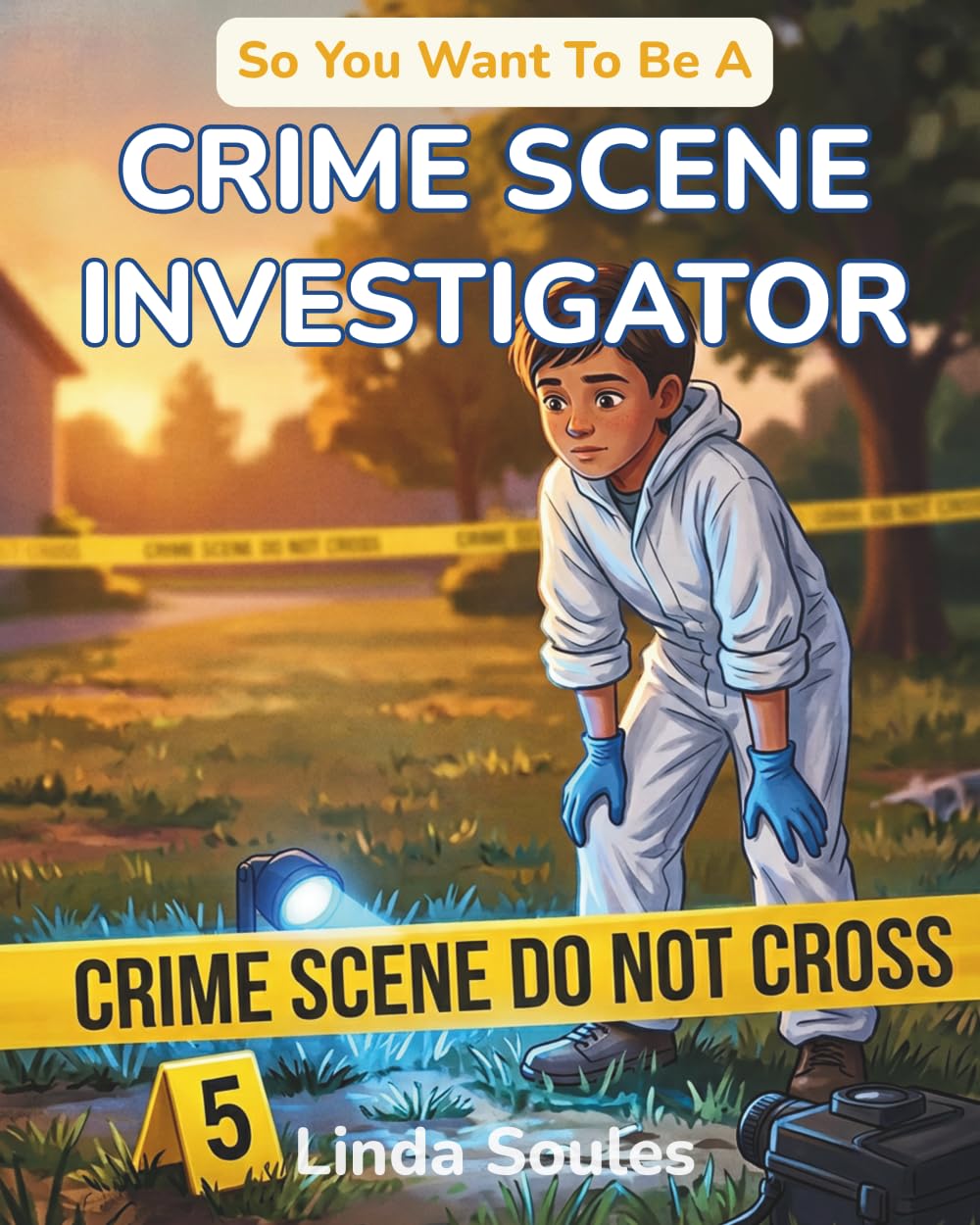
So You Want To Be A Crime Scene Investigator, by Linda Soules, is a fascinating and kid-friendly guide for young readers who are curious about forensic science and what crime scene investigators actually do. Instead of giving kids the flashy TV version of CSI work, this book explains the real job in a clear and honest way. Readers learn about photographing crime scenes, collecting fingerprints and samples, documenting evidence, protecting the chain of custody, and making sure everything is handled carefully enough to hold up in court.
What makes this kids’ book especially interesting is how well it connects science to real life. DNA analysis, fingerprint examination, trace evidence, bloodstain patterns, and lab work are all explained in a way that feels easy to understand without being boring or watered down. The book also shows that crime scene investigation is not just about finding clues. It takes patience, focus, teamwork, critical thinking, and the ability to stay calm when the pressure is high.
The detailed illustrations and fun facts add a lot to the reading experience. They make the information more engaging and give young readers something to look at and really imagine the job. I also liked that the book talks about different kinds of forensic work, the history of forensic science, and even the emotional side of the job. The book states, “Crime scenes are places where something bad has happened…” That honesty helps kids get a fuller picture of the career, including both the exciting parts and the serious responsibilities.
This is a great choice for children who are interested in science or future careers in crime scene investigation. It’s organized, informative, encouraging, and has extra resources that help kids keep learning after they finish the book. So You Want To Be A Crime Scene Investigator is not only useful for young readers but also enjoyable for adults who like learning about forensic science in a simple and engaging way.
Pages: 38 | ISBN : 978-1972766293
Our World’s Precious Resources

Cyborg Contact follows a cyborg ANT who travels through a wormhole to Earth on a diplomatic mission to reconnect with humans who once visited his world and bring them a warning. What was the inspiration for the setup of your story?
Cyborg Contact is the fourth book in The Antunite Chronicles series. I originally intended the series to be a trilogy, with Antuna’s Story, The Rise and Fall of Antocracy, and Antunites Unite. The first three books were all published in 2022, and that was supposed to be the end of the story. Two things inspired me to write this much later installment. First, the political climate in the United States prompted me to write another political satire lampooning the current administration’s policies. Second, as a Metis author, I wanted to include a strong Indigenous main character in one of my novels. I had previously included quotes from Indigenous leaders and statements that reflected Indigenous lore. Still, since the stories took place on a planet and moon inhabited only by insects and insectoids, I could not include such a character. By bringing a cyborg insect from Bilaluna to Earth, my fourth book, Cyborg Contact, allowed me to achieve both these objectives.
What challenges came with writing Earth from the perspective of a nonhuman traveler?
As Cyborg Contact is a Cli-Fi story with stinging political satire, the biggest challenge was to determine just how far I and my main character could go with my intended messages. When writing a tale on another planet, the satirical elements told by aliens are metaphors, and the story’s allegorical nature softens the parody. But when you bring an alien to Earth to further spoof an administration’s political policies, lampooning can come across more as direct mockery. I tempered the ridicule by combining political satire with a highly adventurous story and by having my main character interact with multiple species on Earth, not just humans. My human-sized cyborg ANT first interacts with Earth insects, who see him as a god. Vigilantes and ICE agents later hunt him as the ultimate illegal alien. He adopts the name Dee, short for Dios, as the insects call him, and continues to meet various ant and other insect species who help him overcome obstacles he encounters along his way. But he also meets marginalized humans, particularly immigrant teens, and an Indigenous woman, who help him learn about Earth and human civilization as Dee takes a road trip from the Yucatan to the Yukon across a near-future, splintered America. Dee’s naivety and sense of wonder tone down events that might otherwise shock or enrage a more worldly individual, as he witnesses a civilization in political and environmental turmoil.
How do you hope readers respond to the environmental themes in the novel?
I hope readers will respond with urgency to the novel’s environmental themes, which illustrate the dire consequences if we do not alter current trends. And although some may see the novel as apocalyptic, the high levels of action, adventure, humor, and cross-species connections soften the story, making it not simply a tale of drought and devastation. There are hurricanes, droughts, flash floods, and forest fires, but there are also wondrous moments in lush green jungles, blue-green seas, and arctic-boreal forests. We see the magnificence that nature offers and how that beauty can be lost if not nurtured. We also see a contrast between Indigenous traditional ecological knowledge, which reflects a measured stewardship of Earth’s environment, and a colonial civilization that has lost its way, both politically and in its overuse of our world’s precious resources.
Can we look forward to more work from you soon? What are you currently working on?
I continue to be obsessed with dystopian stories that have environmental undertones. Still, after moving my Sci-Fi stories back to Earth, I plan to keep my feet grounded here while I tell my next story from a human perspective. However, the characters may spend some time at sea before they are Marooned (the working title for my new novel).
Author Links: GoodReads | Bluesky | Facebook | Website | Amazon
A cyborg ANT from Bilaluna, Dee crash-lands in a Mexican cenote and embarks on an epic road trip from the Yucatan to the Yukon across a splintered near-future America. He travels with only a syntax generator and a bag of cicadas and has little understanding of human politics. He befriends Earth insects, rescues kidnapped teens, and battles the elements and a trigger-happy border patrol. His key ally? Seka, a brilliant Indigenous chemist with a sorted past, a spirit strong enough to tame grizzlies, and a heart warm enough to melt his hard exoskeleton.
But as ICE agents close in and climate disasters escalate, Dee realizes his warning about environmental collapse might come too late. Can Dee and Seka spark the change Earth desperately needs?
Find out in Cyborg Contact, an action-packed cli-fi road trip featuring first contact, political satire, and the ultimate fish-out-of-water hero. Grab your copy to ride shotgun with the galaxy’s most charming ANT today!
Tropes
First contact, fish-out-of-water, road trip adventure, climate apocalypse, unlikely romance, found family, political satire.
Microtropes
Alien POV, cross-species bond, damsel-in-distress, hunted by authorities, stranded together, nature’s fury, Indigenous wisdom, secret police.


