Blog Archives
Basically Frightened
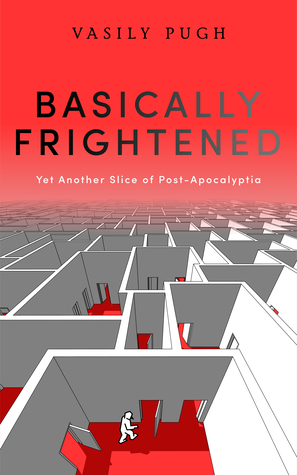
 Basically Frightened is a story about one man’s travels, trials and tribulations in a post-apocalyptic Britain. Finally venturing out to break his cycle of hermitage, the narrator searches to find a group to join in the fight against the end of humanity. He finds group after gang after collective after family. When he finally discovers an eclectic community that takes him in and allows him to stay, he tries to fit into the environment. Sometimes, one can try too hard to fit in and the main character finds this out in spades.
Basic Frightened is a delightful story about one of the most depressing topics: The End of the World. The Narrator has a wit about him throughout the entire story that is both engaging and endearing. The entire time reading this book and the terms ‘Keep a stiff upper lip’ and ‘Keep Calm and Carry On’ kept coming to mind like a gentle yet firm reminder. The characters that the protagonist can be a bit stereotypical and the story itself follows a well-trod path, but neither of those should keep this book from a wide spread audience.
The Narrator, ‘Buckaroo Bonzai’ as he likes to call himself because he never reveals his name, has similarities to other heroes of the wasteland that was once civilization: Strong sense of right and wrong, unique skill-set to help benefit those around him and the courage to do what’s right. Whereas the other ‘nameless’ or legendary characters, ‘Buck’ stands out due to the genuine and compassionate personality he exudes. Throughout the entirety of the book, ‘Buck’ allows the audience to peak not only into the corners of his own mind but why the world is the way it is. And none of it feels forced or rushed. The narrator combines stories from his own life and bits of trivia from everyday life (ranging from movies, hence the chosen name, to celebrity gossip) and allows the reader to step immediately into the current situation. This is a mark of a talented writer.
The author, Vasily Pugh, has a way of weaving a story together without being overly dry (and one could say British) or being overly sappy either. He allows the story to be dramatic and deep and then has a scene where the characters are talking about a modern day chamber pot. The dialog feels natural and the references that give the reader a mental landmark to guide themselves show a well-designed thought process. Other stories and media that deal with this subject matter tend to be gloomy (for good reason of course) and deal with the human aspect of apocalypses. Mr. Pugh has done the latter with being able to bring a fresh new look on the former. The content, while a bit done before, is still a fresh take on a subject that has been prevalent as of late.
In summary, Basically Frightened is truly ‘another slice of Post-apocalyptia’ but one in the same vein of the devilishly too short lived television series ‘Pushing Daises’. A look at a dark subject matter (murder and death/the end of the world) and showing it in an incredibly bright and almost fanciful manner.
This book should and will be a best seller one day. Or at the very least, the fantastic first step in a great literary career.
Pages: 219 | ASIN: B01KYKNQAG


Lady Ruth Bromfield

 As the Nazis begin to take over Germany, a young, Jewish mother strives to protect her daughter from the persecution that her people face on a daily basis. After meeting a secret agent from England, the young mother ships her daughter to the English countryside to live with a minister and his wife with the promise that they will raise her in the Jewish faith. A look into the life of a girl raised to be a Christian Jew, Lady Ruth Broomfield showcases the drive and amazing work ethic that its titular character posses which helped her become a powerful player in a world that once persecuted her people.
Gordon Smith’s Lady Ruth Bromfield proves to be an interesting read in the sense that it reads like fiction, but also reads like a true story. While the story keeps the reader on the edge of their seat near the beginning of the novel, there are obvious dips in the interest levels and movement of the story.
The book is very well written in the sense that the author definitely knows how to pace the story when it comes to facts. However, one of the major issues with the storytelling comes through the depiction of Ruth. While it is understood that Ruth is the story’s hero, she is far too perfect in her depiction. Overly smart, ambitious, and predominantly successful from an early age, the writing of ten-year-old Ruth makes her appear to be unusually self-aware. Certainly, the children of World War II grew up faster than most, but her mentality seems to be a mix of a spoiled five year old and a wise twenty year old.
Similarly, her depiction as a three-year-old is unrealistic. Had some of the conversations happened when the child was five instead of three, it would’ve been more believable than the conversation presented. However, when the reader keeps in mind that the main character is a little bit above and beyond the normal person as the story continues, it makes the unnatural maturity seem more plausible, if only by a little bit. While the writing is mostly well done, the repetitive descriptions and retelling of information slows the flow of the book greatly and dampers the overall mood when reading the story.
It’s really the ending of the story that makes up for the roller-coaster of writing and descriptions throughout the book. The promise of hope and the example of overcoming as a woman in a predominately male field is quite the impressive story. Similarly, overcoming her initial adversity at the beginning of the story as a Jewish orphan to becoming a massive player in the world of construction does offer hope to anyone who believes that their small beginnings do not allow them to go on and achieve greater things. Overall, this story provides hope.
Pages: 250 | ASIN: B01JVV1HLE
Off-Off-West End

Sally Roger Author Interview
Stage Door Comedies provides a cheeky glimpse into the quirky characters surrounding theater life. What has been your experience in the theater industry and how did that bring you to writing a collection of stories?
I trained as an actor in 1985 then undertook what would nowadays be called ‘an internship’ as an unpaid stage manager/lighting/sound operator on the London, England Fringe (professional Off-Off-West End). Fast-forward twenty years and I started writing plays. When I had an offer from two London Fringe theaters to premiere my first play Limehouse I knew I had broken into the business as a writer. That was my calling card.
The book is based in England and Paris, with each providing a unique backdrop that flavors the stories with each local’s unique atmosphere. Was there a reason why you chose these locations as the backdrops for your stories?
The story about my casting in Paris is true; I did approach theaters – including American outfits – for an English-speaking cast and did hit a brick wall. London is fortunate to have so many small-scale venues for new play tryouts and so many ‘pop-up’ comedy venues. I put Paris in Stage Door Comedies because my drama school Artistic Director studied there with Louis Jouvet at the Theatre des Champs Elysees. You could say it’s my school.
In this book you show us the underbelly of the theater industry and all the weird happenings and intricacies of the individuals who call the shots. Were there any characters that you especially enjoyed writing for?
Limehouse and A Suitable Lover are play-to-fiction adaptations of my first two plays which received offers of production on the London Fringe: others, I workshopped in rehearsal for conversational ‘say-ability’ (a comedic craft I honed in stand-up comedy). I directed and acted in Limehouse, an autobiographical twosome about quitting the theater, in a short run. It marked a return to a small-scale London venue. Would I direct again? No thank you, very much, at least, not for stage. In America you don’t have the British class system. What is success? Why do we pursue it? I guess as they say there is a bit of all the characters in the author of Stage Door Comedies.
What was it like to be an alternative comedy monologist at Steve Strange’s Cabaret Futura?
The 1980s was the era of the New Romantics and Karma Chameleon figure Boy George in the London clubs. At Cabaret Futura I did a one-person duologue playing both the comedian Jack Benny and his wife using two chairs back-to-back on the stage as props. I was also an MC at a comedy cellar near to the Royal Opera House Covent Garden.
I understand Stage Door Comedies is your first published book. Are you planning to continue writing? If so, when is the next book due out?
I have some more stories up my sleeve on the theme of the random nature of Fame – many are called but few are chosen. Why is one actor on the West End or Broadway while another is fated to ply their trade in a seedy, backstreet pub theatre? As Oscar winning actor Michael Caine said, it’s the years of rejection and humiliation they pay you for.
Author Links: GoodReads
For the admirers of those entering the stage door, the attraction is in what they represent. In London’s Notting Hill, a BAFTA award winner is sick and tired of people using him as a stepping-stone or step-ladder to the the big time instead of putting in ‘the hard slog’. The hustlers find that talent is not enough – it is a serious game.
A Lot of Pain in their Humor
Marguerite Valentine Author Interview
Echo is a coming-of-age story that explores many different things a young girl could encounter on her journey through life. What were some themes that you felt were important to highlight in this story to convey the innocence and growth of Echo?
I think the main issue for me is the daughter’s need for a father. A good father enables a young girl to define who she is, her attitudes to men, and how to protect herself. Echo was confused which meant her feelings and responses to men could be misinterpreted, which Gareth recognized but JF didn’t. These two men represented the good and the bad. Secondly, she has to separate from the mother and this always involves anger and to some extent a rejection of the mother until she feels secure in her own skin and can accept her mother for who she is, including her failings. I made Echo very feisty and I hope, funny. Her sharp observations of the adult world are, to some extent, based on my work as a therapist with young women. There’s a lot of pain in their humor and vice versa. It’s also about the loss of childhood and taking on the responsibilities of growing up. Thirdly, the importance of a female friend. Maddy gave Echo a good role model of how supportive a good family can be as she works through the trials and tribulations of growing up.
Echo tells the story of her life as an adult looking back. Are there any emotions or memories from your own life that you put into Echo’s life?
It was based mainly on my therapeutic work with young women at university. A therapist is told so much! We’re safe and they can tell us stuff, they wouldn’t tell anyone else. Her sharp humor is a little like me. I sill have that in me…
The story takes place on a farm in Wales and in London, England. How familiar are you with those areas? Why choose those spots as the setting for your novel?
I’m half Welsh and I live in Bristol, near Wales. To cross from Bristol in England to Wales, one goes via the Severn Bridge which goes right over the River Severn. The bridge is massive, a magnificent piece of engineering. The Severn is awesome, its flow, power and danger is as described. It fascinates me. [Check out my Pinterest for the settings of Echo] I did used to go to Wales every summer and the description of the farmhouse is based on a real one. After I’d written Echo it occurred to me that the river was like a metaphor for the difference within me of being Welsh and being English. One wild, the other fairly sophisticated and urban. I also lived in London for twenty five years and I know it well. It’s as described.
What is the next book that you’re working on and when can your fans expect it out?
I’m in the process of finishing my third novel. It’s called History Repeats Itself or Big lies: Small truths. It’s a sequel to my debut novel, Between the Shadow and the Soul. which is about a young woman snatching a baby. History is about an undercover agent and is set against the crash of 2008. It’s both psychological and political and explores the nature of lying and self-deception! I’m looking to finish it by Xmas.
Author Links: Twitter | Website | Pinterest
Echo is growing up. She’s sharp, quirky, funny, with a snippy relationship with her mother. She finds life, especially men, a challenge. From meeting her first and only love, finding out about her missing father, her obsession with a Welsh poet, and a disastrous experience with a therapist, life is a problem. But problems require solutions and Echo is determined to find her own. Using imagination and humor she finds a way to get her own back. Written in her own words, this is a magical tale of desire, fantasy, and revenge, which reveals how one woman played one man at his own game and got away with it.
Stage Door Comedies

 Sally Roger, in her recent book Stage Door Comedies, provides a cheeky glimpse into the quirky characters surrounding theater life. The book is composed of several short stories revolving around people in the theater industry. Roger obviously has a lot of experience working behind the curtain and she gives us a feel for day to day life of the actors, writers, producers, and stage hands who are always trying to keep their careers moving forward – sometimes through very strange, and comical, means.
The book is based in England and Paris, with each providing a unique backdrop that flavors the stories with each local’s unique atmosphere. Characters wander through the West End of London and ring up the Globe Theater, or walk down Boulevard St Michel and get coffee at Montparnasse. But the stories are, in essence, character studies of a wide variety of entertaining people who are almost always trying to push forward obsessively in their careers. With the stories set in these world-renown metropolises known for their arts, we get the feeling that this is the way it really is. This isn’t some little town trying to put on a stage play – this is the weird process a Parisian must go through to find the perfect actor for the main role. In one of the first short stories, an over-the-hill director, tired of being used as a stepping stone by strangers looking to make it big, tries to figure out the meaning behind a bizarre waiter’s rantings – does he want something from the director or is he just crazy – as well as his long-ago connection to a middle-aged actress who has invited herself into his home. In a later story, trying to find an English-language company that will produce her play in Paris, an observant young woman visits the unusual office of a local production company, where American expats seemingly revel in the Bohemian lifestyle of Paris.
Roger shows us the underbelly of the theater industry – all the weird happenings and intricacies of the individuals who call the shots, as well as those who want to ride their coattails. And for this, I give Sally Roger’s Stage Door Comedies a 4 out of 5 stars. As a collection of short stories around a singular theme, it works rather well. She obviously has quite a bit of hands-on experience in theater and therefore she is able to take a biting look at those who work in the industry. However, there’s no real continuity among the different stories, and with some being only a few pages long – I felt like she could’ve gone deeper into the mind, the actions, or pasts of the characters. With that aside though, her writing style is quite engaging and I found myself quickly starting the next story, enjoying the quirky characters and being able to peek into an industry and all its inhabitants that most of us only see from other side.
Pages: 108 | ASIN: B01CBR20WA
Translate Statistics into Individual People
Jason Hensley Author Interview
Part of the Family examines the experiences of the children who came to England from the Kindertransport during the Holocaust. I believe you delivered a compassionate view of this dark time in history. Why was this an important book for you to write?
Before this book, there was one document that attempted to set out in detail the Christadelphian involvement in the Kindertransport––and that was Dr. Chana Kotzin’s thesis that evaluated the reaction of a handful of Christian groups to the Jewish refugees in the 1930s. She was able to go through a lot of the correspondence that took place and really examine the refugee committee side of the Christadelphian involvement––but she was not able to look into the individual stories themselves and how the children lived when they eventually did come to a family. When I attended the Belfer Conference in 2015 at the United States Holocaust Memorial and Museum, the instructors emphasized 10 methodological principles when teaching about the Holocaust, and one of those standards very much resonated with me: translate statistics into individual people. History is not simply about statistics and generalities, but is rather about the lives of individual people. We constantly hear about the six million, and yet so often, the number loses its meaning, not simply because it is such a huge number, but because it is not focused on the individual. When the six million Jews who perished in the Holocaust is mentioned, it should be remembered that these people were fathers, mothers, brothers, sisters, sons, and daughters. When we realize the individuality of the people that we are learning about, it makes them much more relatable and the lessons from their experiences become much more relevant and powerful for us. This was huge for me, and being a writer, lecturer, and teacher, I very much feel a responsibility to tell their stories. A number of the stories told in this book have not been recorded in any way before. As I interviewed the “children,” one of the major things that stood out to me was that they constantly used the phrase “I was part of the family.” Over and over, they emphasized to me that they felt loved and cherished. There were certainly exceptions, as there always will be––but I was amazed at the things that I heard from them. One man, whose story will hopefully be included in volume 2, when I asked him what he would say to the family that had housed him, if he could say one final thing to them, without hesitation, said “I love you.” Though he had not seen them for decades, he still felt that feeling very acutely and strongly––he had become part of the family. Thus, I began to ask myself why these people had such experiences–and the answer came out very clearly, as you mentioned in your review. The Christadelphian families did this and cared for these children because they felt a kinship and a love for the Jewish people. Their beliefs brought them to action––and for me, that was a very powerful statement about the importance of beliefs. In today’s world, it feels as though beliefs are often downplayed and that many are trying to put our the statement that doctrines and beliefs don’t matter––as long as someone is good. While I certainly stand for the idea of tolerance, I think that in attempting to all get along, we cannot lose the lesson that beliefs really do make an impact, and that they can influence us for good or for ill. Therefore, I hope that this book will not only inspire others to help one another, but will also encourage all of us to look at our own beliefs and ask ourselves what kind of influence our beliefs have on our own actions.
The Christadelphians were a small christian group who helped many children during this time. Do you think their compassion and determination were reflective of their religion or their personal moral character?
I think that the answer is certainly both. Recently I had the privilege of interviewing a woman who had come to England from Germany––and who had actually lived with two different families after coming to England. I think her story helps to explain the way in which the Christadelphians acted both based off of their strong beliefs about the Jewish people, and also personal moral character: This woman told me that when she first came to England, she was chosen by a family and completely ignored. This was not a Christadelphian family––and the woman didn’t know what religion they were, if any. But, they brought her to their house, put her in her room, and never spoke with her. Eventually, she said, she went hysterical. She started screaming, banging on the floors, banging on the walls––because she had no interaction with anyone. Because of that experience, the Jewish refugee committee was contacted, and she was removed from that family. From there, she went to live with a Christadelphian family in Birmingham. She stated that the first day that she met them, they had a German/English dictionary and tried to talk with her.
When she got to the house, they tried to help her learn English––pointing at their dog and saying “Billy” (subsequently, she thought that all dogs were Billys…).
She stated that she felt like part of the family. I think that the dichotomy between her two experiences can show what life with Christadelphians could have been like if they had acted simply out of a belief that they should help the Jews. When the Jewish children came to England and lived with the Christadelphian families, they did not have to treat them like family members. They did not have to try to learn German. They did not have to tell them bedtime stories. They did not have to try to correspond with the child’s parents back in mainland Europe. But they did. I think that housing the children and in that sense “saving them” could have been considered enough to say “I helped the Jews.” But, the Christadelphian families, for the most part, out of their moral character, attempted not only to help the children, but to give them the best life that they could provide––just as they did with their own children. We were privileged enough to get together with a professional videographer and put together brief interviews (5 minutes each) with Mrs. Ursula Meyer and Mrs. Rella Adler. Both of them share how the treatment that they were given was as though they were daughters:
Ursula
https://www.youtube.com/watch?v=XsxFaBBwyeU
Rella
https://www.youtube.com/watch?v=5G7iXMkyPT0
Part of the Family is not only well written but it’s also well researched. How much research did you undertake for this book and how much time did it take to put it all together?
Oddly enough, I began the research for this book last December. I was simply blown away at how well things came together. Ursula Meyer was the first person that I was able to contact, and we conducted our interview on January 19th. From there, the project just came alive. I had Christadelphian families from all over the world contacting me to tell me that a Jewish refugee had lived with them throughout the war. One of my major rules, however, is that I don’t write about someone and publish it unless I can get their approval for what I have written. And thus, hearing about all of these Jewish children that had lived with Christadelphians presented a problem––how to contact them? A number of Christadelphian families had kept in contact with the Jewish children, and so they could actually get me in touch with them, but in other cases, once the Christadelphian parents passed away, and sometimes the children, the younger generation only knew that their family had housed a refugee, but sometimes didn’t even know their name. Attempting to find the refugees and interview them about their experiences was simply amazing. I’ve called all over the United States, Canada, and the United Kingdom. I’ve had conversations with people in Israel, Australia, Spain, and Sweden. Yet, perhaps one of the most exciting experiences was when I was presenting on the Christadelphians at a meeting of Kindertransport survivors, and one of the men seated at my table explained that he come to this very meeting because he had lived at Elpis Lodge, the hostel set up in Birmingham by Christadelphians! I had no idea––and here I had been having lunch with him! This book came together in a matter of months––something which still astonishes me. Yet at the same time, as things kept coming together, I found myself working at it all the time––often getting up at 4:30, just because I was so excited that another survivor had emailed me, and so I couldn’t sleep anymore.
Part of the Family is the first volume in a series. What will the next volume be about and what will the whole series encompass?
Lord willing, I hope to have the second volume finished this December, as well as an audiobook for this first volume at the end of August. The goal of the entire series is to tell the individual stories––and thus, my hope is that I can keep contacting survivors and their families to tell about their experiences when they were saved from Hitler by coming to England and living with Christadelphians. Thus, volume 2 will be more stories, and so will volume 3. I currently have about 35 testimonies that I would like to write!
Author Links: GoodReads | Facebook | Webite
In 1938 and 1939, via a movement known as the Kindertransport, thousands of Jewish children were taken from Nazi-occupied territories to safety in Great Britain. They came to a new family, a new country, and a new life. Approximately 250 of these children were sponsored by Christadelphians, a small Christian group. Often the Holocaust is considered in terms of statistics: how many perished and how many were affected, so much so that at times the individual stories are lost in the numbers. This series examines the experiences of the individuals who came to England as children, and lived with Christadelphians. Ten of these child survivors, and their families, participated in the effort to bring about this first volume. These are their stories.
Echo
 Echo by Marguerite Valentine is a coming-of-age tale that dabbles with mental instability and the crazy world of teenagers. It starts off slow as we learn about the main character, Echo, and her turbulent relationship with her mother. Echo is an adult when she starts telling her story, and goes back in time to when she was nine years old. She grew up in a single parent household and it’s obvious that there are strained feelings with her mother. The story is told in the first person as Echo tells us of her summers in Wales and meeting a boy, Ifan, who seems much like an apparition. The story weaves and turns as Echo grows up and learns more about who she is and how the idea of sex can have such power. Without giving too much away so as not to spoil the read let’s just say that Echo goes on a very long journey of self-discovery that both begins and ends at the farm in Wales.
The tale is broken into six parts and takes place mainly at the farm in Wales and then in London, England. The split between nature and the bustling city serves as a good divide for Echo’s life: the farm holds her youth, her innocence and her naiveté. The city holds her adult life, her disillusions with society and her pain.
The story jumps about and the grammatical issues can sometimes detract from the actual tale. As we learn more about Echo it becomes easier to attribute the choppy parts and the strange emotions the main character seems to go through to the fact that Echo is a teenager dealing with the complexity of growing up.
The central themes of self-discovery and dealing with abandonment are very prevalent in this story. Echo knows only her mother, whom she dislikes, and subsequently gets rejected or hurt by every male presence in her life. These are very real and heavy themes, but the way Valentine has Echo react to their heaviness is very realistic. Echo has been at a disadvantage from the beginning. While she has food to eat and roof over her head she is never treated quite like a child should be allowed to be. This becomes very important later in the story as we watch Echo make some questionable choices. It’s impossible for Echo to react in a ‘normal’ way because she was never taught how.
Aside from some continuity errors, Echo was definitely a more realistic coming-of-age story that suits our current world. There are no rose-colored glasses as Valentine gives us the very raw experience of Echo and her journey to adulthood.
Pages: 278 | ASIN: B0196YHSNC



 LITERARY TITAN