Blog Archives
Silent Spring – Deadly Autumn of the Vietnam War
![Silent Spring - Deadly Autumn of the Vietnam War by [Hogan, Patrick]](https://images-na.ssl-images-amazon.com/images/I/41JW3lLgpgL.jpg)

The war in Vietnam may have ended in 1975, but its effects are far-reaching and more devastating to the soldiers who gave their lives to serve on behalf of the United States than anyone could ever imagine. Agent Orange is the most commonly known chemical to have had an impact on the men and women who served in Vietnam during the decades long war, but it is far from the only substance to have made its indelible mark on millions of unsuspecting American soldiers. In addition to the onslaught of health concerns for the soldiers themselves, their children and grandchildren are potential victims of the effect of the various chemicals as well.
Patrick Hogan, author of Silent Spring – Deadly Autumn of the Vietnam War, lays out for readers, in no uncertain terms a full and complete breakdown of each of the deadly agents used in the pesticides sprayed so liberally in Vietnam during the duration of the war. Hogan, a man who served for just shy of three years in the throes of the war and in the midst of one of the most heavily sprayed areas, brings to light a lengthy list of facts related to each and every toxin administered during those years as well as a complete breakdown of the physical and mental impact each has been proven to cause.
Sadly, Hogan also shines a light on the fact that these brave men and women, now fighting a battle quite unlike the one they faced in Vietnam and one with no end in sight, are being asked to prove, time and time again, that they served in Vietnam in the areas treated by the deadly mixtures. Hogan makes it painfully clear that humiliation, frustration, and fear are all prevalent emotions among the men and women who deserve nothing but respect and the best care our country has to offer. In addition, Hogan reiterates throughout his book, they deserve and are owed an explanation as to why there have not been answers to the endless questions regarding the safety of Agent Orange and countless other toxins used in the pesticides shipped to and used regularly throughout the conflict.
As I read Hogan’s account of his own tragic experiences, I couldn’t help but be overwhelmed by the fact that the general public is grossly misinformed about Vietnam. He is right–most of us are familiar with the term “Agent Orange,” but we have no idea exactly how it was administered, the type of conditions our soldiers endured, and the gross negligence involved in its use. It is simply mortifying, and Hogan should be commended for doing his part to bring long overdue attention to the veterans and their families who deal with the lingering effects of the Vietnam War each and every day.
For as complex as is the subject matter and as involved are his explanations regarding each chemical listed, Hogan writes with a pleasantly conversational and almost familiar tone. The world needs more writers like Patrick Hogan and more veterans willing to come forward and share their own stories. We, as a country, owe them so much more than we realize. Thank you for your service, Mr. Hogan.
Pages: 247 | ASIN: B07KDXN93H

Can Any Changes Be Called Revolution

Sanjay Lahiri Author Intervie
Comrade Netai and the Chronology of His UG Days is a personal and emotional story of Naxalite movement in the 90’s. Why was this an important book for you to write?
There are multiple reasons behind writing this book. First point is obviously, I had this experience which I wanted to share with others. Second- To my knowledge perhaps this phase of Naxalite movement (Now Maoist) has not been captured by any novelist since whenever Indian literature refers Naxalite movement they refer seventies and moreover tries to represent in black and white; quite contrary to the reality. Third- I wanted to raise the question – how come that all socialist revolution ended up of being suppliers of cheap labour and eventually strengthening the philosophy which they supposed to overthrow. Can any changes be called revolution. I took ten years to complete this novel.
Netai is an interesting character that I enjoyed reading about. What was the inspiration for his character and development through the story?
Thank you. Inspiration was my experience. The dedicated marginal people (although may not be quite clear about the philosophy) and squalor and deprived life I witnessed.
This book gives a unique look at the considerations given to decisions, elections, and organization of a revolution. Were you able to provide any personal experiences to this story?
Yes, apart from this book I am having many experiences which I think need another book to share. However, I would like to share one of the most painful experiences i gathered and which still haunts me. There is small place name Manoharpur in Singbhum district (now in Jharkhand but then it was in Bihar. i am talking about 1990) adjoining to Orissa and known for mines of iron ore mostly dominated by a big house. From Manoharpur about 30 to 40 km away there was village named Tonto. There was no proper communication from Manoharpur to tonto. Only one bus plying in morning and evening. otherwise there was commercial lorries which carried people too. Apart from that there was only one goods train carrying iron ore.Otherwise those places were not accessible. I was surveying those ares on behalf of my organization and along with one of my colleagues we reached to that village-Tonto. The first hut we arrived found the door was ajar. I peeped through and found some people stood moaning surrounded a person lying on a sagged charpoy. One of them saw us and rushed to us with a gesture of help. We were not able to communicate as we did not know their language neither they. The figure of the person, lying on charpoy, sent shivers down my spine. The skeletal structure was lying spreading its arms across. A white thin cloth was wrapped around waist. The breast squeezed to such an extent as if stuck to bare protruding ribs and i took some time to realise it was- she. Her slimy eyeballs were moving slowly inside the socket. Her tongue was intermittently flicking out from her wizened mouth; as if trying to taste life. They took me as a medical practitioner and requested me to save her. No they were wrong i was not a medical practitioner however, usually, I would carry some basic medicine but I knew that would not work. Literally we escaped from the spot just providing them some medicines. That moment and that figure still haunts me.
What is the next book that you are working on and when will it be available?
My next book is- A Joker and A Witch. When it will be available – only time can say.
Author Links: Amazon | GoodReads
![Comrade Netai and the Chronology of His UG Days : An Inside Story of Naxalite Movement from Nineties by [Sanjay Lahiri]](https://images-na.ssl-images-amazon.com/images/I/517Gnha2rAL.jpg)
In the nineties, he joined to a splinter group of Naxalite to be associated with the ongoing struggle for the emancipation of the working class and was rechristened as Netai.
However, in subsequent years, he was dismayed seeing the peer rivalry, manipulation to grab power in the organization. Walking with the arms squad, Netai realized that, to the party, the expansion of arms struggle was the sole yardstick of revolution.
Netai’s home turned into a permanent shelter of comrades and gradually thrown into disarray with aimless siblings, cataract ridden mother and a lonesome father, still a sole bread earner despite being retired from a government job.
The Endowment of Isaac Frey

The Endowment of Isaac Frey

The Endowment of Isaac Frey by Val Wilson is a historical fiction story about a haunted old house in Coventry, England, and the family who occupies the house. The book starts in 1920 with John Weir and his friend, Albert Parry hunting for a legendary priest hole tunnel exit on the grounds of John’s family home, The Old House, a residence filled with tragedy and ghosts. The story spans several decades as the friends grow older and World War II separates them for a time, then brings them back together. Before going off to war to join Albert, John marries Annie Goodwin, a local girl who has returned to Coventry after escaping from an abusive man in London. The first part of the story follows John Weir as a boy and then a man (and later on, his wife, Annie), the current occupants of The Old House. Isaac Frey is introduced into the story after the halfway point. An American G.I. stationed at the base nearby, Captain Isaac Frey begins a relationship with Annie while John is away fighting in the war. But The Old House brings madness to the Weir family… and murder when John learns that he didn’t father Annie’s twins. After the murder of his wife, her children, and her lover, John Weir assumes Isaac Frey’s identity.
I enjoyed the author’s writing style. The vivid descriptions of supernatural events pulled me into the story. The house isn’t just the setting–it’s like another character, albeit creepy and suspenseful. The element of mystery surrounding the house kept me interested in the story all the way through till the end.
I didn’t like the character of Annie Goodwin. She suffered a lot of adversity, but her reaction to it was anger and taking her feelings out on others. I didn’t find her to be a likable character. She seemed to wallow in her misfortune, instead of finding a way to raise above it. Her affair with Isaac leads to her tragic end.
There were some minor issues with typos. And the point of view shifts between characters from one paragraph to the next were a bit distracting. Sometimes the shifts happened in the middle of a paragraph, which made it difficult to keep track of whose head I was supposed to be in. Some of the time jumps were a bit jarring, when something unexpected happened, but then suddenly it was years later without the author showing the previous moment in time playing out. Otherwise, a very entertaining novel.
The Endowment of Isaac Frey by Val Wilson
Comrade Netai and the Chronology of His UG Days
Activism is high on Netai’s list of priorities, or at least he thinks as much. As a member of the working class and a young man who is loyal and determined, Netai finds himself deep in the throes of the Naxalite during the decades of the eighties and nineties. While his involvement in the ever-increasing political movement increases, so does the tension within his parents’ household. His mother, afflicted with cataracts, struggles day in and day out while his hard-working father faces his own inner turmoil at being asked by his son to host the members of the resistance. Nowhere is the battle for emancipation so strongly felt as in Netai’s own household.
Sanjay Lahiri’s Comrade Netai and the Chronology of His UG Days traces Netai’s battle with his own participation in the resistance. As he goes about work in the mines, he is privy to a firsthand look at the suffering of the men and women employed there, the reality of back-breaking work, and the hardships of the working class. Lahiri paints painfully clear pictures of the desperation of the mine workers’ struggles in day-to-day living. The bulk of Lahiri’s effectiveness is nestled neatly in his main character’s own horror at the atrocities he witnesses. The author leaves nothing to the imagination as he describes the most shocking scenes of life as a mine worker. When Netai finds himself in awe of the scenes he witnesses, the reader is pulled along as an unwilling participant. Lahiri’s writing is vivid and exceptionally effective.
Details are Lahiri’s strong suit. On every level and in every way, Comrade Netai and the Chronology of His UG Days exists as a portrait of life in activism. A work of political fiction, Lahiri’s book provides a unique peek into the intense consideration given to decisions, elections, and organization of a revolution. Readers see the true rigors of rallying around a cause.
For me, nowhere was Netai’s struggle as clear as when it is pointed out to him that he has not had a change of underclothes and has exposed himself to infestation by chillars, insects growing in hay. Netai’s lack of hygiene is but one of the signs of the way in which his dedication to the cause is wreaking havoc on his psyche.
Lahiri’s key character, Netai, demonstrates an endearing eagerness despite the hardships he endures. He is an inspiring character filled with bright-eyed optimism and a strong desire to learn the ins and outs of the political processes involved in making change possible. As he is offered the opportunity to represent the state, his enthusiasm is positively contagious.
Comrade Netai features well-drawn characters and a relatable main character who wears his heart on his sleeve and exhibits humanitarianism along with a certain level of blind innocence. The subplot surrounding Netai’s parents is engaging and powerful. Comrade Netai is a must-read for any fan of political fiction and activists across causes and continents. Lahiri unites readers in a common bond–justice.
Pages: 506 | ASIN: B07JP3F1W6
A Soldier’s Thoughts: A Collection of Poems
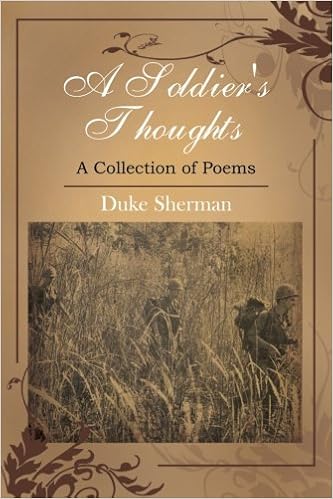
A Soldier’s Thoughts: A Collection of Poems by Duke Sherman is an interesting, decent sized assemblage of poetry. Each poem captures different parts of his life. In doing so, Sherman shares intimate thoughts, feelings, and aspects of his life with the reader. His poems run the gamut of his experiences as a soldier, PTSD, depression, and about his love life and other life experiences. Intertwined through these poems are also spiritual and religious messages and beliefs along with some political beliefs. Sherman is honest in sharing his life with the reader and does not hold back any of his thoughts.
This book is a hefty book of poetry. It deals with feelings and experiences of one man’s life. In the beginning, it offers an introduction where the writer speaks of the many different definitions of what makes a soldier. One can be a person who has fought in the military, while the other is someone who has fought hard in their life. Sherman is depicted as a soldier in both senses of the word.
Reading through Sherman’s poetry, you get a sense for the man himself. Not only do you get deep, intimate thoughts, but the reader also gets the author’s introspection and strong belief systems. A book of poetry in this sense is telling of the person’s character and a sense of who they are. Reading Sherman’s words was like an autobiography given in fragments. The poems are broken up in different formats, which flow nicely. The rhyming of the poems gives each one a nice rhythm as well.
I learned a lot reading the collection. Much of it was thought-provoking. Sherman is a veteran. Because of this, he wrote a series of flashbacks detailing the destruction he saw in war. As a result, there was a lot of patriotism mentioned. It really made you think about how soldiers were and are currently treated and what patriotism means to certain people.
One of the aspects of the book that was interesting was the disjointed way in which the poems were presented. There was no chronological time in which each poem was presented; it jumped around. At one point, there would be flashbacks as a soldier in Vietnam, and then at another point, it would be talking about one of his many loves or children. I felt that it was a good metaphor for how thoughts are often loose and disconnected, especially when recalling memories. The way it was written really made me feel as if I was in Sherman’s head.
I could also tell that the way he wrote was a way of healing, which is what poetry is about. It is an art form that some like to share with others. I could definitely feel the intensity of his feelings through his written word. I would recommend this book for anyone who may be interested in what it is like to be a veteran or to learn more about war as it is a deeply personal account.
Pages: 386 | ASIN: 1477146423
An Interesting Psychology
Igor Valec Author Interview
Damnation is a thrilling dark fantasy novel that follows King Lortar as he finds himself surrounded by enemies. What was the inspiration for the setup to this novel?
Loosely, the Warring States period of ancient China.
Asuf was an intriguing character that I enjoyed following. Your book is filled with interesting characters, who was your favorite character to write for?
Princess Alerise. She has an interesting psychology and fun dialogue. Plus I have a thing for tomgirls, villainesses, and blondes, and Alerise just so happens to tick all those boxes.
The characters inhabit a world with a rich backstory. How did you create the backstory for this world and what were some themes you wanted to capture?
From the ground up. First the geography, then the ecology, then the peoples and their cultures, then their histories.
As for themes, I wanted to show a harsh people bred by a cruel and uncaring world—but more importantly, I wanted to show how kindness, however small, can exist even in a world that punishes the kind.
What is the next book that you are working on and when will it be available?
The sequel to this book will most likely be available sometime in 2021.
Author Links: Website | Twitter
![Damnation: A Grimdark Fantasy Political Drama by [Valec, Igor]](https://images-na.ssl-images-amazon.com/images/I/41x%2Ba5mqJrL.jpg) An Empire fallen. A kingdom beset. A family divided. When King Lortar discovers a savage cult performing heathen rites, he’s forced to battle a foe he never imagined: his own son. Surrounded by enemies, Lortar is trapped in a world of treachery and betrayal, where mercy is vice and malice is glory.
An Empire fallen. A kingdom beset. A family divided. When King Lortar discovers a savage cult performing heathen rites, he’s forced to battle a foe he never imagined: his own son. Surrounded by enemies, Lortar is trapped in a world of treachery and betrayal, where mercy is vice and malice is glory.
The Zimbabwean War of Independence

Jonathan Hatendi weaves a tale of abduction, terror, and young lives forever changed. The most frightening aspect of Hatendi’s writing lies buried deep in the fact that his words are true and lay before the reader the events of his own life prior to Zimbabwe’s successful acquisition of independence in 1980. As a civilian surrounded by guerillas and day-to-day routines fraught with danger and the ever-present element of the fear of the unknown, Hatendi survived to tell a tale like no other. The fact that Hatendi is here today to share his story is a testament to his strength and the determination of the people of his country.
Hatendi’s account of his life during secondary school and the torment he endured is titled The Zimbabwean War of Independence. Hatendi jumps right into the striking events and leaves the reader no time to breathe. While trying to process the fear and overwhelming barrage of emotions he and the other young people may have felt on the night of their abduction, I was left wondering how he and his classmates were able to psychologically survive in the months and years that followed. The author’s style of writing and plainspoken manner translates well into text and helps readers visualize the blatant abuse and the true horrors of the times.
The abduction itself is, by far, not the only striking aspect of Hatendi’s story. He relates several events prior to his abduction and following his return. Hatendi writes openly of the way children were forced to witness death and destruction and describes both the realization for the need of counseling and psychological help and the lack thereof. He shares the atrocities page by page as they relate to the young men and women forced to endure lives of fear always questioning their next move.
Hatendi provides little in the way of dialogue as his book is written in first person and reads similarly to a journal account citing events and detailing remembrances of his journey to adulthood. The manner in which Hatendi records his memories is unique and provides readers, as much as is possible, with a relatable account of his experiences. I was, at times, shocked at how easily he seemed to be able to express some of the most horrifying scenes in such basic terms.
Hatendi has given the world a unique and private account of a life lived under duress and a life survived despite insurmountable obstacles. To have made it through a war for independence as a child and be willing to share the story of that fight with the world is admirable and, quite frankly, nothing short of amazing. Hatendi is to be commended for the unique eloquence of his writing and his willingness to share with the world his life as one of Zimbabwe’s survivors.
Pages: 110 | ASIN: B07F1XHN5J
The Masked Queen’s Lament
![The Masked Queen's Lament (The Gift-Knight Trilogy Book 3) by [Madeley, Dylan]](https://images-na.ssl-images-amazon.com/images/I/513zF9Pr-yL.jpg)
Author of the epic fantasy series, The Gift-Knight Trilogy, Dylan Madeley brings to you the third and last in the series, The Masked Queen’s Lament. A brilliant novel that blends medieval times with on-going issues of the world we live in today.
A fantastical and medieval plotline combining elements of eccentricity, adventure, treason, power, knighthood and intrigue. The Masked Queen’s Lament continues Madeley’s narrative from books 1 and 2 (The Gift-Knight’s Quest and The Crown Princess’ Voyage) to conclude the dramatic twists and revelations conveyed throughout all three books.
The story is set in the medieval era where “Alathea enjoy[s] the feeling of all the thunder-men staring at her, not daring to blink, ready for her signal.” As a ruler of the land, the protagonist attempts to recreate a world in how she perceives it to be. However, all is not as simple as it seems. Alathea must reign in all of her troops in order to combat the wicked witch “Crown Princess Chandra Kenderley”. A real medieval plot line that allows the reader to envision concepts of reigning, power, control, and misjudgment.
Dylan Madeley does a fantastic job at writing fluently with regards to his characters. The characters are well described, and I was able to clearly envision what they would look and act like. The author clearly knows how to build his characters. Despite being the third book in the trilogy, Madeley still continues to keep the reader’s attention with these characters, reinforcing how their presence in the book is key to its success.
What I loved about this book is how the story follows the life of power and reigns. Think about this book like a Game of Thrones episode – packed full of terror, excitement, uncertainty, and conflict. As the story unfolds, the reader is made aware that the end result is going to be via battle, and who wins that battle is very much left in suspense until the very end. I won’t provide any spoilers for those of you longing to read this book, but what I can say is that the ending does not disappoint!
The only downside to the book is the flow. I found it slow at times, particularly in the first few chapters. However, the pace does pick up as the reader is subject to more action between the characters, and this is where it got more interesting for me. What makes for good reading is uncertainty, eccentricity, and uniqueness, and I believe the author of The Masked Queen’s Lament does this outstandingly. The grammar and punctuation is strong, and the narrative is creative and unique.
An emotive, fantastic, epic medieval storyline that is well-written and well-thought out by the author. Dylan Madeley has proven to be a great author, and this book is a great way to end The Gift-Knight Trilogy.
Pages: 476 | ASIN: B07DD18H76



 LITERARY TITAN