Blog Archives
The Power of Life and Death

Linnea Tanner Author Interview
In Apollo’s Raven we follow a Celtic princess Catrin and her star-crossed Roman lover Marcellus on opposing sides of a fierce battle. What was your inspiration for the setup to this exciting series?
Since childhood, I’ve been an avid reader of mythology and legends that portrayed females as goddesses, warriors, and cunning sorceresses. I’ve always been drawn to bigger than life epic heroes and heroines who steered the destiny of their people. In my travels to London, I was struck by the statue of Boudica and her daughters riding in a chariot near the Thames River. I discovered that she was a celebrated warrior queen who united the Britons in a revolt against the Romans, almost throwing them out of Britannia in 61 AD. As I did more research, I became intrigued that Celtic women were considered as equals in this war-like society. The Roman historian Dio Cassius describes Boudica as having the mystical powers of a Druid. Other Roman historians wrote of Celtic women’s ferocity as they fought alongside their husbands.
The heroine Catrin is based on historical and legendary accounts of Celtic warrior queens such as Boudica in Britannia where women were held in higher esteem and could serve as warriors and rulers. The storyline of star-crossed lovers in Apollo’s Raven series is inspired by the legacy of Cleopatra and Mark Antony but with a Celtic twist. Archaeological evidence and sparse historical accounts suggest that Rome heavily influenced the politics of southeast Britannia prior to Claudius’s invasion in 43 AD—a political situation similar to Cleopatra’s Egyptian kingdom. I was also drawn to the tragedy of Mark Antony and his son, Iullus Antonius, whose downfalls were associated with powerful women. Their infamy cast a shadow on Marcellus, the great-grandson of Mark Antony, which will be further explored in the Apollo’s Raven series.
Your story is able to portray ancient Roman life in a believable yet entertaining way. What kind of research did you do to make sure you got everything right?
I did extensive research on the Roman life by reading books, journal articles, and blog posts by historians and archaeologists. Of particular interest are the written accounts by Julius Caesar which he sent to the Roman Senate as propaganda to support his military expeditions in Gaul and Britannia. I’ve also explored several Roman archaeological sites in Britain and France where scenes from the Apollo’s Raven series take place. Locations include Dover, Bath, Fishbourne Roman Palace, Colchester and Hadrian’s Wall in England, and Lyon in France.
As I researched Roman historical events and culture, I also tried to understand their mindsight. In Rome, the male head, the paterfamilias, had complete control over his family—wife, children, and slaves. If they disobeyed him, he had the power of life and death over them. Women were held in higher esteem in Celtic societies which is in sharp contrast with the paternalistic, empire-building Romans.
Catrin is a princess, yet she is not fragile. She’s tough and trains to be as strong as her sister. What themes did you want to capture while creating Catrin’s character?
It is my hope that modern women can draw on the rich traditions of the ancient Celtic civilization where females owned property and could become rulers and Druids. These women fought, hunted, rode horses and used weapons, just like the men, to protect their homeland.
Deeper themes that will be explored in the Apollo’s Raven series as Catrin matures and faces new challenges on her journey of becoming a warrior queen are as follows:
- Coming of Age
- Power to change destiny
- Sacrifice and love
- Corruption of power
- Quest for redemption
What is the next book that you are working on and when will it be available?
I am in the process of finishing Book 2: Empire’s Anvil, which should be available by the summer of 2018. The epic tale continues when King Amren accuses Catrin of treason for abetting her Roman lover, Marcellus. She must prove her loyalty to her father and people by forsaking all men and defending her kingdom even to death. Forged as a fierce warrior, she begins a quest to redeem herself and to break the curse that foretells her father’s kingdom will be destroyed. Yet, when she is reunites with Marcellus, she must face her greatest challenger that could destroy her life, freedom, and humanity.
Author Links: Website | Blog | Email | Twitter | Facebook

The world is in turmoil. Celtic kings hand-picked by Rome to rule are fighting each other for power. King Amren’s former queen, a powerful Druid, has cast a curse that foretells Blood Wolf and the Raven will rise and destroy him.
King Amren reveals to his daughter, Princess Catrin, the grim prophesy that his former queen pronounced at her execution for treason to him.
The gods demand the scales be balanced for the life you take. If you deny my soul’s journey to the Otherworld by beheading me, I curse you to do the same as mine. I prophesize your future queen will beget a daughter who will rise as a Raven and join your son, Blood Wolf, and a mighty empire to overtake your kingdom and to execute my curse.
Catrin is trained as a warrior and discovers she is the Raven and must find a way to block the curse of the evil former queen. Torn between her forbidden love for her father’s enemy–Marcellus, the great-grandson of Mark Antony–and her loyalty to her people, she must summon the magic of the Ancient Druids to alter the dark prophecy that awaits her.
Will Catrin overcome and eradicate the ancient curse? Will she be able to embrace her forbidden love with Marcellus? Will she cease the war between Blood Wolf and King Amren? Will she save Ancient Britannia?

To Be A Symbol

Murray Lee Eiland Jr. Author Interview
The Wanderer’s Last Journey opens to Orfeo being kidnapped by mysterious strangers and heroes from all over the Aegean join forces in the quest to find the lost prince. What excited you the most to write this 4th book in the Orfeo saga?
This book was the one that involved a trip to the New World. There have been many theories about Mediterranean contact with the New world, and I knew that in some ways the plot would be “far out.” Interestingly, there have been traces of cocaine found in ancient Egyptian mummies, so I had a plausible reason for travel. I did not want to fall into the well worn idea that any contact with the New World would be from a more advanced “European” culture. I think I portrayed the contact as one involving matched but very different cultures. In fact, Orfeo was taken in order to be a symbol that could be manipulated by extremely savvy leaders.
The Wanderer’s Last Journey has all the makings of a classic fantasy epic, as the rich and evocative world is as intriguing as it is intricate. Did you set out to create such a detailed world or did it happen organically?
I would like to say that I planned it all. In reality the Orfeo Saga happened book by book for the first few, and then I had an idea of a wider sweep later on. This novel marks the beginning of a larger plan. At the end of the day it is all about writing about interesting periods in history. What could be more interesting than a very early journey to the New World? What if that culture could be just as treacherous and manipulative as any in the Mediterranean? Of course I had fun with this part of the book. The second part of the book, dealing with Sparta, also has a bit of humor. However, I explored how dangerous a defeated people can be. Sparta will of course emerge during the Classical period as a very serious threat to Athens. More to the point Sparta will also emerge as a threat in my (fictional) Bronze Age Orfeo Saga. I have many more books planned.
The Iliad seems to be a source of inspiration for this book and your love of this period clearly shows. What is it about Greek/Roman mythology that you find interesting?
I read a huge amount of Greek and Roman mythology when I was younger. I had to take Latin in school and I always found myself wanting to read at a much higher level than my Latin ability would allow. I finally decided on a career in psychiatry. At the time Greek and Roman myths were mined for their insights into human nature. They express rather unvarnished characters (good and bad, sometimes in the same character). I was really interested in motivations, and of course the biggest motivation of all. There is phrase “collective unconscious” that coneys something like “cultural memory.” I am not sure that anything like that exists as an entity, but as a concept there is something to that. People collectively wanted to move their culture and civilization on to other things. I am not so silly as to think that everything in society just keeps on getting better, but there is something in that argument!
Where does the story go in book 5 of the Orfeo saga?
There is unfinished business in Babylon. Zinaida has been put on the throne in Orfeo 2, and now she feels like she should exert the power of Babylon to conquer her neighbors. Orfeo 2 dealt with Babylon using military force. This novel introduces a new character called Cyrus. He is extremely resourceful and takes up the identity of a merchant. He is a character that I will use in some future novels. I like the fact that he is not just simply a warrior or even a Wanderer. He becomes something entirely different.
Author Links: GoodReads | Twitter | Facebook | Website
![The Wanderer's Last Journey (The Orfeo Saga Book 4) by [Eiland Jr., Murray Lee]](https://images-na.ssl-images-amazon.com/images/I/51nnWkToCJL.jpg) “A Powerless Prisoner: A Captive God
“A Powerless Prisoner: A Captive God
No one is sure when the New World deity Quetzalcoatl was first worshipped. The god-man can be portrayed as a feathered serpent – and also associated with a bright green bird of the same name – but he was worshipped in a variety of ways by various cultures. Some versions of the myth state that he was a man with light hair, beard, blue eyes, and light skin. After helping humankind, he was said to have returned to his home, promising to return. It is not surprising that he has been identified as a Viking by some historians (and as an extraterrestrial by more adventuresome scholars). The Aztec Emperor Moctezuma II is reputed to have initially believed that when Hernán Cortés appeared in 1519 Quetzalcoatl had returned.
Here Orfeo has been kidnapped by a New World tribe. They plan keep him as a prisoner while presenting him to a subjugated populace as a god. He has no desire to live his life in a gilded cage. His wife, Clarice, his aging mentor, Zurga, and the jack of all trades, Daryush, must cross the ocean to save their friend. They soon find they are involved in a civil war between the Nastases and Ixtlans. It will take all their cunning to rescue Orfeo and get back alive. Back at home a war is brewing between Sparta and Pylos. This time Zurga is not there to keep the peace.”
Life Gets Complicated

Kevin James Breaux Author Interview
The Lifeblood of Ill-Fated Women revolves around the story of two Valkyries, sisters Astrid and Yrsa, in a world still ruled by Nordic Gods. What was the inspiration for this novel and the Norse mythology used throughout?
Spoiler alert in that question. Lol.
My inspiration was two fold.
One, I really had not read or seen much about Valkyries in years. They are very interesting mythological beings, but not really focused on in movies, cartoons, or TV. Seems like a wasted opportunity, so I took it. I wanted to write a story about a woman who was questioning her reality on several levels. Is she alive, is she dead, was she adducted by aliens, is she in hell? etc.
Two, I felt like Norse mythology is something people, readers, movie-goers, are willing to openly accept easier than some other myths or cultural beliefs. Maybe because of it being so fantastical. Sometimes we believe the things that are harder to believe and accept quicker than those things more based in reality.
For example…. So many people watch and follow ghost shows and believe all that we are shown, but then laugh at the hunters chasing Big Foot in the forest. Paranormal vs. A living being (although myth). Seems like it would be easier to believe in a missing link than spirits from another realm right? Well, maybe that’s just me.
Note: I believe in both actually. 🙂 And aliens.
Regardless, Norse myth is fabulous. And there are a few good fiction books you can find and read. I read one prior to writing this book. Good reference material to pick over. That and my old original Deities and Demigods D&D book. 🙂
What kind of research did you have to do to make sure you got the mythology correct?
As stated about, I bought and read one book. Norse Mythology: A Guide to Gods, Heroes, Rituals, and Beliefs by Lindow. I also used my old hardbound Deities and Demigods D&D book for inspiration.
I spent a LOT OF TIME online researching what “curse words” and foul language would have been used in the Viking Age. I could not deal with or accept the use of modern four letter words being said by my characters. I really lost sleep over it. I finally found some replacement words that were close to the time period or language. Not perfect, but I felt like the reader would understand what I was going for.
I never like watching movies set in ancient times with characters spewing modern day bad words….unless we are talking about STARZ’s SPARTACUS. That was awesome, and with all the over the top blood and guts it was fine. 🙂
As a writer who researches, I like to find the facts and then decide how best to use or alter them to fit into my works of fiction.
When Astrid falls in battle and wakes up with no memory the reader is brought into Astrid’s mind to be witness to her paranoia, fear, confusion and inner struggles. What were the obstacles you felt were important to highlight to connect readers with Astrid and develop her as a character?
Everyone struggles with these things on some level.
Astrid is a big, strong, proud Viking warrior. Who can relate to that? BUT they can relate to all her inner struggles. Who hasn’t questioned their reality? Who wasn’t felt afraid of something one moment, then loved it the next. Think of skydivers. Fear and then joy in a matter of seconds.
Astrid was originally designed as a near cave woman. She grunted and groaned. Took what she wanted. Feared nothing. But an early draft was read by my editor and she pointed it right out. Astrid was unrelateable. I did not want that.
My plan was to write a fantasy-horror story with a character who just cannot figure out if she is alive or dead. Her beliefs would pull her thoughts into both directions; a tug-of-war. While she struggled, the story played out. Things would be happening all around her and she would have to decided what to do, regardless of her inner struggles. That’s life. We all are faced with that.
I was really sick with the flu or something the other week. Two days of being the sickest I had been in 20 years. And guess what, I needed to go get my new drivers license photo. Time had ran out. I was faced with an obstacle on top of another obstacle. Life gets complicated.
In some books or movies, it seems like the hero only has one major concern. That’s unrealistic to me. Yeah, go save your kidnapped daughter Liam Neeson, don’t worry about needing to buy more ammo, or the authorities, or laws, or weather, or your own wounds, or….
This is a well written novel that leaves open the possibility for other stories to follow. Do you have another story in the works?
Book two is currently being written. It takes place several months after book one. I envision this series as 3-5 books long.
Author Links: Website | Facebook | GoodReads | Twitter
![The Lifeblood of Ill-fated Women (The Blood, Sun, and Moon. Book 1) by [Breaux, Kevin James]](https://images-na.ssl-images-amazon.com/images/I/51R7TYh9USL.jpg) “Astrid the White isn’t an average princess. She has always stayed by the side of her father, King Kol, and learned warfare and weaponry from the best Vikings in the land. When she awakens in the city of Birka and hears the sounds of war, she rushes proudly into the fray. She is more than capable of taking down any enemy wishing to disturb the peace.
“Astrid the White isn’t an average princess. She has always stayed by the side of her father, King Kol, and learned warfare and weaponry from the best Vikings in the land. When she awakens in the city of Birka and hears the sounds of war, she rushes proudly into the fray. She is more than capable of taking down any enemy wishing to disturb the peace.
This enemy, however, isn’t what she expected. Before Astrid even gets outside the walls, a golden light knocks her out.
She comes to in the snow, in full battle armor. Astrid first suspects that this is a challenge from her father–or even the gods themselves. By acting correctly, she can gain the favor of Odin, the Allfather.
Astrid wants to complete the test, but it becomes more and more difficult as she explores this new part of the world and encounters both monsters and monstrous men. As creatures from the darkest legends reveal themselves, Astrid will discover that her journey isn’t about acting correctly or passing Odin’s test. It’s about pure survival. Before she can even think about finding Birka, she will have to defend herself against the demons of this new world.”
My Father’s Kingdom
![My Father's Kingdom: A Novel of Puritan New England by [George, James W.]](https://images-na.ssl-images-amazon.com/images/I/51jYlqd-IfL.jpg)

A historical fiction novel by James George, My Father’s Kingdom is centered heavily around the religious strife during the American settlement at Plymoth in the late 1600s. The story is told through the narrative of both native Indian tribes and from English settlers, 50 years after our beloved Thanksgiving holiday occurred. The differences between the two people, especially in religious decisions, is what drives the stress between the alliance. The wordsmanship by George is a beautiful combination of elements and themes, pulling together from the hardships our ancestors faced and the fear that comes with abnormalities and change.
The narrative of this story is told mostly by Linto, Metacomet, and Israel Brewster. Each offers a different opinion and set of beliefs on the alliance between the people, and on their personal religious journeys. This plot of the story is comprised of a brewing rebellion after an untimely death nine years prior. Tension is strong between the two people, and fear and talk of war is present early on.
Meanwhile, the characters are on journeys of their own, to find a connection with God. Linto is hungrily trying to understand the Englishmen’s God, and is plagued by the stress. He seeks comfort in his own communion with nature with The Great Spirit. Metacomet is overcome with grief for the loss of his brother, and struggling with the responsibility of leading his tribe down the correct path. His distrust for the Englishmen and the revenge he seeks plays an important role in the evolution of the story, and it feels like you grow right along with the young leader as the tale unfolds.
On the other side of the coin, the English settlement faces troubles of its own, told mostly from the Reverend’s point of view. Israel is also a character who is suffering internally, battling the repercussions to his faith with the loss of his wife. While he does his best to keep his community pure by offering extensive counseling, he also battles with the shaky relationship with the local native tribes.
The consistent theme to the story is that which exploits the importance of peace. Often we forget what truly happened in the history of America, and instead focus on the gracious holiday that was born from the struggles of the first settlers. This story helps serve as a humble reminder of the bloodshed and the turmoil that really occurred.
Everything meshed together beautifully, staying accurate enough to the history of the war that happened while giving a unique and fresh tale to follow. It breathes life into the history we read so blandly, and George does an excellent way of making the scenario relatable and understandable to modern time. The characters are beautifully flawed, and all so different from one another. You feel the pain they feel in their journey, and I was eager to discover the endings that they would come to face. It’s a beautiful picture of American History and the fragile nature of peace and friendship.
Pages: 169 | ASIN: B01MS5OQP8
The Lifeblood of Ill-Fated Women
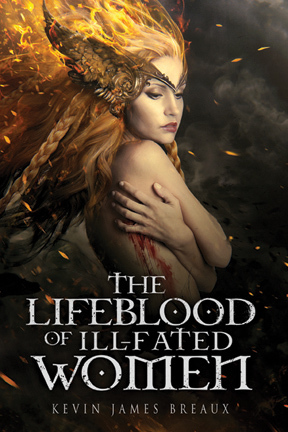
As you step back into the past, you enter the world of the Norse, a time when the Goddess Freyja and the God Odin influenced the world. Freyja commands the ranks of Valkyries, immortal women that bring those slain in battle to the afterlife of Valhalla. The Lifeblood of Ill-Fated Women revolves around the story of two of these Valkyries, sisters Astrid and Yrsa. The sisters are from a Nordic area called Birka, they raid and plumage for wealth and entertainment. One night their home is attacked and Astrid believes she has died. Astrid awakens in a strange land with no memory of how she arrived there. She is found by a farmer named Warren that is kind to her and goes out of his way to help her having no clue either about her past or what she really is. This novel tells the story of how Astrid finds her family and discovers a life can have more meaning than how many villages you conquer.
Kevin James Breaux brings readers into a distant world where people are stilled ruled by the Nordic Gods. Times of war are ending and settlements are turning more to farm towns and less militant. Astrid arrives in one of these small farming towns called Gromstad. She is convinced Warren is her captor and she must escape, frightened by her lack of memory, she cannot comprehend that her home Birka is long gone and far away. Breaux does an excellent job bringing the reader into Astrid’s mind and seeing her paranoia and fear, her confusion and inner struggles. Even once the secret of her past as a Valkyries is revealed through her sister, she is still faced with even deeper struggles and decisions. Like all great epic tales, this one delivers the deep character development and inner conflict to match the action that is going on outside of the character’s inner struggles. The relationship of Warren and Astrid is hot and cold. There are some graphic sex scenes but their love and passion is a contrast to Astrid’s warrior goddess nature. The world they live in is being sieged upon by demons and Astrid must use her powers as a Valkyrie to save herself, Yrsa and the town. Typical of hero’s in epic tales like this, things are not so easy. Astrid must make sacrifices and choices that will impact the rest of her life, and the lives of the people she cares for. Breaux shows this inner struggle and lets Astrid’s personality take over the story driving it forward. The other characters react to Astrid and further the plot along showing their own personality traits and allowing them to be dynamic characters not just filler for novel. The overall development of plot and characters is well balanced making it appealing to people looking for an adventure as well as a love story.
Astrid is the focus of the novel, but her interactions with the other characters brings forward additional stories for Kevin James Breaux to add to the series. He already has the next book in the works and I am sure it will continue this epic journey and bring more characters to life as he did for Astrid.
Pages: 409 | ASIN: B01MU9F5JX
Heroic Fiction
Murray Lee Eiland Jr. Author Interview
Zurga’s Fire takes place in historical Greece and the rest of the Mediterranean and is broken up into four books filled with short tales of adventure. What was the inspiration for this third book in the Orfeo Saga?
The fictional universe laid out by Tolkien in Lord of the Rings was probably the series that got me thinking along the lines of an extended saga. I liked the way Tolkien used ancient sources to create heroic fiction. At the same time I wanted to be more historical like Robert Graves and his series I, Claudius. I wanted to write something that would not be fantastic, and which would not re-tread well known history. The Bronze Age offered scope to speculate. There are few written sources, but what there is offers scope to invent characters and place them in historical context.
Zurga’s Fire introduces the issue of nomads and how they impact civilization. I had been researching nomads for my other interest, Oriental carpets. Nomads were very effective warriors, and they could overwhelm sedentary societies. They did have one weakness, and that was leadership. Every group from that lead by Attila to Ghengis Khan eventually fell apart. A charismatic leader is essential for nomads. In Zurga’s Fire the leader of the nomads is eventually undone not so much by a face to face challenge, but by a crisis in leadership.
Why did you go with the format of short stories told as a collection?
This is a very good question. I really did not think about the format before I started writing the series. I wrote many short stories over a period of years that were never published. Looking back that was probably a good thing. I always liked reading short stories. I think I have a short attention span. The result is that I am quite comfortable writing short stories and I have structured my Orfeo Saga that way too. Many books in the Orfeo Saga are made up of two different stories which are divided into books. In contrast my other series about a Los Angeles based private eye (the Bart Northcote series) are entire novels.
I felt that the characters in this book were complex and well thought out. What was your favorite character to write for?
I think that the character I had the most fondness for was “Zurga.” I gave him a rather ridiculous name because the character went by many names. This name suggests that you cannot take the character seriously. Zurga likes to deceive people as to his true intentions, as well as build up a mythology around himself. Zurga realized early on that he would not be fully accepted. No one would ever select him as a leader. In contrast his protege Orfeo can become a leader. Again I was well aware of Orpheus in the Greek pantheon. While Orpheus was a gifted lute player, he is also credited introducing civilization to savages. My Orfeo character has some similarities with Orpheus, but I have taken all supernatural elements away.
I think of Zurga’s Fire as a historical adventure tale. Did you do any research to keep the setting and characters true?
I studied ancient and modern nomads for years. I read about them, their social structure, history, and particularly art. Many of my research trips were to see nomads making textiles, particularly Turkish speaking people. I knew that for the Bronze Age there were not good historical sources, so I filled in the blanks with what I understood from more modern nomadic groups. I tried to capture their lifestyle in the novel, without going into the nuts and bolts of their society. The interesting thing is that the Greeks had recently settled by the Bronze Age. In the novel they were well aware of the kind of enemy they faced. The same pattern repeats throughout history many times. A group settles and then the next group of nomads impinges on them. Every sedentary group has the same choice. They can fight or they can flee. For Zurga’s Fire I wanted to show how the nomads being horse riders and archers had an advantage. Sedentary society, with farmers, had fewer people who would naturally take on a warrior role. They could fortify cities to stop nomads, but that does not always work. That is the tension I wanted to accentuate in the book.
What does the next book in the Orfeo Saga take readers?
The next book is also divided into two main parts. The first part takes the characters to the New World. There has been a huge amount of scholarly speculation about the contacts between the Old and New Worlds. I think that there must have been limited contact between these two areas, but I am not sure that it occurred as early as the European Bronze Age. However, there was likely early contact. There was a report that a scientist had found traces of cocaine as well as nicotine in Egyptian mummies as early as 1000 BC. I think it is important to look at evidence with an open mind but have a healthy skepticism about big claims.The Orfeo Saga volume 4 has a bit more humor in it than other books in the series. I also thought it was important for Orfeo to take a greater role in his own fate. His teacher disappears during this story.
Part II of the book deals with the rise of Sparta. This is not as far-fetched as some people think. Archaeology is pushing the date for Spartan civilization further back in time. I try to post interesting links to the archaeology on my Facebook page.
Author Links: GoodReads | Facebook | Website
The Getae inhabited the region on either side of the Lower Danube River, in what is today northern Bulgaria and southern Romania. They were in contact with ancient Greeks from an early date. Herodotus – writing in the 5th century BC – extols their martial spirit: “…when it lightens and thunders, they aim their arrows at the sky, uttering threats against the god; and they do not believe that there is any god but their own.”
They ruthlessly incorporate conquered people into their society through enslavement, and are prepared to kill those who are not useful to their plans. They have no need for the luxuries of city life. Fighting in troops of mounted archers, they mock individual heroes. Getae have a long history of reducing enemies in deadly hails of arrows while not getting close enough to lose warriors in single combat. Here Orfeo and his warriors must deal with an expanding Getae empire during the heroic age of Greece. Vastly outnumbered, can they stop an invasion that threatens not only their lives, but also their entire culture?
Sicania Rising


Sicania Rising by Daniel Buckley is a work of fiction set in the ancient times of sea trade routes and praises to gods for their help in all matters of life. The story features several characters and a depth of detail sure to please any lover of historical fiction, especially of the Mediterranean variety.
One of the great rulers, Seidon, seeks to make headway on the islands of Sicania to further strengthen his hold on the trade routes of the Mediterranean. Meanwhile, his sons are hoping to be elected as the new rulers of the land but seem to have differing views on how to govern. Several other characters have roles to play as the power vacuum of the Mediterranean attracts all interested and worthy seafarers, creating a dynamic and intriguing story for the reader.
Particularly, I enjoyed the descriptions of adventuring and sea warfare. It was interesting to see how wars on the water would have taken place back then, and the author does a good job of putting the reader right in the middle of the battles to soak in all of the details he provides. Language issues do limit some of this, but the strength of the story still shines through the errors, leaving the reader with a solid understanding of what happened in each situation.
It’s unfortunate that the author doesn’t spend more time developing the characters, because they are interesting and beg to be fleshed out. The story has a tendency to jump into a bit of character development and dialogue, only to quickly fast forward through time with more exposition, leaving the reader’s investment in the characters lacking. Otherwise the historical accuracy of this book is the true gem of the story. If you are a fan of historical fiction you will enjoy the depth of detail delivered in this novel.
Sometimes the writing is difficult to follow as it often lacks structure and has inconsistent grammar. It’s a shame because there are glimpses of a great narrative hiding under all of the mistakes.
Overall, Mr. Buckley does a fantastic job of establishing a fictional conflict in a well-documented historical setting. However, his focus on historical facts and neglect of meaningful character development might leave fans of fiction wanting more. For those that enjoy nonfiction, historical sea battles and Mediterranean politics, this story is worth your time.
Pages: 235 | ASIN: B01M3X3YDG
The Crown Princess’ Voyage


We’re brought into a fantasy world right after a princess has ascended her throne while another plots the death of a beast. The Crown Princess’ Voyage by Dylan Madeley tells two intertwined stories about young women thrust into power and broken from that power at the same time. Both have won, both have lost and in the end they both will fight over the same possession. Our princess Chandra is about to be thrust from her kingdom as a peace-keeping act to satisfy those disenchanted with the monarchy. Alathea has ascended to goddess-hood and viciously fights to keep her place. Both women are wrapped in mystery and an air of sorcery, yet which one of them will be victorious in the end?
In the beginning of the book it is a bit difficult to fully grasp which tale is being told. The switch from one to the other can be a bit confusing, especially when Alathea’s peculiarities are taken into consideration. A self-proclaimed Goddess who needs to wear a mask in order to fulfill the dirty parts of being royalty could just as easily be a figment of Chandra’s imagination.
They are two separate women, however, and while they are living different lives they share something in common: Derek Wancyek. This assassin-turned-knight who serves Chandra is also desired by Alathea. There comes a point when he is offered an easy life or the choice to struggle. This means betraying one for the other and the decision our dear Derek makes will be surprising to some readers.
The first section of the book seems devoted to world-building which is important when you’ve got complicated structures like those that exist in this tale. After the first few chapters when the reader realizes that Chandra and Alathea are two separate women who will eventually come into contact with each other, the book is easier to read.
The joy of this book is that we’ve got two strong female leads. More often than not it is the men who shine in tales like this. While both Chandra and Alathea have men that they confide in, trust in, it is clear that these two women are the ones who call the shots. Alathea especially. Her youth was twisted and taken from her in the most dramatic of ways, yet she used this to her advantage and pressed forward with her goals.
One of the best parts of Madeley’s tale is the description. Everything is explained with intricate detail that would have taken ages to compile and keep straight in the mind. Dialogue isn’t used to fill gaps, as it sometimes can be. While there are some rough areas that need tidying up, the story as a whole is compacted into a single volume that does lead to a resolution. The only thing that can be a bit difficult to digest is the large cast of characters and learning about their fates post-story. But in then end, readers won’t be disappointed with this fantastical tale.
Get book one of the Gift-Knight series available NOW at Amazon
When a young woman named Chandra takes the throne under suspicious circumstances, she has to solve the deaths of the King and Queen before those responsible get to her. She has to maintain peace in an empire where people consider her the number one suspect. Derek is summoned by an official letter and his people’s tradition to be Chandra’s personal guard. He’s immediately suspicious given that her family ruined his once-noble ancestors, but if there’s no way to escape the world’s largest empire, what might he do to turn the tables? Interwoven with Derek and Chandra’s story is the history of their ancestors, infamous and famous, that lead them to confrontation. A new world is built before the reader’s eyes, and key groundwork is laid for the impending sequels, leading to a highly detailed narrative.
![The Gift-Knight's Quest by [Madeley, Dylan]](https://images-na.ssl-images-amazon.com/images/I/51R969AV%2BeL.jpg)



 LITERARY TITAN