Blog Archives
Powerless But Not Helpless

Powerless But Not Helpless by Buddy C. is a self-help book about taking steps to overcome addictive behaviors and alcoholism. This exceptional book is written with inspiration from Tao Te Ching, a highly regarded work of Chinese classic literature addressing how to live a virtuous life, from the wisdom of Lao Tzu. The author addresses how to live a life free of addiction and alcoholism while pulling from the wisdom of Lao Tzu and applying life virtues to the recovery journey.
Readers will discover a book that is rich with practical tips and wisdom to help those struggling with a life of addiction, ensuring that the recovery journey is holistic and spiritually sound. Buddy C. takes a well-rounded approach to address recovery with virtues, personal affirmations, and spiritual fruit. He addresses 81 verses of Lao Tzu and applies them to the recovery process. With statements from Living To Give and Surrendering Expectations to Love Is The Bridge and My Loss Is My Gain, there are many calls to action throughout this book to provide help and support for anyone who reads it.
There is much wisdom in the pages of this influential book for anyone struggling with substance abuse, addiction, and even low self-esteem. The author provides readers with the tools needed at any stage of their recovery. I really appreciated that the author shared his personal experience with readers, which made me feel confident in the advice he provided.
Powerless But Not Helpless can help readers develop a positive mindset and overcome obstacles they might face during their lifetime. Readers who enjoy self-help books, and words of wisdom, will find this an enlightening read. For those looking to better themselves, this is an excellent place to start that journey to become a more well-rounded person with a broader mindset. I feel this could be a challenging read, filled with self-reflection, but the outcome is worth it.
Pages: 191 | ASIN : B09HMPHY7V

A TEAR OF JOY A TEAR OF SORROW
What do you see when you look through biblical stories and the relationship between God and man? Do you see a judgmental God eager to bring down the hammer on erring men, or do you see a loving father painfully wading through the errors of man and their inevitable consequences as he works on his master plan to save humanity and once again be reunited with his children?
A Tear of Joy A Tear of Sorrow is an attempted expository look at the scriptures from God’s perspective using evidence from the same scriptures. The author traces the display of God’s love and his experience of sorrow through the defining moments in the scriptures, right from Adam and Eve’s fall. This shows that God wasn’t a passive bystander and he was involved all along, demonstrating his love while persevering through the pangs of pain man’s actions and their consequences caused him. The author takes biblical accounts and examines them based on their immediate context and in the context of the entire scriptures, peeling open the layers to reveal insights about God’s consistent character throughout history.
What’s interesting is how the book points out the often-overlooked personal sacrifices God had to make in defining moments such as the expelling of man from Eden, the flood, and the disbandment of the congregation at the Tower of Babel. It also looks at how these events worked together to keep man on the path to true redemption. Overall, it’s a thought-provoking interpretation of Bible stories people may have gotten too familiar with to properly appreciate. The narrative structure of the book makes it easy to read and keeps you engaged. It also reflects thoughts that are very well put together and, given the topic, digestible.
If you want answers to some pressing questions like how God could allow tragedies like the flood to happen or why he’d even allow Adam and Eve to be tested in the first place, or just why he allows anything untoward to happen to those he claims he loves, this book may give you some. It provides a different way to look at the stories beyond their superficial details.
Works like this are generally considered to be highly opinionated but some opinions are worthy of attention. A Tear of Joy A Tear of Sorrow is an enlightening read that I would recommend to readers looking for a refreshing look at scripture.
Pages: 283 | ASIN : B089HWK493
Did Jesus Die For Dogs?
![Did Jesus Die For Dogs?: What does the Bible say? by [Steven Boint]](https://m.media-amazon.com/images/I/410Z9+-jmTL.jpg)

Rev Steven J. Boint helps readers understand the Supreme Being that is God and how humans relate to him in his book, Did Jesus Die For Dogs? In the book the author analyzes different theological narratives and how they have shaped the lives of Christians around the world. The tone of the text is neutral and the author is objective with the points that he shares. Along the way the reverend uses bible scriptures to help the reader comprehend the creation story, sin and how Christ loves his people.
As a follower of Christ, one is assured of God’s unending love and mercy. The author writes about God’s love and why every creature on earth exists because of his grace. There are multiple lessons on salvation and how broad Christianity is. Did Jesus Die For Dogs? is a a surprisingly thought-provoking book, considering the title. This book enlightens the reader on the role of Christianity and living righteously. The discussions are sober and the author is impartial in his analysis. Rev. Steven Boint has written a short but deep book that explores Christian salvation, and if it applies to dogs.
Pages: 29 | ASIN: B0867FSZY5

Between the Ticks of the Clock
![Between the Ticks of the Clock by [Barnes, J.H. Carpenter]](https://images-na.ssl-images-amazon.com/images/I/51XOfwcyZGL._SY346_.jpg)
Between the Ticks of the Clock by J.H. Barnes is a spiritual novel that evokes the senses of mystery and redemption. It’s an introspective story that helps frame theological and societal questions within a framework particular to the dredges and monotony faced in daily life. This is accomplished through the perspective of the novel’s main character, Jamison Haro
ld Donovan, an executive working for a business known as Omni Cron Corp. Donovan is placed within the confines of a failing marriage and a dreary workplace. However, it becomes clear that these factors are minute points in a grander tale. This banal existence is quickly juxtaposed by a spiritual experience, where Donovan comes to grips with forces higher than himself and where he leaves the event a changed and more enlightened individual. From there, the novel examines Donovan’s growth and his spiritual enlightenment while at the same time highlighting the challenges and responsibilities that come with such an awakening. Between the Ticks of the Clock is unique in its pondering and musings, and as the novel progresses, it ascends to newer heights and different dimensions than one could have anticipated.
More importantly, Between the Ticks of the Clock is written in a literary style incredibly suited to its plot. The diction is easily digestible and the first-person narrative helps place the reader within the shoes of Jamison Harold Donavon, allowing us to experience some of the spiritual revelations he faces. This is coupled with emotive word choices that help paint clear imagery and scenes for the reader. J.H. Barnes does a wonderful job in setting the scene. All of this is framed within a writing style that is introspective, ethereal, and lithe. When taken as a whole, one is left with strong themes and feelings of wonder, of spirituality, and of internal pondering once the book is put down. However, there are moments where this style of writing can lead to some confusion. Points of discussion within the novel are often interjected with additional ideas or flashbacks that might hinder some comprehension of the overall idea. Yet, this stylistic choice helps remind us that the story is based around the perspective of Donavon, and this free-form stream of consciousness helps remind the reader that these experiences are still derived from a human perspective and thus creates a sense of immersion.
Overall, Between the Ticks of the Clock by J.H. Barnes is a lucidly written novel that provides readers with hard-hitting questions about life, religion, and their place in the modern world. It is an incredibly deep story, filled with important ideas and concepts.
Pages: 288 | ASIN: B07GC8GSZK
A Pandeistic Universe

Knujon Mapson Author Interview
Pandeism: An Anthology is a collection of work from different authors that seeks to provide intellectual backing to the idea of pandeism. Why was this an important book for you to put together?
Pandeism is a pretty old idea, but is one which has very long been little known — discussed almost exclusively in scholarly and academic settings, and usually in a sort of abstract and theoretical way. Perhaps that will always be its primary locus of discussion, but as scientific knowledge comes to match up better and better with a pandeistic Universe, it would be a wonderful thing for people to be made aware that this possibility is out there. And as the Anthology writings show, it has proved itself worthy of consideration from many angles.
There is surely some long-term gain to be realized, as well, from a world wherein people generally understand that all things are part of our Creator, and all life ought to be accorded the respect due to even a fragment of our Creator. And even as Pandeists bear no club with which to threaten ‘disbelievers’ with eternal torment or the like, imagine how you might react if you felt there was a possibility — a reasonably high probability even — that if ours were a created Universe at all, then it would be the sort of Universe in which your own actions towards others (and, more largely writ, everybody else’s actions towards everybody else) directly dictated the experiences which would be had by your Creator; and not only by your Creator but quite possibly by every entity ever existing — including yourself, to some immeasurable extent, all of these being your Creator, which has momentarily (for perhaps just a few hundred billion years) become fragmented apart. If there is any possibility that we are creating experiences to be shared with by our Creator, ought we not by this knowledge to be motivated to create positive experiences, for ourselves, and for one another?
And though all of these are, in my view, respectable reasons for my advocacy and regular formulation of new arguments, the simple truth is that I love the idea for its elegance, for its simplicity, for the strength of its explanatory power wrapped in extrapolations from a few simple assumptions of logical necessity. And so I want to pull it down from the academic tower and present it in ways suitable for a larger slice of the world to get to grasp it.
You work with sixteen authors on this anthology. How did this book come together and what was it like working with so many bright writers?
As to how it all came about, I first began putting together the ideas for a book on the topic some thirteen years ago. I always knew that I wanted to write about Pandeism, and I researched intensely, and found other people who had written on the topic and in the area. I never intended to do an anthology, but as I worked on my own book, it seemed to just get more and more sprawling. I was trying to grasp in all of the ideas that I could possibly cover, and it was more than I could do. And then, at some point, I simply threw my hands up and decided that it was not something that I would ever be able to finish.
But, as I pored over the many writings which I had accumulated in the area overtime, and the connections I had made with people who write in this area, I was struck by the fact that I might well be able to assemble enough to make a book that captured many of the ideas that I wished to express, but which had already been put into words in other ways by other people. And once I had had that realization, the whole structure of the book, the give and take and opposing viewpoints and variety of possible approaches simply came together, almost instantaneously. I immediately knew, for example, that I wanted to have poems punctuated the sections, and to divide the book in the general sort of way in which it ended up, and I am tremendously gratified with the result.
One of the most remarkable experiences and joys of my life has been working with these authors. I ought to mention that two of the writers were deceased — one, nearly one hundred years before, and the other just a few years ago, a good friend who I had been in communication with and who had written his piece for me before his quite untimely death, years before I ever knew I was going to assemble an anthology. But as to all the rest, every one of them was note only a unique and powerfully thoughtful and excellent to communicate with, but remains a friend. Really, it is like we are a family of fellow travelers along the same route. There are several of them who I bounce ideas off of frequently.
The book is separated into three sections, the fundamentals of Pandeism, philosophical implications, and criticism from other views. Why was it important to include alternate analysis of pandeism?
Most works on a specific theological point of view are told from the proposition of that view being true. And indeed, even anthologies written within specific faiths tend often to be single-minded collections of endorsements of that faith. There is something about such an approach which instead rings untrue to me — if your belief system is so ironclad, why only present one side of it? And yet we know there are those who dispute the truth of every theological model, so why not present their arguments directly and let the reader choose who has made more sense? Why collect an anthology at all if all the views provided assume the same position?
If we only present arguments favoring Pandeism, or even present only one view of Pandeism, then we are doing the readers a disservice. It is not the sort of position which can be insisted to be true in a gnostic sense. It is one logical possibility out of a field of them, with certain points of logical appeal, but at the same time with an acknowledged impossibility of knowing the truth of it. And even if there are those who believe that it is untrue, it presents a paradigm which they must contend with. Neither Atheism nor any Theistic faith can escape the intellectual obligation to confront the possibility of this model, and when they do so, and commit to it in a serious way, some great and deep writing is bound to result from this.
What do you hope readers take away from Pandeism: An Anthology?
Well, firstly I really hope that readers take away the sense that Pandeism, as a theological model, is indeed a serious possibility. And secondly, I hope to just really make people think about all the possibilities that are out there, and the fact that there are indeed so many possibilities which are unknown. I want readers to feel a bit challenged and a bit enlightened and more than a bit informed. One thing, I think, about this book, with its breadth of authors and approaches from diverse and sometimes opposing viewpoints, is that it is impossible to read it through without learning something of interest, something which will stay with you for the rest of your life thereafter. I hope that readers take away a lot of feelings like that, and that every reader takes away at least something like that.
Book Links: Facebook | Twitter | GoodReads | Website | KickStarter
 Pandeism: An Anthology presents the work of sixteen authors, new and old, examining the implications of the revolutionary evolutionary theological theory of Pandeism – the proposition that the Creator of our Universe created by becoming our Universe, and that this proposition can be demonstrated through the exercise of logic and reason. These authors present a wide range of views originating from their varied experiences, from professional theologians and religious educators to lay philosophers with PhDs in the hard sciences. Collectively, these authors have assembled the most extensive examination of Pandeism put to print in over a hundred years.
Pandeism: An Anthology
Is God real? If He is, where he is and why does he allow certain things to happen? Is our current status a result of constant evolving Or a conscious action of an entity granting each individual a choice? I am quite certain that everyone has had the above mentioned questions at some point in their lives.
The book Pandeism: An Anthology edited by Knujon Mapson is one of the few works that could be classified into an intellectual query, or rather a search for one of the fundamental beliefs or belief systems existing in the modern world – Existence of God. Keeping aside what may or may not be my bias for or against such topics, I will give the editor a round of applause for carefully selecting and presenting an interesting collection of essays.
The anthology has been grouped into three sections, The fundamentals of Pandeism, Philosophical implications and Criticism And analysis from other views. The sixteen authors of the essays are by scholars and doctorate holders. These individuals have often, through their pursuit in their field of study, have come into the realm of beliefs and religion. Each of them, in their own way, have tried to provide a logical inference based on their understanding and how they see the supernatural entity or God in other words. The essays themselves are an intellectual search they performed while wondering about the divine, which forms the basic belief. There are four major principles which have been taken as the yardstick, they are: God as the primary cause and the long held beliefs – God being an entity which is omnipresent, omnipotent, and omniscient.
In the middle section, the essays describe the philosophical leanings of the Pandeism. This section also contemplates the drive of living things to live, and of intelligent life to better itself, achieving some remarkable conclusions about the desire of non-omnipotent beings to obtain omnipotence — and of an omnipotent being to destroy itself and begin anew.
The last section describes that Pandeism has drawn both a critical and comparative eye from adherents to other theological models. The above can be seen by the conventional practice in organizing comparative religious literature, seems to be to order pieces so that conventional Western world views are given prominence. This is balanced with the comparative study and analysis of the different world religions such as Hinduism. There are also other views which encompass some nontraditional approaches as well.
This book stimulates the mind to ponder over one of the basic queries. This book is for those who would like to indulge their intellectual faculties. Admittedly, the level of comprehension is higher than a run of the mill book, but still makes for a good read.
Pages: 473 | ASIN: B01N0MHK72
We Need Not Face Our Journey Alone

Anthony Maranise Author Interview
Cross of a Different Kind dives into the relationship between cancer and Christianity. Why was this an important ‘field guide’ for you to write?
“I’ve felt my own sort of ‘calling’ to research, teach, and write about matters of the heart and soul, particularly through the lenses of Judeo-Christian theology for more than 14 years now. For 21 years, I have been a cancer-survivor. Without a doubt, I believe my own cancer-experiences have shaped my faith and personal investment in the academic areas I study and write about. That said, Cross of a Different Kind is not a purely academic text in theology and spirituality – I mean, yes, it is these things, but it’s also a self-help guide. I’ve personally experienced all three possible ways that a person can experience cancer. I’ve lost loved-ones to it; I’ve personally fought my own battle against it; and now, I live as a survivor. Those three means of experiencing cancer form the three parts or sections into which the book is divided. In my years of academic study and personal application, especially as both a chaplain and cancer-coach, I’ve seen and experienced firsthand how great the spiritual and existential struggles can be for persons facing cancer in any of these ways. I know their struggles and empathize wholly because I have lived them myself. Faith for me is much more than just a provision of comfort or hope based in naively following a mythic figure. Faith, for me, is the reason I live and love. I believe that, if in the midst of the gargantuan trials and calamities of cancer, persons can cling to their faith, and somehow derive strength from it, that they will find peace in their struggles so that no matter how it turns out – and of course, we pray for survival in all cases – they will know and feel the certainty of love’s triumphant power. This book is about assurance… and not necessarily the assurance of faith alone, but that others have gone through, are going through, and will go through the same things. It’s a reminder that we need not face our journey alone.”
Each year 12.7 million people discover they have cancer. What is a common misconception you find people have about cancer and faith?
“Perhaps one of the wisest persons I know is my theological mentor and former professor (now friend) from both undergrad and grad school. This man is a brilliant theologian and I aspire to be like him as a theologian myself. He once told me, when I was going through a very tough time, something that I believe applies directly to this question. He said, “Anthony, I know that you know there is a difference in knowing something and believing it. You have to ask yourself if what you know is also what you believe.” For so many persons of faith who discover that they have cancer, the enormity of doubt, fear, despair, and hopelessness sets in like a rock tied around someone’s waist in a storm-ravaged sea. It quickly takes persons under. If not instantly, over the course of one’s treatment or the witness of such should they be accompanying a loved-one through cancer, that once indomitable faith in which they were certain begins to be tested, tried, and, in some ways even weakened. When this occurs, I have spoken with many who believe, this is a sign of God’s anger with them, absence from their life, or denial of their devotion to the Divine. This is perhaps the most common misconception I’ve ever encountered. As a Christian theologian, I often study the writings, philosophy, teachings, and associated commentaries surrounding the exemplar of Christianity, Jesus. Even Jesus Himself experienced doubt, isolation, despair, physical and emotional struggle. From the Cross, He cried out, “God, why have you abandoned me?” How often we feel in our own weaknesses that we are so far from God and God’s mercy, comfort, and love when we are struggling! Jesus struggled and had the same sort of experiences. We are in good company. But, here’s the kicker in both a spiritual and theological sense (in fact, this idea is the basis and is further expanded upon in Chapter 10 of this newest book): At the moment when Jesus was at His weakest point and questioned the Father, “Why have you abandoned me?,” God the Father could not have been any closer to Jesus. At that moment when in pain and agony, Jesus asks such a question, His Father had vacated the Heavenly Throne and was, in fact, fully One with Jesus Himself. Very God of Very God had not abandoned His Son to suffering, but was suffering with, in, and through Him. And the same is true for each of us! When we suffer and doubt and feel weak in our faith, it is in those moments that God is not passive, removed, or distant from us. He could not be closer to us.”
National Cancer Survivor’s Day is the first Sunday in June. Do you have any events planned?
“An excellent question. Thank you for that. Many people don’t know that there is a day to honor all persons considered cancer survivors. I should note that in cancer survivorship, a cancer survivor is a person, yes, who has attained remission or cure from their illness, but it extends also to current fighters who survive day-to-day; as well as to family members whose loved-ones have passed, but, for the love, memorial, and honor of their loved one, live on in spirit, metaphysical reality, and memory. Cancer survivor’s day, then, is for all of us who are cancer-touched persons. And indeed, I do have an event planned. I will be offering my 2nd book-signing event and presentation in New Orleans, Louisiana on Sunday, June 3rd from 1030AM to noon at St. Jude Hall (next to The International Shrine of St. Jude) on North Rampart Street. All are welcome to attend. 100% of all proceeds from the sales of my book (not only at this event, but always, including online purchases) directly benefit the institution responsible for saving my life from cancer, St. Jude Children’s Research Hospital in Memphis, TN). It is truly an honor for me to sign this book and present it again on National Cancer Survivor’s Day. I don’t believe in coincidences, but instead in divine providence so I know it must be for that reason that when I was planning this signing with the person who will host me, we set this date before we even realized it was Cancer Survivor’s Day for 2018. Totally amazing!”
In this book you describe your childhood battle with cancer and the feelings surrounding your family. Was there anything that was difficult for you to write about?
“Absolutely; but, of course there would be given the content and nature of the book. I’ve written 4 other works aside from this one as my 5th, but I whole-heartedly believe this one to be, and so refer to it as, my “labor-of-love.” The content dredged up a lot of tough memories from my own cancer-experiences from childhood as well as some of the emotional and traumatic after-effects that I deal with even now. Plus, I would think upon persons I have personally loved and lost to cancer and in other situations. During the time of this book’s composition and editing, I lost two persons I very much loved in the span of 5 months while also needing to complete grad school. I lost a best friend to a much unexpected passing and the woman I thought at the time I would have married to an emotional distance. These things were very difficult to power-through when writing contents that are already so emotionally weighty. However, these experiences actually helped me personally relate to the depth of loss and suffering from loss that so many in the cancer-affected community often feel. I think that really shines through in the pages of this book. My ex and I continue to have a cordial and positive relationship now, which is itself a blessing, because we truly recognize a significant goodness in one another. I mention this because I even dedicated this newest book to both of these persons I lost. In that way, I am reminded that incredible good (this book and those it will help) can come out of the deepest possible pain, sorrow, and shame.”
Author Links: Twitter | Publisher | Website | LinkedIn
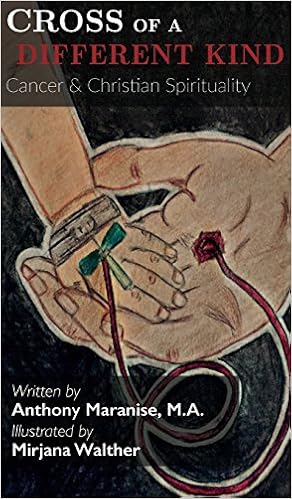
CANCER: with often abrupt and unwelcome entry into human lives as well as profound multi-dimensional impact, such an illness is, for many, considered to be a ruthless thief, intent on stealing not only joy, but life itself. Of course, even as cancer attempts to steal life and captivate those under its hold, lest we forget that as powerful an adversary as it may seem, it is no contestant against the power of the One who “has come to set the captives free” (Luke 4:18) and who is Life itself (John 14:6) and its Source.
Cross of a Different Kind: Cancer & Christian Spirituality draws upon the richness of Christian spiritual theology with the aim of rejuvenating hope within and imparting eternal Truth to all persons who have been “touched” by cancer in any of its wicked forms. Divided into three parts addressing those who have lost loved ones to cancer; those currently confronting their diagnoses; and survivors, this book serves as both a “spiritual field-guide” as well as an informative, yet practical helpmate to ensure all facing such adversities that they are never alone in their journey.



 LITERARY TITAN