Blog Archives
Inspired by my Love of Art and Music

Mallory O’Connor Author Interview
American River: Tributaries follows three immigrant families struggling to pursue their dreams during the turbulent 1960’s. What served as your inspiration while writing this book?
My love of Northern California, the place where I grew up, and the wonderful history of the area. I was also inspired by my love of art and music and my passion for social justice issues. Immigration and ethnic diversity are the cornerstones of the story.
This book has so many fascinating characters that are well developed. What were some themes you wanted to capture in your characters?
Basically, the story focuses on the creative search for meaning, knowledge, compassion and understanding in a tumultuous world filled with prejudice, obstacles, jealousy, and betrayal. As my characters encounter these obstacles, they discover their own strengths and weaknesses and grow beyond their self-centered ambitions.
I thoroughly enjoyed the historical backdrop to the story and how well researched it was. What historical milestones were important for you to highlight in this book?
The Gold Rush had a tremendous impact on the population and culture of California. Before the Gold Rush, the population consisted mainly of Native Californians and Californios (settlers and landowners of mixed Spanish, Native Californian, and African descent). But gold fever brought people to California from all over the country and the world. The Anglo Americans (of English, Irish, or Scots descent), other Europeans (including Italians, Russians, Greeks and East Europeans), Chinese, Japanese, African Americans, and many more who came and stayed. This changed the makeup of the state’s population making it one of the most ethnically diverse in the country. So, this cultural diversity sets the scene for later entanglements.
Most of the story takes place in the 1960s, that decade that Time Magazine recently termed “The decade that changed a generation.” So, I take the reader down memory lane as my characters encounter the major issues of the time: immigration, racial prejudice, migrant workers, gay rights, women’s rights and the Vietnam War.
This is book one in the American River Trilogy. What can readers expect in book two, American River: Currents?
In Book Two, American River: Currents, a cavalcade of disasters—both personal and public—threatens to overwhelm the scattered members of the McPhalan, Ashida, and Morales clans. Alliances fray, relationships dissolve, divisive secrets are revealed, and promises are broken as the members of three California families struggle to salvage their shattered dreams. The story follows the character’s journeys to places as distant as Cleveland, Ohio, Venice, Italy, and Kyoto, Japan. From the concert halls of Europe to the artist’s lofts of Manhattan, American River: Currents is filled with passionate and resolute characters who refuse to let go of their unique visions of success—even as life’s tumultuous currents threaten to sweep them all away.
Author Links: GoodReads | Facebook | Website
![American River: Tributaries: Book One of the American River Trilogy by [OâConnor, Mallory M.]](https://images-na.ssl-images-amazon.com/images/I/51o27VrET0L.jpg) In the mid-1800s, three immigrant familiesIrish, Japanese, and Mexicansettle along the American River in Northern California. A century later, only one family remains.
In the mid-1800s, three immigrant familiesIrish, Japanese, and Mexicansettle along the American River in Northern California. A century later, only one family remains.
Owen McPhalans Mockingbird Valley Ranch is still a thriving family business in 1959. But when his wife, Marian, leaves Mockingbird to follow her dream of becoming a successful artist, she ignites a firestorm that impacts the descendants of all three families. As artists, musicians, writers, and politicians inherit their immigrant parents hopes, they are torn apart by ambition, prejudice, and deception while struggling through the turbulent 1960s. From the concert halls of Europe to Kyotos ancient avenues, and Manhattans artists lofts to San Franciscos North Beach, they each learn the price they must pay in order to realize their dreams. But just as the river is drawn to the sea, they eventually find themselves pulled back to the place that forged the original link between their destiniesa place called Mockingbird.
American River: Tributaries follows three California families as the descendants of Irish, Japanese, and Mexican immigrants embark on unique journeys to pursue their dreams amid an unsettled 1960s world.

Revelations: The Colburn Curse


Natalie leads a life like no other woman. The man in her life is not her husband and her son is not her own. As a woman in the pre-Civil War days, she does as she is told, and her life is simply not her own. Her son, Matt, who she lovingly protects from the hatred and violence of his brother, the man in her life, is being raised with no idea of what true love is. As Natalie continues to serve Pete and put up with his endless brutality, she simultaneously succeeds in teaching Matt how to recognize his brother’s faults and steers him toward the life he deserves.
Catalina DuBois’s Revelations: The Colburn Curse contains rich tidbits of various genres, and they all seem to blend flawlessly into one breathtaking piece. With mystery being the underlying and ever-present element, DuBois’s book is laced with romance, historical fiction, and tantalizing snippets of fantasy.
As I read, I felt as if I were on an emotional roller coaster of the most bizarre kind. I desperately hated Pete from the moment he entered the picture. There was not a signal redeeming quality present in him, and I felt no qualms about despising the sight of his name. Then DuBois throws a monkey wrench into the equation– a complete game-changer. I was amazed at how swiftly the author was able to make me change my mind. Then, as quickly as she brought me to a new line of thinking, she reintroduces the Pete of old. DuBois is a master of the plot twist. I was two breaths away from an audible gasp when she had Natalie suddenly reveal her own revelation about Pete’s true identity. Who doesn’t yearn for a book that gives them that feeling?
I will admit that I had a difficult time in the early chapters seeing how the vast array of characters would fit together by the book’s end. DuBois, however, is more than adept at pulling together characters from settings that are seemingly unrelated. I might add, when she does, it is amazing.
The storyline centering about Ambassador Florian Lafayette and his sister, Embrasia, is the most engaging in the book. The two are, without a doubt, bent on living on the edge. Their antics would seem to lead them down a path of destruction, but a few chance meetings change the siblings and their wild ways like no amount of preaching could. I find their storyline to be filled with the most rapidly moving action.
Having read several other books by the author, I can say this one is, by far, my favorite. When you can finish a book and feel immediately like rereading it, you know you have found a keeper. DuBois is the queen of prologues. I never ceased to be amazed at her ability to pull me in within the first paragraphs. There is no one else out there penning romances with touches of fantasy based on historical fiction like Catalina DuBois.
Pages: 285 | ASIN: 1973233002
Barnes & Noble.com
Conservative Views 101 Plus
![Conservative Views 101 Plus by [Gall, Alex]](https://images-na.ssl-images-amazon.com/images/I/41OA9qKivRL.jpg)

Life is more difficult now than it was a few years ago. More and more people have to work multiple jobs just to stay above water. Utilities cost more than they used to and money is losing value. By the time one receives their salary, it’s already spent. With high trade deficits and national debts, people have much less purchasing power. What is happening now that was not happening before? How have we gotten to this point? What conversations do we need to have to change things? How can there be more employment opportunities? How can the citizens live to work as opposed to working to live?
Alex Gall has produced a well-written account of everything people should be saying but will not. The language used in the book is strong but not abrasive and drives the point home effectively and firmly. The authors passion and commitment to the subject matter is commendable and infectious. I consider myself to be an average citizen, I read the occasional hot headline. But this book made me look a little further, and a little deeper, and find something that was shocking and appealed to the citizen in me. This book is delivered from the point of view of a concerned citizen painting a picture, a person who is inviting others to a well thought out and open conversation.
I would appreciated more references of source material because, as stated previously, this book will leave you digging for more information and getting more involved in politics. Some statistics or studies to back up the subject matter would have been appreciated. This book is well researched and is laid out in an easy to follow manner in a compact and readily available format. At times I felt the content a bit dense, or maybe the topics overwhelming. I had to put the book down and think about what I just read. This book certainly causes one to reflect. But once you come out of your reflection, once you put the book down, you will come away with an overriding need to do something.
There are some sensitive topics covered but the author uses a neutral approach which is inviting. His approach to the subjects is completely ‘take it or leave it’. This is one of the best qualities of this book. The fact that the author lays out his position without dragging people with him. The intensity of the book and the truth in the subject matter will carry you effortlessly.
This book does a fantastic job of starting a serious and necessary conversation. This is necessary for anyone who wants to be an informed citizen.
Pages: 260 | ASIN: B079YP7LGM
The Complexity of the Crisis

Laura A. Zubulake Author Interview
Slay the Dragon follows Cesar as he rises from his working class roots to fight against the opioid crisis while navigating South American politics. What was the inspiration that made you want to write a book about this topic?
Years ago I enrolled in a creative writing class at New York University. The professor required us to write short papers about what protagonists and antagonists would do in various scenarios. For one assignment, I used a magazine article about drugs and corruption for inspiration. My professor graded my paper A+ and strongly encouraged that I develop this theme into a novel. I did and then for various reasons put the novel aside for many years. During the presidential election, I became aware of the extent of the opioid crisis. I was astonished and particularly concerned that this epidemic was hardly reported by the media. I realized that this crisis would work well into my existing novel and was a way to highlight the gravity of the issue to a wider audience. So, I spent the past year updating my manuscript. The result was SLAY THE DRAGON.
I felt like this book could have easily been non fiction. What kind of research did you undertake to ensure the story was as accurate as possible?
I enjoy reading novels that are somewhat based on fact. I find reading realistic fiction a casual way to learn about issues and locations. Combine realism with suspense and conspiracy and I am sold. As a writer, realistic fiction gives me the opportunity to loosely express experiences and issues while being creative. For SLAY THE DRAGON, I traveled to Latin America and observed. I visited several countries and cities, explored the countryside, walked the streets, and spent time with locals– all the while taking notes. I love destination novels and wanted my book to capture the essence of the location. Since I am an economist and worked on Wall Street, it seemed natural that my protagonist would be the finance minister and that much of his efforts entailed economic issues. I did little research for the economic side of the book. For weeks, I researched the opioid crisis– reading articles and medical surveys. I wanted to learn how, why, and who. I could not find a single article that addressed the complexity of the crisis. Most articles are biased toward one reason or another. However, there are many causes and many to blame. SLAY THE DRAGON attempts to encapsulate all the forces and entities that contributed to this tragic epidemic.
Cesar was an intriguing and well developed character. What were some themes you wanted to capture while writing his character?
César Rosada is the conscience of SLAY THE DRAGON. He is a decent man with good intentions who faces reality. The themes I attempted to capture through Cesar include: good vs. evil, doing the right thing, power and corruption, personal responsibility, self-reliance, how actions of a few affect us all, and why social ills exist.
What is the next book that you are working on and when will it be available?
My next novel will address themes expressed in SLAY THE DRAGON but will be set in the digital world.
Author Links: Website | GoodReads | Facebook
![SLAY THE DRAGON by [Zubulake, Laura]](https://images-na.ssl-images-amazon.com/images/I/51mk7b8v8zL.jpg) Slay the Dragon is a political suspense novel set in Latin America that explores how corruption and inefficiencies feed into social ills and how leaders exploit these conflicts to cling to power. César Rosada is on a crusade. Descended from generations of coffee farmers, the former professional athlete turned politician is determined to improve life for the working class of his country. As Minister of Finance, César is committed to righting decades of corruption, crime, and misguided economic policies, and defending progress made in the fight against the illegal drug trade. He anticipates resistance from those with money, power, and vested interests. However, he now confronts a burgeoning challenge—America’s opioid epidemic. This deadly crisis poses more than the usual conflict between law enforcement and organized crime. It is a complex and insidious challenge with pervasive and deep-rooted origins. César’s adversaries intent on maintaining the status quo conspire and threaten everything for which he has worked. The stakes are high—a reversion to the days when drug syndicates rule, politicians collude and profit, and the people remain hopelessly trapped in a cycle of poverty. César is conflicted, but must decide on a course of action. Weighing choices between what is perceived as right versus wrong, he pursues a path that for some is morally ambiguous.
Slay the Dragon is a political suspense novel set in Latin America that explores how corruption and inefficiencies feed into social ills and how leaders exploit these conflicts to cling to power. César Rosada is on a crusade. Descended from generations of coffee farmers, the former professional athlete turned politician is determined to improve life for the working class of his country. As Minister of Finance, César is committed to righting decades of corruption, crime, and misguided economic policies, and defending progress made in the fight against the illegal drug trade. He anticipates resistance from those with money, power, and vested interests. However, he now confronts a burgeoning challenge—America’s opioid epidemic. This deadly crisis poses more than the usual conflict between law enforcement and organized crime. It is a complex and insidious challenge with pervasive and deep-rooted origins. César’s adversaries intent on maintaining the status quo conspire and threaten everything for which he has worked. The stakes are high—a reversion to the days when drug syndicates rule, politicians collude and profit, and the people remain hopelessly trapped in a cycle of poverty. César is conflicted, but must decide on a course of action. Weighing choices between what is perceived as right versus wrong, he pursues a path that for some is morally ambiguous.
Slay the Dragon

Slay the Dragon is an action-packed mystery about a man named Cesar Rosada. He is descended from a line of coffee farmers, a former professional athlete and now a rising politician with a single goal; to help the working class of his country. He is determined to fight for the rights of his people but there is one crisis he can not see a way out of, the opioid addiction. Working as the minister of finance he will stop at nothing to fight against corruption. This leaves him with a choice that will test his own morality.
This book was written by author Laura A. Zubulake who worked for years on Wall Street and is a frequent world traveler. She has written non-fiction before, but Slay the Dragon is her debut fiction novel. The prologue got my attention from the very beginning and is an engaging start to an intriguing novel that hits on a subject that is destroying families and individuals in America. Slay the Dragon does a fantastic job of using fiction to understand a complex problem, and helps you visualize the enormity of the opioid crisis today. I enjoyed how the world unfolds slowly, detail by detail, we get to piece together a seedy world reminiscent of the show Narcos. César’s character development reminds me of George R.R. Martin’s characters. They are characters changed, dramatically, by circumstances out of their control, and they’re just trying to adapt.
This story is exciting, dangerous, thrilling, and full of adventure. Cesar is the kind of character you can’t help but root for with his pure ideals and determination to help those around him. When his actions enter a moral gray area you can empathize. How do you find such entrenched corruption? Zubulake has written a world that feels real in its gritty depictions of South American politics.
From beginning to end this book held my attention and kept me guessing. This is definitely the book for you if you like political thrillers that leave you thinking long after you’ve closed the book.
Pages: 289 | ASIN: B07BH2VMNQ
History Is Not Always Pretty

Ed Protzel Author Interview
Honor Among Outcasts continues the story of the Dark Horse inhabitants that joined the Union Army as soldiers in the Missouri State Militia Calvary. What direction did you want to take this book that was different from book one in the series?
In the first novel of my DarkHorse Trilogy, The Lies That Bind set in the antebellum South, I wanted to debunk many stereotypes and myths about blacks, whites, rich and poor, regarding slavery and gender. Southern literature is generally about powerful aristocrats who make fortunes, and often ignores the slaves who actually did the work or gives them little credit. So I created a situation where the protagonist, Durksen Hurst, a hustler/drifter, forms a secret partnership with a group of escaped slaves to build their own egalitarian plantation in the fictional hamlet of Turkle, Mississippi. But, rather than the white man, one of the slaves, Big Josh Tyler, who had run his former master’s plantation, is the natural leader of the group and is greatly responsible for their enterprise’s success. (Such was often the case, historically.)
Developing the novel into a trilogy allowed me to show the full historical arc and the resultant changes of the time period: from antebellum South/slave society (The Lies That Bind, book 1); to the Civil War years (Honor Among Outcasts, book 2); and end in post-war Reconstruction (Something in Madness, book 3). You see the arc.
Together, the three novels depict the historical developments and their effects on the men and women, black and white, of all social stations.
So to answer your question, in book 2, Honor Among Outcasts, the milieu, conflicts, plot, and themes all had to be completely different from book 1, as will those in the third.
I felt like you did a great job with the historical details and facts. What were some things that you felt had to be accurate and what were some things you took liberties with?
Although I am a big Civil War buff, I didn’t want to write a typical battle-type novel. Fortunately, the guerrilla war in western Missouri was like modern-day Syria, with terrible murders and depredations like the massacre and burning of Lawrence, Kansas, by Quantrill’s Confederate bushwhackers. In Missouri, combatants of both sides took scalps! I felt it important for the characters to face these major events in order to illuminate humanity’s potential for brutality and cruelty.
Also, in the spring of 1863, President Lincoln began to allow “colored” regiments to be formed, but these required a white officer to lead them. Naturally, having the DarkHorse partners form their own regiment was a nice parallel to their dreams of the democratic enterprise depicted in The Lies That Bind.
Throughout Honor Among Outcasts, I tried to remain faithful to the difficulties and unique dangers these regiments and the local populace actually faced. In rare cases, I had to move minor events around to aid the narrative. For example, a train raid massacre like the one in Honor did take place, but at a later date and at a different location. Nevertheless, in writing book 2, the actual history did very much shape the story.
The characters were very well developed in this story, which led to some heartbreaking scenes when some characters met their end. What was your decision process like in deciding who stays and who goes?
Heightened emotions give your themes greater impact. I hated to kill off some of the characters I’d become attached to, but in doing so, the reader is able to feel the senseless terror and cruelty of the time, which required more than the characters merely observing the conflict.
For example, wise Big Josh is the backbone of the DarkHorse partnership, despite the many loses in his past that he carries in his heart. So when his mate, Ceeba, found late in life, is one of the three women killed in the train massacre, the poignancy of the event is increased. Plus, Josh’s emotional state throughout the rest of the novel is deepened. Similarly, in the Lawrence massacre a relatively unarmed colored regiment training there actually was massacred. How could I ignore that in my novel? And with the loss of a favorite DarkHorse character during the Lawrence raid, I hoped to bring out the horror of that event. (I, myself, had to recover after writing that wrenching scene.)
Where will book three in the Dark Horse Trilogy take readers and when will it be available?
In the final novel, Something in Madness, at war’s end the surviving characters return to Mississippi, only to confront new indignities restricting the rights of freedmen in the South.
Researching the Black Codes, lynchings, and other humiliations perpetrated on blacks during Reconstruction made writing book 3 tough, and I expect it will be tough on the reader, as well.
History is not always pretty. I only hope the DarkHorse Trilogy does its part to see that such cruelty and hatred doesn’t re-occur. Something in Madness is planned for release in 2019.
Author Links: GoodReads | Twitter | Facebook | Website
![Honor Among Outcasts (DarkHorse Trilogy Book 2) by [Protzel, Ed]](https://images-na.ssl-images-amazon.com/images/I/61bPtY8HKRL.jpg) After their harrowing escape from Mississippi, abolitionist Durksen Hurst, his fiancée Antoinette DuVallier, and their friends — a group of undocumented slaves — land in guerrilla-infested Civil War Missouri, the most savage whirlwind of destruction, cruelty, and death in American history. Trapped in a terrifying cycle of murder and revenge, scarred by Quantrill’s cold-blooded Lawrence massacre and the Union army’s ruthless Order Eleven, Durk and everyone he cares for soon find themselves entangled in a struggle for their very survival.
After their harrowing escape from Mississippi, abolitionist Durksen Hurst, his fiancée Antoinette DuVallier, and their friends — a group of undocumented slaves — land in guerrilla-infested Civil War Missouri, the most savage whirlwind of destruction, cruelty, and death in American history. Trapped in a terrifying cycle of murder and revenge, scarred by Quantrill’s cold-blooded Lawrence massacre and the Union army’s ruthless Order Eleven, Durk and everyone he cares for soon find themselves entangled in a struggle for their very survival.
Honor Among Outcasts takes readers on a pulse-pounding journey of desperate men and women caught up in the merciless forces of hatred and fear that tear worlds apart, and the healing power of friendship to bring them together.
Allegories of Biblical Narratives

Arnold Holtzman Author Interview
The End of Days follows the tragic story of Avrum as he spends his young life making his way to America to build a life for himself and hoping to reunite with his brother. What was the inspiration for the setup to this emotional novel?
TO THE END OF DAYS can best be understood when the characters and episodes are visualized as allegories of biblical narratives. The saga begins with the covenant between God and Abraham (through his mother). That covenant is in effect a prophesy that foretells of the forced separation between the brothers (the separation between the tribe of Judah and the “lost”, or dispersed tribes of Israel – and their eventual reunification.
Avrum and his brother share a tight bond with one another that I truly appreciated. What were some themes that guided you when creating their relationship?
Ianuk, the giant lumberman at the start of the story is the Pharoah of biblical Egypt who held Avraham (the Hebrews) for those years in slavery. The Hebrews then cross the Red Sea to the land of Can’nan (here the water crossed is the Atlantic – and America is the “promised” land). Bella reflects the infamous Golden Calf, Fanny represents the extremely fanatic biblical clerics obsessed with purity (the Essens) – those responsible for the destruction of the temple and the loss of Jerusalem. “The Doctor” (among the woodsman) and “Strulevitch” in Montreal represent Sodom and Gomorrah. Israel’s prophets are represented in Kapitolnik. Avram’s battle with the street gang that so violated Fanny reflects the wars of Israel against those who had so violated the Holy Land and Jerusalem and successfully redeemed it – bonding with an evolved Fanny. The reunion at that time between Avrum and his brother reflects the reunion between all the tribes of Israel in the rebirth of the land (the ingathering of the exiles)
I felt myself immersed in the sights and sounds of early 1900’s America. What kind of research did you do to ensure you maintained accuracy?
I am 80 years old born in Montreal to parents who reached Montreal in the 20″s. No research was necessary.
What is the next book that you are working on and when will it be available?
There are 2 other books I would like to share with you: Dead-End Sex – 42 accounts from the 42 years of my clinical work as a psychologist. These introduce serious problems with intimacy and failures in relationships, and explaining their core failures. Neurotic Children as Adults: a book as much for people who suffer their lives going nowhere as for truly caring mothers of young infants.
Author Links: GoodReads | Amazon
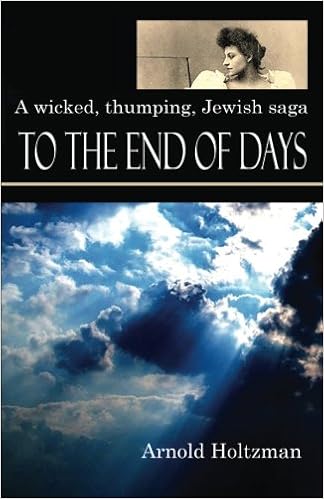 To the End of Days is a pulsing theater rich with allegories of Old Testament narratives. This is the story of a heritage delivered by a mother to her very young sons in the last hours of her life. It is a heritage which man could not modify, time could not temper, and the expanse of oceans could not distance from their lives. This is a book of secrets. The steamy alchemy of will, fate, and destiny deliver a kaleidoscope of everything human and inhuman in man. It is an epic saga charged with life and the thick rich of blood. where lawlessness and anarchy are the vehicles of timeless and inexorable laws of this universe. But all that was promised becomes delivered.



 LITERARY TITAN