Blog Archives
If You’re Laughing, You’re Listening

The Apprentice’s Bankruptcy is a political satire that uses a fictionalized caricature of Donald Trump to explore power, corruption, grievance, and the moral and democratic consequences of the Trump era. What draws you to write political satire?
I’m a novelist, academic writer, constitutional law scholar, and a civil rights (mainly First Amendment defense) attorney, so political satire just fits my skillset. Also, my favorite entertainment is short-form political satire like John Oliver, or what Matt Stone and Trey Parker have done in the last season of South Park, so I think it’s the best medium for calling attention to the ridiculous without calling normal people stupid or ignorant. If you’re laughing, you’re listening, and if you’re listening, you might be open to hearing the underlying message of the content.
As a lawyer, my job is to be persuasive, and yelling at people is never persuasive. Either way, we need a serious global reset, and that’s deadly serious. I want people to recognize that the loss of constitutional democracy is possibly the most catastrophic event in human history. I don’t think anyone wants a well-researched doomsday manifesto, so I tried to make the most serious of points in the funniest way possible.
How did you decide which real-world events and political figures to transform, exaggerate, or combine for the novel?
I’ve been watching Trumpism unfold for over a decade, and, to some extent, watching the progression of Trump the businessman since I was a little kid. There are hundreds of possible characters that could have been included, but I had to pick the ones that had the best angles to tell the story in the aggregate.
The book is almost like an anthology because it’s told from so many perspectives in individual chapters that focus on brand new characters, so the book would be a mess if it were just random Trump-like characters just spouting off. The book is structured like World War Z. There are admittedly too many characters, but their setups were actually pretty easy because they’re parodies/satires of well-known individuals, but the choice of who to use was dictated wholly by who would allow me to actually tell an Animal Farm-type story of the whole Trump period.
Your treatment of January 6 shifts the focus from one political leader to the broader forces that made the event possible. What did you want readers to consider about that moment?
The real January 6th event was a populous uprising based on disillusionment. The reimagined January 6th event is a populous uprising based on disillusionment. The pain normal Americans feel about their present circumstances are the same motivating factors, but both versions ultimately result in further tyranny.
Constitutional democracy is the guardrail that keeps either side from getting everything they want, but provides everyone sufficient opportunities and security to live their lives, seek their fortunes, participate in the political process, and enjoy their civil liberties. I.e., political extremism of any stripe leads us back to chaos and the subsequent loss of freedom and liberty.
What do you hope readers understand about the relationship between power, grievance, and the desire to “win” at any cost?
Publius is the pseudonym that Alexander Hamilton, John Jay, and James Madison used when they wrote the Federalist Papers. Federalist No. 10 warns of factions, and Fedearals No. 51 warns of tyrannies of the majority. Absolute power, the inability to address grievances, and a win-at-any-cost mentality are incompatible with the free-market liberalism of Enlightenment philosophers, and the separation of powers and checks and balances that made American democracy what it is. There’s never been a nation with that secret sauce, and it’s what put the United States on top, and what has maintained its position since WW II.
Devolving into the authoritarian aspirations of a Trump strongman-type government ensures we will lose the future. I like being on top. I like America being the place that everyone else aspires to be. That can’t happen with the current trajectory. The current trajectory ensures we will be less innovative, less powerful, less influential, and less culturally relevant. For all it’s messiness, I love America, and I want us to remain on top. That can’t happen in an authoritarian echo chamber, and once the secret sauce is gone, we cease to be exceptional.
Author Links: GoodReads
Daniel Thorp bankrupts everything he touches — car dealerships, marriages, casinos, the truth. So when a failed salesman turned reality-TV strongman rises to become America’s self-declared “president for life,” the only real question is how long a nation can run on borrowed principle before the bill comes due.
Told as an apologue — a savage, uproarious moral fable — The Apprentice’s Bankruptcy reimagines a democracy’s slow-motion collapse through a cast of unforgettable grotesques: the conscience-free fixer who builds the throne, the pundits who mistake ratings for journalism, the loyalists who go along until there’s nothing left of them to lose. It is crude, it is fearless, and beneath the laughter it is deadly serious.
Fans of 1984, Network, and A Modest Proposal will recognize the lineage — political satire with prestige-TV bones and a scalpel where its heart should be. By turns filthy, hilarious, and genuinely frightening, it builds to an uprising, a reckoning, and a final match no tyrant has ever won: because you can’t beat Death at checkers.
Dedicated “to the American people,” Publius doesn’t want to comfort you. Publius wants to wake you up.
“I’m Publius, and now so are you.”
The Apprentice’s Bankruptcy: An Apologue


The Apprentice’s Bankruptcy, by Publius, is a sprawling political satire that casts the Trump era as an American morality tale about power, grievance, corruption, and democratic decline. Calling the book “An Apologue” is fitting because its exaggerated characters and deliberately distorted events serve a larger argument about political culture. At the center is Daniel Jim Thorp, a grotesque caricature of Donald Trump whose financial failures, appetite for attention, and hunger for authority become inseparable from the political movement surrounding him. The book establishes its governing metaphor almost immediately when Daniel declares, “Bankruptcy is power; winning is everything. No debts are ever paid, no recompense, no responsibilities.” Financial bankruptcy becomes only the first layer of the idea. Across the novel, Publius broadens it into moral, institutional, and civic bankruptcy.
The novel unfolds through thirty-two chapters that combine biography, parody, political history, character sketches, and cultural allusion. The story builds an ensemble of politicians, lawyers, media figures, family members, opportunists, and followers whose stories show how a political system can deform through ambition, fear, prejudice, vanity, and self-interest. Rawl Cline is especially important as Daniel’s mentor and ideological enabler, while later chapters widen the book’s attention to television punditry, immigration policy, political violence, racial resentment, government appointments, and the transformation of a political movement into something larger than its original leader. The constant references to films, television, music, literature, and advertising give the book the quality of a dark pop-culture collage. Its chapter titles reinforce that approach, repeatedly borrowing familiar cultural language and repurposing it as political commentary.
Publius writes in a deliberately abrasive comic register, using obscenity, sexual grotesquerie, caricature, and absurd escalation as central parts of the satire. The method is excessive by design. Characters speak with inflated confidence while exposing their own stupidity, cruelty, or hypocrisy, and the narration frequently moves from a joke into a sustained argument about law, race, media, class, or authoritarianism. That combination gives the book an unusual texture: part comic novel, part polemic, and part warning. The sheer density of commentary can make individual chapters feel more like satirical essays or extended sketches than pieces of a conventional plot, but that structure also allows Publius to attack the political ecosystem surrounding Daniel from many directions. The recurring jokes, insults, and deliberately outrageous scenarios create a world in which the absurd gradually becomes normal, which is central to the book’s view of how democratic standards erode.
The final chapters bring the book’s themes together by shifting attention from Daniel himself to the political forces capable of surviving him. January 6 is reimagined as a moment in which former supporters turn against their leader without abandoning the authoritarian impulses that helped create him, and Ricky Spanish emerges as an example of how the movement can reproduce itself through new personalities. Daniel’s eventual encounter with Death closes his personal story with the same selfishness and transactional thinking that defined his life, while the afterword states the book’s political purpose directly: “Democracies are about not always getting your way.” The Apprentice’s Bankruptcy is ultimately a furious, profane, and highly referential satire about the fragility of constitutional democracy. Its central achievement is turning bankruptcy into a political metaphor for a society that repeatedly spends down its principles for the temporary rewards of power, belonging, and victory.
Pages: 251 | ASIN : B0HCK5YTKF

Corruption


In Gerard Hogan’s compelling crime fiction novel Corruption, moral ambiguity and the allure of power are explored rivetingly. In the murky depths of a world veiled in shadows, lawyer Patrick O’Leary emerges as a formidable figure adept at navigating the intricate webs of deceit and manipulation surrounding him. Intrigued by the elusive promises of success and survival, O’Leary finds himself entangled in a web of illicit dealings, grappling with the ever-present question of his own moral compass.
Hogan masterfully delves into the complexities of human nature, skillfully portraying O’Leary’s internal conflict as he confronts the dichotomy between ambition and conscience. While the novel adeptly portrays O’Leary’s internal struggles, it occasionally presents opportunities to enhance its momentum by introducing a more compelling overarching objective. Hogan’s insightful examination of power dynamics enriches the narrative, offering readers a deeper understanding of how corruption manifests in intricate ways. As readers follow O’Leary’s journey, they are encouraged to reflect on their moral beliefs and sense of accountability. This leads to a captivating exploration of human nature and the pursuit of redemption. While the novel unquestionably excels in exploring complex themes and creating well-rounded characters, a few readers might perceive the resolution as slightly forced, potentially missing the organic development showcased earlier in the plot. Nonetheless, the overall journey offers a profoundly engaging and thought-provoking experience.
In Corruption, Hogan delivers a thought-provoking narrative that captivates readers with its exploration of morality, corruption, and the complexities of human behavior. Engaging and insightful, this novel invites readers to ponder the depths of the human psyche and the eternal struggle between power and conscience.
Pages: 185 | ASIN : B09BTGCJ89

Shared Sorrows
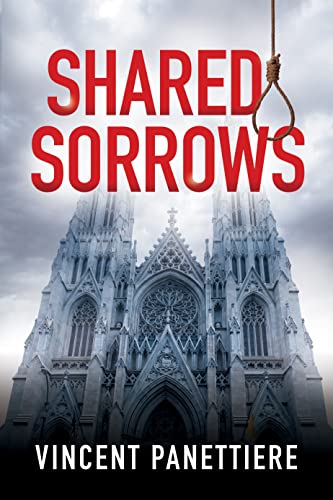

Shared Sorrows by Vincent Panettiere is an intriguing murder mystery that follows Frank DioGuardia. On the surface Frank has everything going for him. He may not be at the top of his field but as a college professor one could say he is doing well for himself. Back home he has three loving children and a wife of thirty years. Yet Frank is not a happy man. He is haunted by the loss of his father, a seemingly average Joe who passed away at the age of 61. Ever since his father’s passing Frank has had one goal in life, to outlive his father. We find him as this grim milestone rapidly approaches. Frank has become increasingly bored of his same old daily routine as his fixation with outliving his father has grown. Everything escalates at the annual Columbus parade. Frank finally snaps and gets himself involved in a scuffle. At his age this earns him a one-way ticket to the hospital. From here his life is changed forever. Frank meets Laurie, a doctor with an equally dark past. She also lost her father at an early age. We follow him as he deals with the aftermath of his actions and is dragged into the public eye by the ever-present media machine and as he uncovers scandals and corruption.
Author Vincent Panettiere’s character creation is a breath of fresh air, especially with the creation of Frank’s character. Frank can be a little curmudgeonly and blunt. He thinks nothing of telling reporters what he really thinks of them. Yet Frank also has a dry, wry wit that often put a smile on my face. He is also a loyal, loving father who always follows his own moral compass, an easy man to root for. If anything, Frank is almost a little too relatable. Anyone who has ever felt stuck in a rut is likely to empathize with him. Likewise, anyone who has been unlucky enough to lose a loved one at a tender age is also likely to recognize some of Frank’s survivors’ guilt in themselves. The fledgling partnership between Frank and Laurie stops the book from becoming too heavy. You will be rooting for them all the way as they take their combined pain and use it to take down corruption.
Shared Sorrows by Vincent Panettiere is gripping and unforgettable. The character of Frank is emotionally charged and drives the plot forward. Readers will find the character studies of Frank and Laurie thought-provoking. Following Frank as he is forced to adapt to scenarios increasingly out of his comfort zone is thrilling and inspired. Readers who enjoy suspenseful drama will not want to put this book down.
Pages: 200 | ASIN : B09JPGW5G1

Missing: A Finn Delaney New York City Mystery
![Missing: A Finn Delaney New York City Mystery Book 1 by [Bryan, Robert L.]](https://i0.wp.com/images-na.ssl-images-amazon.com/images/I/51oQnIzy5uL.jpg?resize=275%2C438&ssl=1)
Mystery readers who love New York: this book is for you. Missing: A Finn Delaney New York City Mystery introduces 25-year-old Finn, a fifth-generation police officer from a family that reveres the NYPD. When an unlucky accident ends his NYPD career, Finn becomes the next best thing: a Private Eye. Finn’s new career is off to a rocky start, complete with threadbare office and octogenarian assistant. Luckily, Finn quickly moves beyond the so-called “cavalcade of crazies” and stumbles into his first serious case. Follow Finn as he searches for a missing person who NYPD claims is not missing at all.
In Missing, Robert L. Bryan explores duty, loyalty, and friendship. He also plumbs the depths of vice that simmer in the city: corruption, greed, and crime. Bryan hits his storytelling stride as the details of the case unfurl. The plot moves quickly with confounding clues, hints of danger, and a parade of compelling characters.
Bryan has a knack for provocative characters. Finn’s apparent lack of self-determination can be frustrating—he seemingly rode a conveyer belt from booties to NYPD blues—but he develops into a likable main character. Early client stories, like the time Finn tailed a cat, are charming but lose something in bullet point format. The reader groans when Finn’s most pressing professional dilemma involves a desk chair and cheers when he finally lands a case.
Still, Finn is inscrutable. Other characters respond to him with generosity and affection when he shows none. I think the women in Finn’s world would benefit from added nuance; they are often one-dimensional. Finn’s father is a bright spot: unwavering in his support and helpful when Finn needs it most. We should all be so lucky.
Fans of the boroughs will enjoy devoted descriptions of Queen’s minutiae. Every intersection is noted, every landmark observed. Do I see a Finn Delaney walking tour of Queens in my future? Yes, please.
The book doubles back at times with Finn uncovering clues already revealed; in one notable situation, Finn hits upon the lynchpin of the case twice in seven pages. The book is lightly sprinkled with errors in grammar and punctuation. Despite these minor distractions, Missing is a satisfying mystery and a good read.
Pages: 197 | ASIN: B07L9DBXDN

The Truth Won’t Help Them Now – Trailer
It is 1939 when the bullet-riddled body of an accounting clerk from a gambling ship washes up under the Santa Monica pier. As city homicide detectives tenaciously chase down their only clue—a fast, expensive, and very exclusive Bugatti—their investigation leads them into a tangle of competing gangsters all looking to muscle their way to a bigger share of illegal gambling.
Meanwhile, Los Angeles County deputy district attorney Cliff Thoms is leading a special squad searching for a pair of serial killers who have already killed four young women and are on the hunt for more. Thoms, with the help of a self-proclaimed psychic he doesn’t quite trust, risks lives and careers in a desperate gamble to catch his elusive quarry. As the two investigations collide and rush to a deadly conclusion, dirty cops, DAs on the take, mobsters, grieving families, and reformer politicians must attempt to distinguish lies from the truth. Unfortunately, they are all about to discover that even the truth won’t help them now.
In this fast-paced tale of murder and gangland intrigue, a gritty district attorney and a band of detectives set out on a quest to solve two separate crimes amid a corrupted 1939 Los Angeles.
Mortgaged Goods
![Mortgaged Goods by [Cobcroft, Lorraine]](https://i0.wp.com/images-na.ssl-images-amazon.com/images/I/51lyObV%2BEgL.jpg?resize=274%2C389&ssl=1)
What is the meaning of success; titles, money, family, happiness? These are the questions Nata and Karl must face as their life makes dramatic changes from their carefully planned out future. Nata is fostered by working class parents Joe & Hetty, Karl comes from the upper-class elite. Nata’s biological father was abusive to both her and her mother, leading her to fear men, and especially any and all sexual contact. Despite her reservations Karl works his way into her heart and they marry with the intent of living full professional lives that does not include a family. Nata however finds out she is pregnant and together they must figure out how to adjust their life goals and ambitions to this new situation. While battling with his ideals about his personal life, Karl must make some choices about his professional career as a lawyer. Knowing what is right and knowing what you can make a difference with are gray areas when you’re a lawyer dealing with the upper-class elite.
On the surface this book starts off with the story of two people from different worlds coming together to make their relationship work through unplanned events, pregnancy. As the story deepens you see beyond the surface struggles or plans changing, you see the deep wounds that childhood sexual abuse brings; you see the residual effects of emotional abuse and withholding of love and support to a child. It changes the world view, it changes what is important in life. Nata and Karl could be anyone you encounter in the professional world. They are focused on their goals but when life turns things upside down, their struggles to connect and find a path forward are relatable. Unplanned pregnancy, changing life goals of prestige or happy home life, can they all be merged? Karl’s professional life is also dealt a staggering blow. He knows the difference between right and wrong but knows fighting against what is wrong in this case is career suicide. He takes the safe way out to save his career, but it nags at him. He continues to try and find balance between right and wrong.
While Karl is trying to find his way, Nata is trying to make peace with her past and the demons that follow her. It is a realistic view into how sexual abuse continues to hurt people well into adult lives and impact their life decisions. When her baby is born early due to a car accident she is thrust into even more challenging emotions, a premature birth, a child that will have lifelong medical needs, a husband that can’t come to terms with a non-perfect child. Lorraine Cobcroft’s ability to tap into those emotions and the mindset of a new mother experiencing them is profound. So often these things are glossed over for other more comfortable plot lines, however Mortgaged Goods puts these deep emotions and controversial topics right into the forefront of the novel, making them key points.
While the novel starts out looking like it will be a ‘lawyer takes on the corrupt upper tiers of society’ type novel, this book is so much more. Mortgaged Goods by Lorraine Cobcroft tackles deep emotional issues, sexual abuse, sexual exploitation, corruption of society, to include law enforcement, judges, and politicians. Through it all though, it is a novel about making a relationship work though the hard times, finding out what is truly important in life, and making the best of what life hands you, even when that is not what you have carefully laid out in your life plans.
Pages: 278 | ASIN: B018ZVWE5O
How Corruption Evolved

Joe Khamisi Author Interview
Looters and Grabbers, 54 Years of Corruption and Plunder by the Elite is a detailed account of the many corruption cases throughout Kenya. Why was this an important book for you to write?
It was important for me to write this book to show Kenyans and non-Kenyans how corruption evolved from the day Kenya attained independence in 1963 to 2017, a period of 54 years stretching through four regimes. What this book shows is that corruption and bribery have a long history that goes back well before independence when the country was under British rule. The African rulers, beginning with Jomo Kenyatta, institutionalized it by engaging directly in criminal acts. They grabbed land left behind by the British instead of distributing it to the landless, encouraged relatives and cronies to engage in outright theft of other resources, and created cartels that were immune to prosecution due to their close association with the elite and the ruling class.
What do you think is a common misconception people have about corruption in Kenya?
The common misconception people have is that corruption is a state-sponsored malfeasance that ensures impunity for those in power. There is a saying that a common chicken thief is punished more severely than a person in power who commits a more heinous crime involving billions of dollars. And because corruption and bribery are rampant among the elite, the ordinary folk see no evil in participating in similar criminal acts. Thus, a policeman would do everything to extract bribes from passing motorists, and government clerks will hide files to entice payment, commonly known as “chai” or tea. One recent headline in Kenya said it all that everyone in Kenya is corrupt including grandmothers. And I agree.
The book details contemporary corruption as well and doesn’t leave one feeling as if things will get better. Do you see positive change happening for Kenya with it’s current government or is there many changes that still need to happen?
Like all previous governments, the present regime of Uhuru Kenyatta has made a myriad promises about nailing corruption. In his first 5-year term in office, not more than five government officials were jailed and those were junior officers in the civil service. The big “fish” including those in Uhuru’s own Cabinet and executive office are free despite involvement in mega corruption scandals. In recent weeks, and immediately after the release of my book, Uhuru announced some sweeping measures intended to tackle corruption including what has come to be known as “lifestyle audits” on officers – starting with himself – and changes in the way government tenders are advertised and awarded. It is too early to judge whether these measures would indeed be implemented and those found to have obtained properties illegally jailed. My own view is that that was just a PR stunt to silence corruption critics.
What do you hope readers take away from your book?
So far, the book has been positively welcomed by the majority of Kenyans who have read it. They say it was timely and informative on the genesis of corruption and on contemporary events. The irony, however, is that some “corrupt” individuals “looted” the book pdf file and began selling the file to a huge group of Whatsapp members in what was a clear violation of copyright. The action was severely criticized by writers who demanded that the looters compensate the author. A few did but that is as far as corruption has reached in Kenya.
Author Links: Website | Instagram | LinkedIn | Facebook | Twitter
![Kenya: Looters and Grabbers: 54 Years of Corruption and Plunder by the Elite, 1963-2017 by [Khamisi, Joe]](https://i0.wp.com/images-na.ssl-images-amazon.com/images/I/51v-dLSWdGL.jpg?w=604&ssl=1) This book is about unbridled corruption, bribery and scandalous financial skullduggery in one of Africa’s most promising countries, Kenya. It is a narrative of money-laundering, mega scandals, and international wheeler-dealing, and describes how Mafia-like lobbyists have been devouring the country’s resources with blatant impunity over four regimes since independence in 1963. It is an important resource for historians, students, researchers, social and political scientists, non-governmental organizations, development and anti-corruption agencies.
This book is about unbridled corruption, bribery and scandalous financial skullduggery in one of Africa’s most promising countries, Kenya. It is a narrative of money-laundering, mega scandals, and international wheeler-dealing, and describes how Mafia-like lobbyists have been devouring the country’s resources with blatant impunity over four regimes since independence in 1963. It is an important resource for historians, students, researchers, social and political scientists, non-governmental organizations, development and anti-corruption agencies.


