Blog Archives
The Dark Age Chronicles – Trailer
In 1717 it was a time of darkness,where stations kept to their own and people struggled to survive. A time where pirates still roamed the seas, slavery was suffered and ignorance reigned supreme. But there is coming a greater darkness that man can’t hope to fight A darkness that will consume every soul on earth. One young girl named Eve, born with a mark on her hand, outcast and abused, learns that she is the chosen one that must stop the rising evil. The last of a known race who protected the world, she must fight a horde of demonic hell hounds, demons, and her worst fears. Together with six others, she must learn to use powers she never knew she had if she ever hopes to defeat Nyx…. the most powerful Necromancer ever born.

Cottonblood – Trailer
This saga begins amid the wealth of Southern plantation owners and Northern investors. By identifying the equities gained, greater concerns began to rise among the nation’s abolitionists. As a consequence, regional politicians began moving the citizenry into opposing camps.
COTTONBLOOD tracks the lives of two adolescent murderers: The first, a mixed-breed Canadian entering American waters as a deckhand aboard a French freighter. The second, a youngster captured from Sierra Leone to a foreign land where a strange language is spoken. Although the two men never meet, their journeys lattice one another as each search for some form of security. When false hope leads one into an unsolicited life of labor, the other haphazardly finds a future of opulence.
The plot traces their lives, and relations, through generations of survival leading the inheritors into the first year of America’s horrendous Civil War.
Intrigue and Chaos

Juliann Troi Author Interview
The Dragon of Hidden Treasures follows Kathryn and Ty through the perils of 1900’s China as they seek their dream. What was the inspiration for the setup to this intriguing novel?
I’ve been a student of Chinese history for more than thirty years, though my interest was mainly ancient China. One night in 1996 I had a fantastic dream about a foreign woman captured by a warlord. It was just a thread and probably inspired by something I’d read in passing, but it stuck. I wasn’t really a writer then and certainly not interested in Republican Era China (1911-1949) but I just couldn’t forget the dream. I started focusing my studies on the period and got totally sucked in. There was so much intrigue and chaos during that time, I had no trouble taking that thread of a dream and turning it into a thrilling series full of twists and turns, some based on actual historical events.
Kathryn is a unique character that I enjoyed watching develop through the story. What were some ideas you wanted to capture in her character?
There wasn’t just upheaval in China during the 1920’s. The whole world was changing. In Kathryn, I saw a chance to show the evolution of women: from having no rights, no voice or even choices, to challenging the established system on every level with the hope of changing things for the better. There were women like Kathryn then, courageous pioneers who dared to dream big and rise above their lot in life. They laid the foundation for the rights and freedom today’s women enjoy.
I felt like this was a story about empowerment and pursuing your dreams. What were some themes you wanted to explore in this book?
I had two main themes in mind for this story: put aside prejudice and dare to strive for your dreams. Dreams are important. They give us hope, and without hope, we will literally shrivel up and die. For a variety of reasons, we can put ourselves in a box and be held prisoner by ‘can’t’ or ‘impossible’. It’s difficult and often painful, but I believe if you’re willing to work hard and make the necessary sacrifices, you can break out of the box and achieve your dreams.
What is the next book that you are working on and when will it be available?
I’m currently working on Sunrise In Kweilin, Book 2 of the ‘Hidden Treasures’ saga. It’s set to be released in February 2019.
Author Links: GoodReads | Facebook
![The Dragon of Hidden Treasures: Book 1 by [Troi, Juliann]](https://images-na.ssl-images-amazon.com/images/I/31XLuT2BurL._SY346_.jpg)
China, 1923: In an ancient land battling for its very existence, violence and chaos reign supreme. Amidst the devastating aftermath of a revolution that toppled the divine Imperial system and left the once glorious Empire torn and bleeding, ruthless warlords have claimed dominion. Political intrigue and betrayal are the only rulers now.
In the wrong place at the wrong time, Kathryn Kidwell is captured during an invasion of Canton by the warlord, Cheng Jiong. Recognizing the folly of allowing the only daughter of a powerful American trade lord to be cold-bloodedly murdered, Ty Wang must make an impossible choice: to save Kathryn will cost him his life, but to let her die could mean the death of his beloved homeland.
The Dragon of Hidden Treasures, Book 1 is the first chapter in the electrifying saga of Ty and Kathryn’s desperate struggle to stay alive and stop a war that would blow China to pieces. Bound together by a love as strong as it is forbidden, their efforts could ultimately change the fate of a nation…and destroy them both.
The Labyrinthine Journey
![The Labyrinthine Journey (Servant of the Gods Book 2) by [Cavallaro, Luciana]](https://images-na.ssl-images-amazon.com/images/I/51gZDxUtN5L.jpg)

Evan is a normal twenty-first century man who works as an architect. However, to interrupt his daily routine, none other than Zeus himself, has decided to transport Evan to the sixth century BCE. Evan now travels across ancient Greece with his companions, including Atlanteans, a high priestess, and his friend, Dexion, who has the power to see into the future. All of this is for a mighty cause, Evan has been chosen by Zeus to unite two powerful relics in order to save the Gods from extinction.
Stuck in the sixth century BCE Evan longs to return home. Given his precarious position between times, the juxtaposition of his wants against his reality serves to highlight the stark differences between the comfort of home that Evan is used to and what he is currently facing. For instance, walking across a sandy plain in sandals verses the want for a motorbike to make short work of the distance. His modern life’s influence over his worldview often leaves him homesick, but he must complete his mission. On the other hand, his life back home gives him ways to solve the problems he faces in the sixth century BCE, taking ideas from the pop-culture of his own time and bringing them into the past to aid his quest. This fusion of time periods makes for some brilliant innovations and cross-overs between what we as the reader understand to be ancient Greece, and the modern day.
The Labyrinthine Journey is book two in Luciana Cavallaro’s Servant of the Gods series and it follows on fluently with the events of the previous book with references here and there to book one. Something striking about the series is the relationship between mortals and Gods. With whole chapters dedicated to the musings of God’s and their society it gives the reader an insight into their intentions. Furthermore, the book proposes an alternative viewpoint on the beginnings of Christendom. The Greek Gods fear that they will lose their dominance in light of a God-sent child being born that will potentially lead to the widespread belief in a single God instead of the current pantheon.
This retelling of the birth of Christ from the God’s perspective explains why Zeus wants the relics united – to maintain his and the other Gods’ significance. However, there are some Gods trying to interfere with the mission and stop Evan’s and his companions’ journey. Evan searches ancient Greece, already in possession of the first relic, for the second to unite the two. The perilous journey over a treacherous landscape naturally reminds one of the epics of Homer.
The Labyrinthine Journey was a thoroughly enjoyable read. I give it five out of five for its sophisticated and inventive retelling of the well-known and widespread story of Christ and its ability to connect it to the overarching quest narrative seamlessly. Luciana Cavallaro’s prose fits the story perfectly, making the journey truly epic. Furthermore, the fusion of God’s, monsters, ancient philosophers, magical ancient relics and even time travel, leads to unexpected twists and turns throughout the novel.
Pages: 311 | ASIN: B075QGZQP9
Trillium
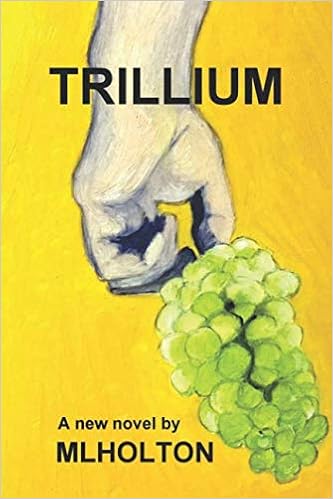

As the Niagara River flows into Lake Ontario, a young farm boy sits at the front of a boat as lookout, in the year 1758. A man from Sicily steps off a ship and finds himself in the bustling Hamilton Harbour as he looks for work, in the year 1835. Finally, a man from Dublin looking to make his fortune finds himself tossed out of a bar on Barton Street, in 1885. These are the seeds that Holton plants to begin the intricate intertwining of stories throughout the book. Trillium sees these three characters, with three vastly different backgrounds, struggle to make a home in Canada, and follows their legacies as their memory lives on through their descendents.
The book connects with the history, not only of Canada, but of the world. It draws upon various historic events, including both world wars, as its context. This grounds it in the real world and gives it a universal sense of what we all strive for in much the same way as the three families – a home. As generations pass, they seem to take a firmer grasp on the land they live on and become part of the history themselves. As such their progress fits well with the underlying rural theme that the chapters take, such as roots, growing vines, and the grape harvest. The book seems to create a family tree, which intertwines with the other family trees in the book, as they grow.
The reader is plunged into a world shaped by conquest. The characters in the book encounter wars, displacement and enterprise, all of which are constantly shaping the landscapes. Each character tries to find their place in this world of uncertainty. Throughout the generations, they all have a hope to find their way in a changing world and to settle down somewhere – to carve out their own patch of land to call their home.
Holton brings this world to life with poetic prose. As the book spans literally centuries, the passage of time is very clear in its writing. The natural setting is gorgeously described through the changing of the seasons, right down to the colors of the leaves. The natural Canadian landscape appears utopian when set in the foreground against the chaos of the world wars or the bustle of a city harbour or the noise of a railway being built. This contrast is eloquently drawn in the prose, especially when WWII hits the novel, where, though the characters have deep personal ties to the war, daily events in the book still transpire on a humble peach farm in Ontario.
I give this book a four out five for its awe-inspiring approach to the natural world and everyone’s place in it as we carve our path in the landscape through agriculture, enterprise, and even war. I cannot recommend this book enough. The stories connect beautifully and get to the heart of what it means to have a place to call home.
Pages: 340 | ASIN: 0992127289
Society Doesn’t Approve

Laura Hunter Author Interview
Beloved Mother follows the lives of several family members in a poor coal-mining town during the 1900’s. What was the inspiration for the setup to this intriguing novel?
I know these people. I grew up in a lower Appalachian coalmining area. My mother grew up in the Appalachians where coalmining was a way of life. I spent my summers there where soil was a black as the coal itself, where miners can’t wash the black rings from around their eyes. The livelihood of the community depends on what can be extracted from the earth’s belly. No coal=no food, no warmth, no clothing. An accident, a death, would turn a woman’s life into a catastrophe, as she tired simply to feed her children.
Three woman struggle to find their place in a harsh Appalachian mining town. What were some obstacles you felt were important to telling their story?
One of the primary obstacles women faced then, and for many today, is society’s failure to recognize that women must cope with whatever they have available. Often times, what they are relegated to do is not what society accepts. Society then shuns them, casts them aside, because they are different. The women in BELOVED MOTHER must choose. Mona must choose a way of life that will allow her to survive by using what she has been taught. Anna chooses to live her life for a lover, and Lily chooses to make her own way through what Nature offers her. Society doesn’t approve of any of their choices. As a result, all three find themselves isolated.
You explore many ideas in this novel like family, God, and humanity. What were some themes you wanted to capture while writing?
I didn’t think about themes as I wrote BELOVED MOTHER. The threads seemed to come together as the plot developed. This novel was gifted me. Once the characters and setting gelled, the action, dialogue, senses and plot – all the story elements – played out before me as if I were watching a movie. After I finished the preliminary plot, I did see that each of the women hold a different concept of family, even though they are biologically connected. I initially included the spirit world to emphasize the Cherokee legends, to justify the bizarre actions of Mona and to lighten the tone of what was happening to the earth people. As the spirits Sister Sun, Brother Moon and Great Spirit came into focus, I realized that they offer the differing beliefs of many people, not just mountain folk or Native Americans. As a result, the earth characters pull from the spirit world in order to establish their own philosophy. The beliefs are as different as the characters themselves. Some would argue that one belief is as valid as another.
God? God, or a supernatural power, is presented as a vengeful Old Testament being, a being that terrifies Anna as she realizes she is dying. As Great Spirit is known to Mona and Lily, this supreme being is sometimes tired, a forgetful character who gets overwhelmed by the actions of those on earth. Other times, he leaves people to survive their own actions. He also merges with the spiritual concept of a loving God for good, to help Lily survive the loses she must face. Then, too, Mona so distorts the concept of a superior being that she, or her talking weasel, convinces herself that she is more powerful than Great Spirit. In looking back, the reader might see these characters as prototypes of different ways of looking at a supreme being. I had no intention of writing such, but perhaps I did.
Humanity is depicted as humanity often shows itself to be: hurtful, manipulative, greedy, gentle, loving. One character who borders on being a narcissist comes forward to save the most vulnerable character in the novel. One character has no concept of the role of father and almost kills his son. One character, on the other hand, bribes his boss to insure that his son will have an education that will carry him out of the coalmines. Overall, the characters portray the different personalities that we encounter. We all are different. We all have different reasons for doing what we do. We make mistakes. We have successes. Like the characters in BELOVED MOTHER, we trod along, attempting to survive as best we can.
What is the next book that you are working on and when will it be available?
The working title of my current project is SUMMER OF NO RAIN. The manuscript is currently with Beta readers. I hope that it will be available late 2019. The story is based on actual events of the late 1960s near Montgomery, Alabama. A clinic for women of color used 1964 Civil Rights monies to establish a program that used sterilization experiments on illiterate and young girls of color. The case against the clinic went to the US Supreme Court in 1974.
In SUMMER OF NO RAIN, the characters, the setting, the events all are fiction. I researched what medicines and procedures were used to sterilize these young girls and let those events become part of a 12-year-old mulatto’s summer. The plot focuses on her socialization failures, her physical decline, and her eventual suicide attempt and the love her mother has for her.
Like BELOVED MOTHER, the tone is serious. It must be, for the procedures were brutal. The outcome was a farce as the reader will see, but I tried to lighten the mood by including events typical of children in 1968 in rural Alabama.
SUMMER OF NO RAIN depicts a grave injustice that many today know nothing about. Unlike when writing BELOVED MOTHER, I had a goal in creating this novella. That goal is to make people aware of the hidden evil man can perpetrate on his fellowman.
Author Links: Facebook | Twitter | GoodReads
 A story of the lives of three women, tightly woven together and surviving the harsh societal environment of an Appalachian mining town in the early to mid-1900s. Two religions contrast with each other—the Cherokee spirits of the native people and the Old Testament God of the white settlers—as each woman struggles to find her place. Love and hate, marriage and adultery, childbirth and abortion, all have their parts to play. Beloved Mother accurately portrays the evilness in humanity, in which the wicked corrupt the innocent to create a vicious cycle of abuse, until one person—with a heart of understanding and forgiveness—has the courage to end it.

Kaifeng Chronicles

Robert Campbell Author Interview
18 Cranes follows a young boy as he prepares for an important civil servant exam while being tormented by nightmares. What was the inspiration for the setup to this intriguing story?
The story was inspired by my own journey of learning about China, first through teaching Chinese students in Canada, and then through my eye-opening experience teaching and traveling in China.
Bing is an interesting character that continued to gain depth as the story progressed. What were some driving ideals behind his character?
Bing is a composite character, reflecting some the attitudes and behaviors I’ve observed in my Chinese students, but also embodying elements of historical and fictional persons I’ve read about.
This story takes place during the summer of 1630 in China. Why did you choose this time and place for your story?
The story takes place in the final years of the Ming dynasty, culminating in a monumental and highly consequential event that takes place in the city of Kaifeng in 1642. By starting in 1630, I’m building the necessary background for readers to understand the significance of the event when it takes place.
What is the next book that you are working on and when will it be available?
18 Cranes is the first in a series of nine novellas, collectively known as, Kaifeng Chronicles. The second book, Mandarin Ducks, has been available for the past few months. The third book, Grand Canal, is scheduled for release in late January 2019.
Author Links: Website | Twitter
![18 Cranes: Kaifeng Chronicles, Book One by [Campbell, Robert]](https://images-na.ssl-images-amazon.com/images/I/41yNsThvW0L.jpg) In the late summer of 1630, 23-year old Li Bing writes the provincial level imperial examinations, the first step towards entering the Chinese civil service. He is tormented by a dream of 18 cranes, and as he awaits his exam results he seeks out insights from those around him to help him understand his dream. In the end, he learns more than he imagined.
In the late summer of 1630, 23-year old Li Bing writes the provincial level imperial examinations, the first step towards entering the Chinese civil service. He is tormented by a dream of 18 cranes, and as he awaits his exam results he seeks out insights from those around him to help him understand his dream. In the end, he learns more than he imagined.
The Dragon of Hidden Treasures
![The Dragon of Hidden Treasures: Book 1 by [Troi, Juliann]](https://images-na.ssl-images-amazon.com/images/I/31XLuT2BurL.jpg)
Kathryn is faced with giving up her dream of being an independent professional woman and putting to use her education in her father’s company, and Ty is a man trapped in a job for the Chinese warlord, Cheng Jiong, wanting nothing more than to be with Kathryn. The ties that bind him, however, may be stronger than he thinks. When Kathryn is kidnapped and Ty finds himself part of the plot to use Kathryn’s position as leverage, Ty and Kathryn strike up an unusual alliance which leaves both of them in danger and both with more to lose than they could ever realize.
I do not know exactly what I expected as I began to read of Kathryn’s education and her father’s plan to marry her off to a man she did not know, but I know this much: Juliann Troi’s writing in The Dragon of Hidden Treasures Book 1 is simply beautiful. When an author writes so fluently in the language of imagery that it makes you forget where you are and who is around you, you know you have met the best of the best.
Kathryn is a force with which to be reckoned. She is beyond her time and is as cunning a character as I have seen in a while. Right out of the gate, Troi had me rooting for Kathryn to overpower her father with her obvious common sense and business savvy. She is a true testament to the fact that women have, for decades, been a force in business whether they were allowed to have their names attached to their work or not. She exemplifies every strong woman striving to be heard and seen in a man’s world.
The budding relationship between Kathryn and Ty is enviable. His love for her is clear from the first words he speaks of her. Though the “stalker-esque” behavior at the outset is a little unsettling, it plays well into the plot and is less of an issue when the reader sees their destiny play out. Again, Troi is an artful writer–plain and simple–making the most basic of actions flow beautifully across the page.
Revelations are an important part of Troi’s writing. As Kathryn and Ty’s story progresses, Kathryn is stunned by Ty’s admissions about his family. Without giving anything away, I can say that I was just as surprised as the key character. Ty has been down quite a harrowing road, and that experience lends itself well to Troi’s plot and is a vital part of the character development. Troi does not lay all her cards on the table and is a master at throwing the reader for the proverbial loop.
Juliann Troi’s historical fiction is an all too accurate portrayal of the struggle women have faced to be heard and to take part in the biggest decisions in business dealings throughout history. Interspersed throughout the romantic tones of the book are tidbits of China’s history peppered with glances into the horrors of war. I look forward to Book 2!
Pages: 584 | ASIN: B079XX8BZM



 LITERARY TITAN