Blog Archives
History Is Not Always Pretty

Ed Protzel Author Interview
Honor Among Outcasts continues the story of the Dark Horse inhabitants that joined the Union Army as soldiers in the Missouri State Militia Calvary. What direction did you want to take this book that was different from book one in the series?
In the first novel of my DarkHorse Trilogy, The Lies That Bind set in the antebellum South, I wanted to debunk many stereotypes and myths about blacks, whites, rich and poor, regarding slavery and gender. Southern literature is generally about powerful aristocrats who make fortunes, and often ignores the slaves who actually did the work or gives them little credit. So I created a situation where the protagonist, Durksen Hurst, a hustler/drifter, forms a secret partnership with a group of escaped slaves to build their own egalitarian plantation in the fictional hamlet of Turkle, Mississippi. But, rather than the white man, one of the slaves, Big Josh Tyler, who had run his former master’s plantation, is the natural leader of the group and is greatly responsible for their enterprise’s success. (Such was often the case, historically.)
Developing the novel into a trilogy allowed me to show the full historical arc and the resultant changes of the time period: from antebellum South/slave society (The Lies That Bind, book 1); to the Civil War years (Honor Among Outcasts, book 2); and end in post-war Reconstruction (Something in Madness, book 3). You see the arc.
Together, the three novels depict the historical developments and their effects on the men and women, black and white, of all social stations.
So to answer your question, in book 2, Honor Among Outcasts, the milieu, conflicts, plot, and themes all had to be completely different from book 1, as will those in the third.
I felt like you did a great job with the historical details and facts. What were some things that you felt had to be accurate and what were some things you took liberties with?
Although I am a big Civil War buff, I didn’t want to write a typical battle-type novel. Fortunately, the guerrilla war in western Missouri was like modern-day Syria, with terrible murders and depredations like the massacre and burning of Lawrence, Kansas, by Quantrill’s Confederate bushwhackers. In Missouri, combatants of both sides took scalps! I felt it important for the characters to face these major events in order to illuminate humanity’s potential for brutality and cruelty.
Also, in the spring of 1863, President Lincoln began to allow “colored” regiments to be formed, but these required a white officer to lead them. Naturally, having the DarkHorse partners form their own regiment was a nice parallel to their dreams of the democratic enterprise depicted in The Lies That Bind.
Throughout Honor Among Outcasts, I tried to remain faithful to the difficulties and unique dangers these regiments and the local populace actually faced. In rare cases, I had to move minor events around to aid the narrative. For example, a train raid massacre like the one in Honor did take place, but at a later date and at a different location. Nevertheless, in writing book 2, the actual history did very much shape the story.
The characters were very well developed in this story, which led to some heartbreaking scenes when some characters met their end. What was your decision process like in deciding who stays and who goes?
Heightened emotions give your themes greater impact. I hated to kill off some of the characters I’d become attached to, but in doing so, the reader is able to feel the senseless terror and cruelty of the time, which required more than the characters merely observing the conflict.
For example, wise Big Josh is the backbone of the DarkHorse partnership, despite the many loses in his past that he carries in his heart. So when his mate, Ceeba, found late in life, is one of the three women killed in the train massacre, the poignancy of the event is increased. Plus, Josh’s emotional state throughout the rest of the novel is deepened. Similarly, in the Lawrence massacre a relatively unarmed colored regiment training there actually was massacred. How could I ignore that in my novel? And with the loss of a favorite DarkHorse character during the Lawrence raid, I hoped to bring out the horror of that event. (I, myself, had to recover after writing that wrenching scene.)
Where will book three in the Dark Horse Trilogy take readers and when will it be available?
In the final novel, Something in Madness, at war’s end the surviving characters return to Mississippi, only to confront new indignities restricting the rights of freedmen in the South.
Researching the Black Codes, lynchings, and other humiliations perpetrated on blacks during Reconstruction made writing book 3 tough, and I expect it will be tough on the reader, as well.
History is not always pretty. I only hope the DarkHorse Trilogy does its part to see that such cruelty and hatred doesn’t re-occur. Something in Madness is planned for release in 2019.
Author Links: GoodReads | Twitter | Facebook | Website
![Honor Among Outcasts (DarkHorse Trilogy Book 2) by [Protzel, Ed]](https://images-na.ssl-images-amazon.com/images/I/61bPtY8HKRL.jpg) After their harrowing escape from Mississippi, abolitionist Durksen Hurst, his fiancée Antoinette DuVallier, and their friends — a group of undocumented slaves — land in guerrilla-infested Civil War Missouri, the most savage whirlwind of destruction, cruelty, and death in American history. Trapped in a terrifying cycle of murder and revenge, scarred by Quantrill’s cold-blooded Lawrence massacre and the Union army’s ruthless Order Eleven, Durk and everyone he cares for soon find themselves entangled in a struggle for their very survival.
After their harrowing escape from Mississippi, abolitionist Durksen Hurst, his fiancée Antoinette DuVallier, and their friends — a group of undocumented slaves — land in guerrilla-infested Civil War Missouri, the most savage whirlwind of destruction, cruelty, and death in American history. Trapped in a terrifying cycle of murder and revenge, scarred by Quantrill’s cold-blooded Lawrence massacre and the Union army’s ruthless Order Eleven, Durk and everyone he cares for soon find themselves entangled in a struggle for their very survival.
Honor Among Outcasts takes readers on a pulse-pounding journey of desperate men and women caught up in the merciless forces of hatred and fear that tear worlds apart, and the healing power of friendship to bring them together.

Looters and Grabbers, 54 Years of Corruption and Plunder by the Elite, 1963-2017


“While Kenyatta initiated corruption, and made it a pastime for well-placed government officials, Moi institutionalized it and made it routine within all ranks of society.”
Looters and Grabbers, 54 Years of Corruption and Plunder by the Elite by Joe Khamisi is a detailed account of the historical and contemporary corruption plaguing the African country of Kenya. It details corruption from the highest levels of government down to average citizens. Each chapter is dedicated to a specific theme of corruption spanning from 1963 to 2017 and encompassing four presidencies; Presidents Jomo Kenyatta, Daniel arap Moi, Mwai Kibaki, and Uhuru Kenyatta.
I started this book thinking there would be some kind of a silver lining at the end, but there isn’t one. What you’ll find is a detailed account of the pervasive corruption that is literally everywhere in Kenya. Time and time again it’s shown how corruption is despised by all but is undertaken at every opportunity. It seems that anti-corruption is the political rallying call, but profit is always the underlying goal.
This is a historical book in that it does describe the rise of four of Kenya’s presidents, Kenya’s independence from Britain, and the development of Kenya’s modern government, but it does all of this with a focus on corruption; from it’s inception into it’s many manifestations in every part of Kenya’s government. One thing that I learned is how corruption in Kenya is not a local affair, but a global enterprise. European, Asian, and Western countries have had their turn profiting from corruption in Kenya.
One thing I did enjoy was how we get to see the country develop, through stories of corruption, into modern times. We go from President Kenyatta who is the first president when Kenya receives its independence from Britain, to president Uhuru who its noted as having a large Twitter following. At one point even mentioning Paul Manafort and his company helping the Kenyan President resuscitate his global image.
This is a good book for those interested in history, African culture, political science students, and most of all corruption. If you’re interested in learning how corruption is instituted, contributed to, and perpetuated, then this book is a master class in delivering specific examples.
What concerned me the most after reading account after account was that, as the author states, these are the corruption cases that we know about, and have been documented or reported on by the media. I’m sure there are plenty more that we don’t know about.
This book is exceptionally researched with a wealth of references. Joe Khamisi has done a fantastic job turning a list of corruption cases into a linear narrative that is compelling and thought provoking.
ISBN-10: 9966192123
Treasure on the Southern Moor

Treasure on the Southern Moor is set in the eighteenth century, during the golden age of sail, and shows how gentlemen sailed the raging seas. Written by Joshua A. Reynolds, this historical fiction novel takes the faithful crew from Plymouth, to West Africa, and back to Plymouth, with only the guidance of an old map that was given to the captain by an old sea friend.
Back Description: The thrill of the sea – the song of the ocean winds – out sails and up anchor! – guided by the compass and stars – as a poet once said, “to the lonely sea and sky”. It is the eighteenth century, and the sailing vessel is the only way to travel the raging seas. The Southern Moor sets sails from England to Africa with a crew of forty-two persons, guided by a captain with his son and daughter, where those of the trusted crew hope to find treasure with only the guidance of a map an old friend of the captain’s had given him and a handful of the treasure itself, brought back from the African shoreline. With the smell of cooking from the galley, you may find them about on the weather decks reefing the sails or lashing down the ship’s boats, or listen to the captain play on his fipple flute with the accompaniment of the cello and violin. Hear the ocean waves lap against the bows, or have cataracts of sea water come flooding over the main deck in the midst of a raging storm.
In Plymouth, England, there are those few friends of the captain who wonder if he will ever return. Is the Southern Moor, newly finished vessel and never before tested in the ocean waters, strong enough to sail through storms and cannon fire to reach the warm lands of the African shoreline and make the same journey back? With all of its rectangular sails billowing in the wind, bowsprit brass tip of heather shining in the sunlight, and the polish of the wood shining without a fingerprint to be seen, the Southern Moor leaves the harbor of Sutton Pool to test itself in the ocean and plough the stormy seas. . .
Treasure on the Southern Moor is expected to be in print within two weeks’ time! Check out his website for purchases and updates.
Recommended for family reading. They were specially written for children but have something that all ages can enjoy.

Joshua A. Reynolds
Joshua A. Reynolds writes to restore Christian virtues and family values back into society. He is a member of the Orthodox Presbyterian Church and holds to the reformed faith of Christendom. Russell Kirk’s conservatism most closely aligns with his political views, and his desire is to redeem the innocence of the “permanent things” in literature. One of his main goals in storytelling is to allow the reader to understand better theology, history, and more wholesome ways of living in a simple imaginative way. Some of the authors that have inspired his imagination are C. S. Lewis, Edith Nesbit, Frances Burnett, Mary Dodge, Beatrix Potter, Kenneth Grahame, and Lewis Carroll.
To find out more about Joshua A. Reynolds, please visit his website at www.conservativecornerstones.wordpress.com.
It Arose in Dreams

Ruth Finnegan Author Interview
Black Inked Pearl follows Kate, a young Irish girl, as she searches for her lost lover. What was the initial idea behind this story and how did that transform as you were writing the novel?
It began in a dream when I was in New Zealand visiting my daughter and granddaughter who live there. This was, essentially, the first page (and chapter) of the novel when Kate, panicked and feeling she was too young for love runs away desperately as her best childhood friend (I never learn his name) tries for the first time, a teenager to kiss her. That scene, that act, is the foundation for the story as she years later discovers that she as frantically and desperately loves him as she had frantically fled from him years before
I say ‘dream’ as that is the nearest word I can get, vision perhaps they would have called in in the middle Ages. But that word’s a bit misleading. In two ways.
First, it wasn’t exactly a dream in the sense of being, asleep more an experience in that liminal in-between state of being neither awake nor asleep but somehow fully both – the whole novel came in that somehow enchanted enspelled state ( I suppose you might call it ‘inspiration’). I planned nothing, but it was still a chapter a night, written down effortlessly (I don’t even remember doing it! or, by now, what the words were. it surprises me every time – so many times – I reread the book now).
Second, ‘dream’ suggests something visual, But it was more a kind of very intense node of emotion, something very personal to me (in a metaphorical sort of way the whole book is kind of autobiographical – what serious novel is not? – and the second chapter about a small girl experiencing the magical world of Donegal – is directly so.
Then the novel – and Kate – just grew. I came to know the hero well, but wish that my ‘dreams’ had given me his name
Black Inked Pearl is told in a dreamlike, almost stream of consciousness, style of writing. Why did you want to tell the story in this style and what were the challenges?
Well, it arose in dreams and the writing essential came from, and took place in, my unconscious – at least that is the only way I can understand and it. So the style is scarcely surprising, it was little under my deliberate control and almost not at all revised later.
I didn’t know in what style I was writing – the process was almost unconscious – but when it was finished I saw (or rather heard when I read it aloud ih my inner ear as I always do with my writing)that it had the rhythms and sonorities of African and Irish story-telling (my mother was a wondrous story-binder) and that some literary giants (Joyce, Fulkner, Hopkins … many others) had written in similar styles. Poetry is mixed with prose – well in a way, as with its oral resonances (a subject on which I have written in academic contexts, in Oral Poetry for example), it is all poetry, some fully, some ore in a kind of blank verse: all unexpected by me!
Also, the content. Part of what I learned as the story revealed itself to me was that the division between dream and reality is an elusive and perhaps non–existent one.
Problems – well some of my readers have problems with it! Some object because they cannot abide what they see as ‘incorrect’ grammar orthography words, not what they learned in the first form at school – I appreciate that they have tried but think they miss the point (how do they cope with Shakespeare?).
Others including my deeply wise best friend, get a bit lost in the plot from time to time, too full of Celtic mists said one. It’s too late now to amend that (and maybe it is just a necessary feature of the novel – mystic, mysterious – anyway) but I have tried to make things clearer, while not abandoning what has now has now become my signature style, in the related ‘Pearl of the Seas’ and, on the way, The helix pearl’ (the latter the same story but this time as told by the garrulouos ever-sprarklng laughing sea (a very different perspective but equally born in dreams). I wonder what is coming next ..
Oh yes, the unusual spellings were loved by the Garn Press, the lovely publishers, but at the same time gave the copy-editor real problems. Microsoft, can yoy believe it (the cheeky thing) kept automatically ‘correcting’ the ‘wrong’ spellings. In the end they got me to send a special list to add to their ‘glossary’ of all my new spellings and word and abbreviations etc. I thought that would be quick and easy – about fifty cases? Whew, no! They tell me, incredibly, that it was nearly two thousand! Don’t believe it! Ut they ear that’s true. Anyway, hey did a great job whatever.
Kate is an enthralling and curious character. What were the driving ideals behind her characters development throughout the story?
As I say it wasn’t conscious since it all came in dreams. So in a way no ‘driving ideas’.
Still I have noticed some abiding themes , detected, later, in the text, as if looking at someone else’s writing (well in way it’s NOT exactly mine, not t=in the normal way anyway – not of the deliberate, conscious careful academically trained me). /tow especially, the ones `I swoudl like to think readers will take form the novel (and from the movie if it gets made a I hope it one day will)
First as I said earlier is the understanding , that we may pretend or think we do, but that actually we do not really know the difference between reality and dreams. Given the way we have been brought up as children of the scientific revolution, this is an exceedingly difficult idea, is it not – but so important to try to accept, specially now as we become more aware of the lives, and, in a way, precious value of those with dementia. Perhaps it is only through literature and metaphor that we can eventually begin to grasp this.
Second is the thought, revealed near the end, that it is and was indeed right as Kate did, to search for others and try to help them carry their burdens. But that in the end it isourselves we are responsible for, it is our own souls for which we have to answer before (whatever metaphor we prefer here) the last judgement throne. As Kate in the final chapters had to do.
Also, after I had finished the book, I was inspired by the little butterfly that, unknown to me, the publishers had put, with the pearl and the jagged black, on the beautiful cover. ‘Butterfly’ in Greek –elsewhere too I think – is the same word and concept as for the soul, breath, spiritus, life: psyche (as in ‘psychology’, ‘psychiatry’). So the soul – figured as Kate, as every man – flies through the black ink print of the story and at the end settles down on the back cover, life fulfilled story told, with her wings folded.
Kate’s discovery of herself at the end was also, I now see, a kind of discovery of myself as person, as soul.
What are some of your inspirations as a writer that helped shape Black Inked Pearl?
Again, ‘dreams’, my unconscious I suppose. But, as one perceptive reviewer put it, only someone with my background and personality would have had those dreams. So – my life, my loves, my experiences of the resonances and styles and images of great literature, above all Shakespeare, Rumi, Homer and the Bible.
Author Links: Facebook | GoodReads | Twitter | LinkedIn | GarnPress | OpenU
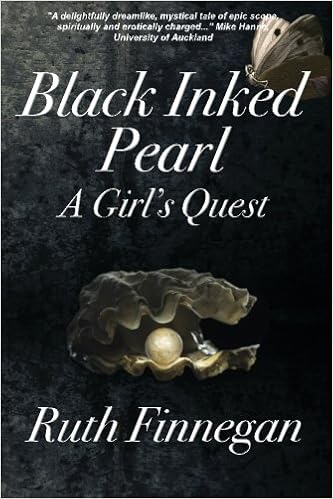
An epic romance about the naive Irish girl Kate and her mysterious lover, whom she rejects in panic and then spends her life seeking. After the opening rejection, Kate recalls her Irish upbringing, her convent education, and her coolly-controlled professional success, before her tsunami-like realisation beside an African river of the emotions she had concealed from herself and that she passionately and consumingly loved the man she had rejected.
Searching for him she visits the kingdom of beasts, a London restaurant, an old people’s home, back to the misty Donegal Sea, the heavenly archives, Eden, and hell, where at agonising cost she saves her dying love. They walk together toward heaven, but at the gates he walks past leaving her behind in the dust. The gates close behind him. He in turn searches for her and at last finds her in the dust, but to his fury (and renewed hurt) he is not ecstatically recognised and thanked. And the gates are still shut.
On a secret back way to heaven guided by a little beetle, Kate repeatedly saves her still scornful love, but at the very last, despite Kate’s fatal inability with numbers and through an ultimate sacrifice, he saves her from the precipice and they reach heaven. Kate finally realises that although her quest for her love was not in vain, in the end she had to find herself – the unexpected pearl.
The novel, born in dreams, is interlaced with the ambiguity between this world and another, and increasingly becomes more poetic, riddling and dreamlike as the story unfolds. The epilogue alludes to the key themes of the novel – the eternity of love and the ambiguity between dream and reality.
On A Hero’s Journey

Rocco Ryg Author Interview
The Genocide Gene is the third book in the thrilling Onryo Saga and continues the adventures of the teenage superheroes in their fight to save humanity. I felt this story was very well written. What is your experience as a writer?
In addition to term papers in grad school, I wrote fanfiction about my favorite shows growing up. It was great practice to hone my craft and experiment with my original concepts. As fun as that was, nothing beats creating original characters and guiding them on a hero’s journey.
One thing that stands out to me in The Genocide Gene is the creativity embedded in this world. What was your inspiration for creating such and imaginative world?
As I was researching Africa, I had to come up with ways to integrate what I had learned into a creative storyline. I read about the business of portable gas stoves, so I had a battle in a factory. I read about the African boda-boda drivers, so I envisioned a chase scene on their mopeds. Every time I read something interesting, I wondered how I can utilize it in an exciting way.
I also created my own African country so that I could integrate the culture, history and issues of other countries into it, such as civil wars and age-old divisions brought about by European colonization. That way, I could write about the political problems of places such as Uganda, the Congo, South Africa and others all at once.
The Genocide Gene has an intriguing setup to a novel that is high in social commentary. What was your moral goal when writing this novel and do you feel you’ve achieved it?
Bringing people together in harmony has always been my main goal, whether it be American liberals and conservatives or feuding African tribes. I wanted to present a war-torn nation keep impoverished and dysfunctional due to prejudice and hatred, but it was important to show people of other backgrounds getting along in spite of what their groups teach them. While the political extremists seek to tear their nation apart through fear, those who serve the cause of unity and understanding are the only ones who can bring peace to their people. While my conclusion can’t happen in real life, I can only keep the faith that the people of these lands find ways to bring about prosperity.
When will the fourth book in the Onryo saga be available and where will it take readers?
The Tree of Zaqqum will take readers to Israel/Palestine, and others Middle Eastern locations too. My heroes will have to stop a mysterious mastermind and his followers from destroying cities with stolen WMDs and quantum technology. Their friendship is further tested as Chikara gains a new ally that may become something more.
I’m still in the research phase at that moment, but the story is coming together piece by piece. I’m guess it may take two years to complete.
Author Links: GoodReads | Twitter | Facebook
![The Genocide Gene (The Onryo Saga Book 3) by [Ryg,Rocco]](https://images-na.ssl-images-amazon.com/images/I/51Hj0i-5%2B-L.jpg) “It has been only a few months since Chikara Kaminari was given strange powers and a mission from her precognitive mother. Joined by her friends Renka and Gen, she traveled the world and stopped a band of super-powered extremists from imposing their will upon humanity. Now, a new menace has surfaced to threaten the lives of millions.
“It has been only a few months since Chikara Kaminari was given strange powers and a mission from her precognitive mother. Joined by her friends Renka and Gen, she traveled the world and stopped a band of super-powered extremists from imposing their will upon humanity. Now, a new menace has surfaced to threaten the lives of millions.
In the segregated African nation of Ghadhia, two fanatical brothers are scheming to ignite a new civil war and commit genocide against the tribes they have been raised to hate. The heroic trio must unite with new friends and old enemies to stop them, facing African terrorists, Afrikaner supremacists and enraged mobs along the way. But as Chikara and her friends journey further into the heart of darkness, their deepest fears and hidden feelings threaten to tear their friendship apart.”



 LITERARY TITAN