Blog Archives
Tomorrow’s Edge Trilogy

Brett E Armstrong Author Interview
Day Moon is a genre-crossing novel with elements of a history, science fiction, and peeks at the future as well. Did you start writing with this in mind, or did this happen organically as you were writing?
I would say it was a little of both. When I was first inspired to write the story I knew it would be set in the future and because of the nature of the premise it would start to pull in threads of science fiction. I also knew I wanted to include the quotes from Shakespeare to help reinforce the importance of the book Elliott’s grandfather gave him and to fill the novel with a contrast in sound and nature to highlight a key theme of the book. That is the conflict between the old world and the new emerging one. Elliott lives in an area caught in that struggle, which is fortunate because it lets him realize that there are aspects of this new world that are not just dangerous but incredibly sinister. I think for any theme to work well in a book, the author can take steps to draw out the theme, but ultimately there has to be that kind of organic innate vibe to a story and the prose in order to make it resonate the way it needs to. Since I’m by nature someone who thoroughly enjoys history and science fiction, and am a dreamer as well, I think those aspects of me got carried through strongly enough to Day Moon to accentuate those elements and hopefully imbue that old world meets new feeling.
The supporting characters in this novel, I felt, were intriguing and well developed. Who was your favorite character to write for?
First of all I’m glad you found them to be so. I had a lot of fun with just about all of the characters and how they interacted, particularly Lara and Elliott as they sorted out their feelings for each other. It was kind of an unexpected pleasure to write Director Ohlmstadt’s character. He’s only physically in the novel briefly, but his presence and philosophy kind of ripple out and touch so many other characters. Whether they realize it or not, both of Elliott’s co-workers Kendra and Terrance have bought into his “whatever it takes to meet an end” ideals. Though Agent Amar also has that conviction, he wouldn’t attribute it to Ohlmstadt.
There are plenty of references and quotes to Shakespeare in this book. Did you do a lot of research to maintain accuracy of the subject?
I used an online tool that lets you dig down into each of Shakespeare’s manuscripts and search them line by line and by keywords and phrases. That helped ensure I go the quotations right and I tried to keep them contextually and thematically in line with the original text’s spirit. It helped that I’ve been reading Shakespeare’s plays just about all of my life. I knew including them would be a way to ground people in the familiar as well. Most people know at least a little bit of Shakespeare, whether they realize it or not. And though I think Day Moon’s world already looks much like ours, with a futuristic veneer, I wanted to make sure people had some elements woven through it that they could reach out and relate to along the way.
What is the next book that you are working on and when will it be published?
I’m working on Veiled Sun, the next book in the Tomorrow’s Edge Trilogy and its about 75% of the way through its first draft. Originally I meant for Day Moon to be a standalone but realized towards the end of what is Day Moon that the story arc was too big to reasonably fit in one novel. Particularly for a new-to-publishing author. Making it a trilogy has broken it up enough that the chunks should be manageable for readers and make it more appealing to my publisher. I’m hoping my publisher likes it and it can be out by mid or late 2018. Veiled Sun has some competition with me though, because I’ve had another manuscript that kicks off an epic fantasy series rooting around in my mind for almost ten years now. It’s been through multiple drafts and rewrites and finally taking a shape that I think makes it ready for publishing. I call it Quest of Fire, and I’m hoping it will find its way to readers by late 2018 as well.
Author Links: GoodReads | Facebook | Twitter | Website
![Day Moon (Tomorrow's Edge Book 1) by [Armstrong, Brett]](https://images-na.ssl-images-amazon.com/images/I/51AawfNYdxL.jpg) In A.D. 2039, a prodigious seventeen year old, Elliott, is assigned to work on a global soft-ware initiative his deceased grandfather helped found. Project Alexandria is intended to provide the entire world secure and equal access to all accumulated human knowledge. All forms of print are destroyed in good faith, to ensure everyone has equal footing, and Elliott knows he must soon part with his final treasure: a book of Shakespeare’s complete works gifted him by his grandfather. Before it is destroyed, Elliott notices something is amiss with the book, or rather Project Alexandria. The two do not match, including an extra sonnet titled “Day Moon”. When Elliott investigates, he uncovers far more than he bargained for. There are sinister forces backing Project Alexandria who have no intention of using it for its public purpose. Elliott soon finds himself on the run from federal authorities and facing betrayals and deceit from those closest to him. Following clues left by his grandfather, with agents close at hand, Elliott desperately hopes to find a way to stop Project Alexandria. All of history past and yet to be depend on it.
In A.D. 2039, a prodigious seventeen year old, Elliott, is assigned to work on a global soft-ware initiative his deceased grandfather helped found. Project Alexandria is intended to provide the entire world secure and equal access to all accumulated human knowledge. All forms of print are destroyed in good faith, to ensure everyone has equal footing, and Elliott knows he must soon part with his final treasure: a book of Shakespeare’s complete works gifted him by his grandfather. Before it is destroyed, Elliott notices something is amiss with the book, or rather Project Alexandria. The two do not match, including an extra sonnet titled “Day Moon”. When Elliott investigates, he uncovers far more than he bargained for. There are sinister forces backing Project Alexandria who have no intention of using it for its public purpose. Elliott soon finds himself on the run from federal authorities and facing betrayals and deceit from those closest to him. Following clues left by his grandfather, with agents close at hand, Elliott desperately hopes to find a way to stop Project Alexandria. All of history past and yet to be depend on it.

Another Cog of the System

David Berardelli Author Interview
In The Wagon Driver, Earth is overcrowded and Kyle’s job is to collect bodies for government disposal, but soon learns of a more nefarious reason why he’s employed. What was the initial idea behind this story and how did that transform as you were writing the novel?
I initially wrote this story in the mid-nineties, when I was working at AT&T in Lake Mary, Florida. Computers had already begun taking over, and the Y2K phenomenon was being considered globally. My imagination, as usual, went into overload, and I began having dreams about the Government using technology to move into the home, take over completely and systemically select who would be permitted to exist and who would not.
Kyle grows up an in orphanage and I instantly felt the isolation and loneliness that he felt. What were the driving ideals behind the characters development throughout the story?
Being an orphan as well as a loner, Kyle has never felt the bond of friendship before and frequently uses humor and sarcasm to disguise his shyness. When he meets Allie, he thinks he has developed his first true friendship, but when he realizes she has let herself become just another cog of the System, he feels betrayed. And when both Allie and the System turn against someone who could have truly become his one and only friend, he knows he can no longer stick around because he will eventually cease to exist as well.
Do you think over population is a serious concern today? What do you think are the causes and solutions?
I think it is a major concern, especially in many other countries. I don’t want to get political here, but in this country we could eliminate much of it ourselves, without Government intervention. However, I really can’t see it happening.
What is the next book that you are working on and when will it be available?
I am currently working on a Christmas novel entitled, Yesterday’s Journey. It is a fantasy, and should be ready to be published on Amazon and Kindle in early or mid November.
Author Links: GoodReads | Facebook
 In the not-so-distant future, population control becomes a necessity. Turning eighteen, Kyle Sonnet leaves the State Orphanage and becomes an employee of the Department of Population Control. As a wagon driver, he follows the ambulance to emergency calls and collects bodies for Government disposal. However, it isn’t long before Kyle understands that, due to the collapse of the healthcare system and contrary to what he has seen on the news, euthanasia has become the universal solution. But when he suddenly witnesses a horror he cannot accept, Kyle is forced to decide whether to become another pawn of Society or risk escape, which will result in certain death.
Purge Herself of All Mercy

Joshua Landeros Author Interview
The King’s Move follows cyborg super soldier William, who seeks vengeance after finding the latest weapon the Chancellor holds. What was the initial idea behind this story and how did that transform as you were writing the novel?
The original idea was to have a straight forward revenge plot with Will pursuing Chancellor Venloran. As I wrote on, I wanted to give the supporting cast more to do and explore their own demons. It turned out to be just what the story needed because the original draft had far too much of the action delegated to Will. Giving other characters a chance to shine was a breath of fresh air.
The supporting characters in this novel, I felt, were intriguing and well developed. Who was your favorite character to write for?
For this entry, I had a lot of fun writing Gabriella. I feel like she’s changed a lot since the first book where she was more naïve but optimistic. She’s become very jaded, more so than her brother and to some extent even Will. She’s tried to purge herself of all mercy and I wanted to explore how it has skewed her judgement.
The characters remain, along with the action, some of the best parts of the novel. What is your writing process like?
My writing process is probably hardest in the beginning. I try to plan things out with a synopsis and before each chapter is written I like to have a detailed set of events in mind. The easiest, and most fun, part is putting the meat on the bones. After that comes editing, which I like to do as I go before letting a professional give it an additional look.
This is the third volume in your Reverence series. Will there be another book? If so, where will it take readers and when will it be available?
I have a lot of books planned for the series. The finale to the EOK arc will come in September, latest October. I’m editing it as of now and trying to get the pace just right. The next book we’ll see the Crimson Angels try to launch a counterattack on Chancellor Venloran. Unbeknownst to them, Will is wrestling with the offer given to him by Vanzetti. A ticking time bomb is how I would describe the story, and I’m confident it will be a blast for readers.
Author Links: Website | Facebook | GoodReads

Something Beautiful From The Ugly Pain
Sean Michael Author Interview
Stygian is a collection of poems that are presented as a poetic autobiography. Why was this an important book for you to write?
Great question. As you know the biographical material in Stygian shows that I had a very disturbing childhood, and the things that happened to me then have weighed on my mind for many years. I had to write this book in order to get my feelings about this stuff off my chest before I could ever write about anything else. Since the release of Stygian, I have written poems about the gold rush, politics, war, the discovery of King’s tut’s tomb, and so much more. I’m really interested in historical stuff right now. Stygian opened up a doorway of creativity to me by releasing me from the past. In writing this book, I learned quite a bit about the craft as well as myself.
My personal favorites are “The Man in the Box” and the “Endless Tunnels of Darkness” which are beautifully descriptive. What was your favorite poem in this collection?
Wow, let’s see. I love to utilize nature and animals in my writing so a couple of my favorites are “A Forest Called Madness” and “The Elusive Bird,” as well as “Lies Kill,” which features a purple elephant.
What I like most about this book was that it was frank and dark and didn’t hold back. What do you hope readers take away from Stygian?
I think that there is a stereotype attached to poetry that it is always lovey-dovey, flowery hillsides, and blue skies, but that certainly was not the case with Sylvia Plath or Edgar Allan Poe, nor is it with me. I hope that readers will see how powerful poetry can be and range of emotions, thoughts, and ideas that can be expressed in verse. Furthermore, I hope to inform the uninformed, but most of all I hope to touch a wounded soul, so that they know they are not alone, that no matter how broken one’s life seems there’s always the choice to build something beautiful from the ugly pain.
What is the next book that you are working on and when will it be available?
Since the release of Stygian, I have finished a complete autobiography, and compiled another collection of poems. I am also working on a full-length novel called Broken Homes. I’m usually working on a few projects at a time. Most recently, I had a short story called “A Murder of Crows” published in the British horror magazine, Morpheus Tales. I’ve had several other short stories and poems appear in on-line publications. Two of my poems have been accepted for a poetry anthology to come out sometime this year. I’m hoping to get a release date soon. My dear grandmother maintains a blog for me, where I post about my current life and opinions, give updates about my work, and talk about writing techniques.
Author Links: GoodReads | Twitter | Facebook | Website
 Poverty, drugs, child abuse… The streets’ incarceration… Questions of life and contemplations of death, Stygian is the darker side of poetry collected from teen years into young adulthood and composed in homeless camps, churches and a jail cell. The emotion is raw, the poetry is real.
Telling Him to Return Home

Jerry J.C. Veit Author Interview
Days Gone By follows Caleb as he struggles with agoraphobia and the loss of his nephew in a car accident. What made you want to write a story about this topic? Anything pulled from your life experiences?
There are a few things that are taken from my past. At the time of my writing Days Gone By my nephew was five years old. He is now seven and a joy to be around. No tragic car accident; however, I wanted to write a heartfelt, emotional, character-driven story and if I had to go through what Caleb did, I don’t know how I would deal with it, but hiding seemed like a safe choice; and that’s exactly what Caleb is doing.
Many of Caleb’s visitors are based on real people in my life. His grandfather, for one, is based on my Mother’s father who did live in The Azores, Portugal. His story he shared about a possible angel telling him to return home due to a dangerous road ahead was true. Since he also lived so far away I did not see him that much and do wish I had more memories with him.
Caleb’s Irish great, great, great grandmother is also mine from my father’s side who also emigrated to the U.S. from Cork, Ireland. Miss. Di Coco was my second grade teacher and Jessica was my real life childhood friend.
The writing in your story is very artful and creative. Was it a conscious effort to create a story in this fashion or is this style of writing reflective of your writing style in general?
To date all my books are adaptations from my screenplays. So they all share this style of writing. I also marketed it to a local theater to be a play, but my character list ended up being too long. The stories I’ve written before my scripts and now after will follow more traditional book layouts.
Caleb’s has physical and psychological difficulties, but the spiritual burden of guilt for being the cause of his nephew’s death is overwhelming. What were the driving ideals behind the characters development throughout the story?
I knew Caleb’s journey was going to be a hard one. Feeling sadness because of a tragic event is one thing, but Caleb is terrified of it. He’s afraid to feel that deep sorrow and face that reality. This fear became an illness that spread to all aspects of his life. He put up a wall to protect himself and now everything outside of his home and daily routine is scary.
What is the next book that you are working on and when will it be available?
My next book will be written as a regular novel and takes place in 1885, but further advanced than in our own history. I think I’m on page five. 🙂
Author Links: GoodReads | Twitter | Facebook | Website
 Three days after Christmas an auto accident left Caleb partially disabled and took the life of his five year old nephew. Now on the anniversary, four years later, Caleb is afraid to leave his house; even to attend his brother’s upcoming wedding.
Soon past friends and deceased relatives mysteriously begin showing up in his home to deliver their messages and help him through his phobia by showing him glimpses of his past, present and possible future.
Eden’s End

What is Eden’s End about?
Eden’s End follows the journey of Gabriel who’s an angel, and his human friend who hunts down supernaturals who harm humans. They’re daily jobs come to a halt, when several supernaturals and humans come into pursuit of a powerful entity known as Eden which has the power of creation and destruction. Now Gabriel and Roy must race against these people to find Eden before it falls into the wrong hands.
When will the show be out, and where?
We are expecting to release it sometime this Fall, and the episodes will be on YouTube. At first, the entire pilot will be released, and afterwards the episodes will be broken up into segments.
Being independent, how is Eden’s End being made?
In terms of funding, we have set up an Indiegogo page that will help gather funds for the production of the entire season 1 for the show.
What are the recent successes for leading up to the show?
So far we have released a concept trailer and a short film that kind of serves as a sneak peek to the show. They both have been received well especially on Facebook where the concept trailer has over 11k views, and the short film has gained over 20k views and has been shared by a popular movie trailer page. Will are also submitting the short film to film festivals.
What is your role in the web series?
I am one of the screenwriters for the episodes. I have help to write the pilot, along with our concept trailer and short film of the web series.
Why did you want to write for the series?
My brother’s friend approach me because my brother told him how I wrote stories. I like to write, and this was a way for me to expand on my writing since I was already writing short stories for my website, I wanted to add to it.
What is your experience in writing?
I have been writing creatively for 2 years. I have written 22 fictional short stories which I posted on my website. Their genres range from crime, horror, science fiction, and more. I have also written a few movie articles. 1 of my short stories have been published in my college’s magazine. On top of that I am currently working on a science fiction book of short stories which I plan on putting out on Amazon sometime next year.
Links: YouTube | Facebook | Instagram | Indiegogo | Website
The Victim Became Human

Kwen D. Griffeth Author Interview
The Ghost in the Mini Skirt takes an unexpected turn with ghosts, tortured souls and a darkness that leads Jack towards a supernatural mystery. What was the initial idea behind this story and how did that transform as you were writing the novel?
A few years ago, while late at night, I was driving across the desert in Arizona. I could see tumble weeds and sage brush along the side of the road and I started thinking that if an animal jumped out in front of me I would not have time to stop before hitting them. From wondering about an animal, my thoughts drifted to the same question except the victim became human. I chuckled when I thought, “How weird would it be if a human figure jumped in front of me, and I hit him only to drive through him?” From that mind game, the novel grew.
Jack is proud, smart and at times stubborn and the contrast between him and Terri makes for a unique pairing. What was your inspiration for creating the kind of relationship that Jack and Terri have?
Jack is a human computer, close to being devoid of the emotions the rest of us, at time, struggle with. He is successful with both status and wealth, but from the beginning of the book, we learn he is lonely. He longs for emotional companionship and doesn’t know how to go about finding it.
Terri had to be as strong willed as Jack (if for no other reason that not be intimidated by him) and attractive to the point of fantasy to attract him. Where Jack is strong in logic, Terri had to be strong in intuition. I think they make a great pair and they were fun to write about.
I felt that there were a lot of great twists and turns throughout the novel. Did you plan this before writing the novel, or did the twists present themselves to you as you writing?
Elmore Leonard said if he knew exactly where writing a novel would take him, he didn’t write it as it would be too boring. Maybe that is not an exact quote, but the meaning is there. Anyway, when I start a book I know the beginning, the middle and the end. As I write and develop the characters, I let them tell me where the story goes. It may sound strange to non-writers, but Terri demanded I delete and rewrite 37,000 words in this novel. Her ideas were better.
Do you see a possible follow up novel to this book? Where do you think you can take the story in the next installment?
Yes, Jack and Terri are too strong of characters to not have more written about them. Jack and Terri make an appearance in The Tenth Nail, Nate and Clare Book One, as well as Dead Men Walking, Nate and Clare Book Two. I am starting book two of the Jack and Terri series and the working title is “The Ghost in the Senate Chamber.”
Author Links: GoodReads | Website | Twitter | Facebook

Jack Mill was the king of hackers. He was a self-made man. He tested at the genius level and he had made a reputation as well as a fortune doing what he loved, hacking computers. Jack was not only in charge of his world, he ruled it.
Jack had no contemporaries and others in his field either respected him or feared him. Jack was the man in charge. Jack was the man in charge until the night he ran over a man who wasn’t there. A man, or what Jack thought was a man appeared in the traffic lane and Jack hit him, but he didn’t. There was no body, no damage to his car, and no blood. What was going on?
Suddenly, Jack’s life was out of control and he didn’t like it. One person was there to support him, an out of work show girl named Terri. As if he was given a protector, a way to stabilize his way through the mystery, Terri arrived only a few hours before the accident. Now, she helps him find his way back to stability and maybe a fuller life.
“The Ghost in the Mini Skirt” is a tale about ghosts, murder mystery and love story all rolled into one.
Why, Anyway, Do We Quote?

Ruth Finnegan Author Interview
Quoting was something I didn’t even think about until I read Why Do We Quote. What made you realize quoting would be such a rich topic for a book?
Nor did most people!
Not sure. It just crept up on me and once I’d got started colleagues were very very puzzled -well in a way I was too – about what on earth there was to say about quoting. Onced it was published it was published everyoed said they’d been interested in quoting it all along!,
To elaborate, and as I explain in the Preface, until this book somehow crept under my guard I hadn’t thought I was much interested in quoting or quotation: something to be deployed with care in some settings, no doubt, but not a thing to be investigated. Certainly I had learned to use quote marks at school and later to wield quotations in academic writing, and had become aware of copyright obligations and the current concerns about plagiarism and about unauthorised words floating free on the web. I was also vaguely aware that words and voices from elsewhere ran through what I said, I read them in books, recognised them in formal speeches, heard them in conversation. But I had just come to accept this as part of common practice, not anything to be really noticed, far less to arouse particular curiosity.
As I thought about it, I realised how little I knew about quoting and quotation. What does it mean, this strange human propensity to repeat chunks of text from elsewhere and to echo others’ voices? How does it work and where did it come from? Does it matter? Why, anyway, do we quote?
I started by reflecting more carefully on my own experience and was startled by how quoting permeated my world. And then I wondered how others were using, or not using, quotation both nearby and in far away times and places. On some aspects I found a vast and fascinating literature. But there seemed no single account that directly tackled my questions about just what ‘quotation’ and ‘quoting’ were, how we had got to where we now are, and how in practice these had been used and conceptualised. This led me to considering how people here and now actually use quotation (in practice, that is, not just according to the grammar books) and also, going on from that, whether we might understand these present practices better by exploring something of their background and whether the problems currently causing concern belong just to the 20th and 21st centuries, or perhaps have longer roots.
And then? Well, I just couldn’t help writing It! Took longer than I expected, with part of the fun being finding illustrations (yes IMAGES are part of the story). I’d say it is my best academic book, perhaps alog with Communicating to which is it in a way linked (I leave out my novels like Black Inked Pearl).
Did you learn anything that surprised you about quoting while you prepared this book?
YES, and was amazed: about (many) people’s ACTUAL perspectives be on quoting -regarding it as a way of ‘showing’ off: showing off the quoter’s supposedly superior learning or status, putting you down. I was stunned. As an academic had always assumed that (properly attributed) quotation was unquestionably a Good Thing. It would never never have occurred to me without the extensive comments from the wonderful ‘Mass-Observation’ writers (results of this and other enquiries conducted and housed under the auspices of the University of Sussex (www.massobs.org.uk/).
With this book you shed new light on ideas such as ‘imitation’, ‘allusion’, ‘authorship’, ‘originality’ and ‘plagiarism’. How has quoting changed those ideas?
Mainly I think that I now realise how these concepts shade into each other and overlap (there is a stunning diagram at the start by Mark Cain showing this – and more) . Also how they are ALL socially managed and controlled in some way, and how the telling-off for ‘plagiarism’ of students and other ‘subordinate’ individuals is partly an exercise of power. We all in a way plagiarise (ourselves among others) when – almost all of the time – we in some way allude or quote. This was a real revelation to me. Also how invisibly pervasive all these practices, and similar ones, are in our speaking and writing.
There is a lot drawn from anthropology and cultural history. Is there any one event in history that affected quoting dramatically? Or did it all happen slowly over time?
Slowly and over time I think. Quoting and quotations have been there from the very very beginning – though it’s true that some individuals and sources get quoted more than others ( or have attributed to them things they DIDN’T actually say) , like George Washington, Goethe, Disraeli, the Bible. People quote Shakespeare all the time, often without realising that it IS a quote, the words just a special ring to them – isn’t that one of the points of quoting.
And did you know that the first piece of sustained writing, four thousand or ore years ago, was a cuneiform collection of – yes – of quotations (there’s a picture of it in the book)
Author Links: Facebook | GoodReads | Twitter | LinkedIn | GarnPress | Open University
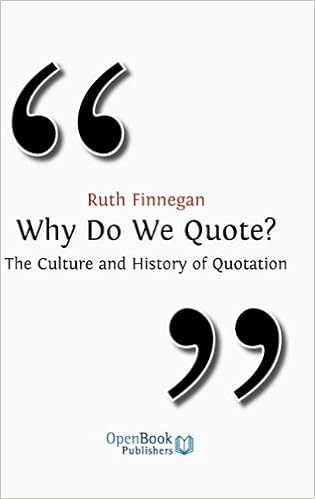 Quoting is all around us. But do we really know what it means? How do people actually quote today, and how did our present systems come about? This book brings together a down-to-earth account of contemporary quoting with an examination of the comparative and historical background that lies behind it and the characteristic way that quoting links past and present, the far and the near. Drawing from anthropology, cultural history, folklore, cultural studies, sociolinguistics, literary studies and the ethnography of speaking, Ruth Finnegan’s fascinating study sets our present conventions into cross cultural and historical perspective. She traces the curious history of quotation marks, examines the long tradition of quotation collections with their remarkable cycling across the centuries, and explores the uses of quotation in literary, visual and oral traditions. The book tracks the changing defi nitions and control of quoting over the millennia and in doing so throws new light on ideas such as ‘imitation’, ‘allusion’, ‘authorship’, ‘originality’ and ‘plagiarism’.



 LITERARY TITAN