Blog Archives
A Constant Reminder

Sergio Tinoco Author Interview
Proud American is a biography about your journey through life in South Texas; from migrant worker to US solider and then US Border Patrol agent. What was the inspiration behind creating such a thoughtful memoir of your life?
My mother passed away in the summer of 2015. After her passing, I fell into a depression because I felt truly alone in the world. Being the only child of a single parent can do that to a person. I had my wife and kids with me but I still felt utterly alone, and I couldn’t shake it off.
My wife kept pushing me to discuss my thoughts and feelings, but I could not muster up the strength. I didn’t know how to discuss what I was experiencing. My wife suggested that I write my feelings down. For years, my wife has been telling me that she believes I’m a good writer. For years, I’ve been ignoring her compliments.
One night after dinner, she brought a letter to me. She handed me a piece of paper and asked me to open it. When I did, I saw that it was a letter I had written to her eight years ago. Eight years ago was when my wife and I first started dating, and one night she asked me over the phone, why I had joined the Army. I wrote her a letter and poured everything out on paper. It opened up the floodgates for me. That letter is now the first chapter of my book.
Do you remember what your idea of ‘America’ was as a child?
Because I began working at the age of seven, my idea of ‘America’ was that of tough living. It is hard for one to realize so young that his or her childhood is nothing like that of other kids. We were dirt poor and I had the full workload of an adult at the age of ten.
In time though, everything around me was a constant reminder of what else was possible in ‘America’. I knew there were better ways to make a living. At such a young age, I wanted to learn how to pursue my thoughts or dreams of a better life. I didn’t have time to dream of the next best toy or fun activity. I spent all my childhood dreaming and thinking of how to break my family cycle of picking crops for a living.
How did your outlook of ‘America’ change after your time in the US Army?
I must say that in many ways, the Army actually spoiled me. Although it increased my awareness of the harshness of life and the many challenges that it can impose on a person, it also continued to show me all the many possibilities available should one choose to work hard to achieve a desired goal. This only enhanced what I already believed as a kid. More so, I also learned of all the harsh realities of life and how people in other countries are in a far worse state than most of us here can ever possibly imagine or understand. I knew, after my military service, that we lived in the greatest country in the world. Even with all our faults and deficiencies, there is no comparison.
Being the son of a Mexican immigrant, was it hard for you to decide to become an agent in the US Border Patrol?
My decision to join the US Border Patrol was actually a fairly easy one. I was looking for something that would allow me to continue my government service. It’s important to note that my grandfather had never talked to us about his encounters with the US Border Patrol and thus played no role in my decision.
It wasn’t until after I had become an agent that I realized how my decision had impacted the entire family. It was a strange feeling and continues to be a delicate subject since I still have family that lives in Mexico and have not been able to visit them because of the dangers a visit from me would pose on them and even on me. With the violent cartel threat just across the border, it will be years before I can see my family again.
What is one stereotype that you think many Americans have of Mexican immigrants?
At this point in time, immigration has become a great issue for our country. With that said, the moment one begins to speak about immigration it is quickly considered to be a topic of Mexican immigrants and the ‘negative’ impact they have on our society.
I am an American Citizen by birth, but I do come from a Mexican Immigrant family and am now a Border Patrol Agent. I have to deal with criminals from every background one can possibly think of. As a federal agent, I don’t merely deal with immigration issues. I also deal with the issue of human trafficking and narcotics trafficking. In essence, I’m caught in the middle of the transaction.
I say this because in any transaction, there is a person providing a product and a person purchasing or demanding that product. I have to process undocumented individuals for deportation while at the same time prosecute the US Citizens that are committing the trafficking.
What role do you feel Mexican-Americans play in bridging the gap between these two countries?
I think we must all play the role of actual educators by way of providing facts and not opinions or emotional outbursts. I wrote a story in the book of an incident that happened to me while on the job as a Border Patrol Agent. The gentleman I encountered truly believed that he was above me simply because of my appearance and name tag. I chose to educate him and not escalate the situation with an emotional outburst. After that interaction, I earned the gentleman’s respect and he earned mine by showing me that he had learned the error in his thinking.
I’m a combat veteran who now has to deport people of my own Mexican Nationality because I have chosen to continue serving my country, the United States of America. And yet, I still have to educate people every single day of my patriotism and the struggles I’ve had to overcome in order to achieve the stability I now have.
Education is key.
Author Links: GoodReads | Twitter | Facebook | Website
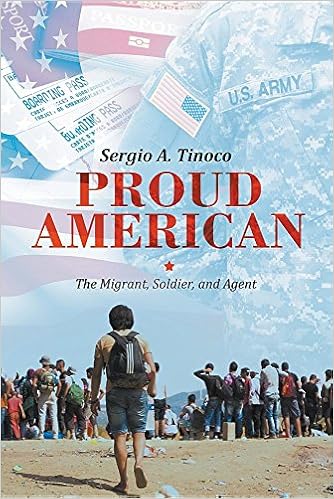 “Being the only child of a single mother, Sergio was raised by his maternal grandparents in a South Texas region better known as the Rio Grande Valley. This memoir details the upbringing of a poor Migrant worker of Mexican descent having to pick crops for a living since the age of seven. As a way to break from the family cycle of picking crops and depending on government welfare programs, he joined the United States Army and served ten years active duty. He deployed to Bosnia-Herzegovina shortly after the Bosnian War only to find and deal with the aftermath of the genocide that took place there and be caught in the middle of several attacks. His experiences in Bosnia ultimately led to experiencing signs and symptoms related to PTSD. After completing ten years of military service, Sergio joined the U.S. Border Patrol. Being of Mexican descent, having family in south Texas, and in Mexico gave way to new issues of having to counter threats against his family and ill-willed opinions of him for arresting and deporting “his own kind.””

Gray Girl

Susan I. Spieth Author Interview
Witch Heart follows Jan as she returns to West Point under a cloud of suspicion when several people are killed in unlucky accidents. What was the inspiration for this 3rd book in the Gray Girl Series?
The Gray Girl series (Gray Girl, Area Bird and Witch Heart) is mostly inspired by my experiences as a cadet at West Point from 1981-1985. Jan Wishart’s adventures are embellished, of course, but many of the events are authentic or realistic to what we experienced at that time. Being labeled a “witch,” for instance, certainly happened to some women then. Recently, we have seen examples of derogatory “labeling” used on outspoken and/or ambitious women.
The novel starts out at Army Airborne School in Fort Benning, GA. What experience do you have with the military. Anyone in your family serve?
Well, as stated above, I attended West Point in the early 1980’s. After that, I served five years as a missile maintenance officer in the Army. As part of our training, I attended Airborne School during the summer before cow (junior) year, which follows the storyline in Witch Heart. I wrote most of the Airborne School chapters based on memory. However, I cheated a little and looked at Youtube videos. I also consulted a few friends who went through Airborne training. One of my beta readers was stationed with the 82nd Airborne for a few years.
The book tackles the social issue of women serving in the military. How do you see women in the military and what is a common misconception you’ve come across?
Women have only added value to the military, as they have in all areas where they have been allowed to compete. One common misconception that seems prevalent is that standards had to be lowered for women to enter the military academies. What is surprising, however, is that ALL standards have gone up since women have been admitted. There’s probably a social-gender dynamic that might explain this reality, but physical and academic standards began to rise considerably with the admission of women cadets.
Jan is a well developed character. What were some obstacles that you felt were important for the characters development?
I wanted Jan to be a good person, but flawed. In other words, I wanted her to be authentic. I think hearing her internal dialogue (which is more prevalent in the first two books) is both an obstacle and an opportunity to bring a character to life. The reader sees her inner self, knowing her mixed emotions and the biases that she carries with her. You don’t really hear the inner voices of the other characters, but hopefully, using dialogue and actions, you get a feeling of the well-developed relationships and personalities.
Where does the story go in the next book and where do you see it going in the future?
Jan has to finish West Point. So, the final book in the Gray Girl series will be about her firstie (senior) year. She will encounter another major problem at West Point which can only be solved with the help of her friends and collaborators. This one, if I can pull it off, will involve international espionage—or something like that. I hate to say too much until it’s written because often times the book takes on a life of its own—and I never really know what’s going to happen until it does. It’s called writing.
Author Links: GoodReads | Facebook | Website
![Witch Heart: Leadership always requires sacrifice (Gray Girl Book 3) by [Spieth, Susan I., Spieth, Susan]](https://images-na.ssl-images-amazon.com/images/I/41DOgIczvvL.jpg) “Jan Wishart starts cow (junior) year at West Point in Airborne School. Terrified of heights, she narrowly escapes an accident that later turns deadly for another jumper. With a third death in as many years associated with her, Jan returns to West Point under a cloud of suspicion. Ominous signs left for her to find cause Jan to lose a precious and necessary requirement for survival at West Point: sleep. With her mental state in question, a masked intruder makes nocturnal visits to her room. Or is she imagining that? Events escalate to the point of no return for Jan and her two best friends. When they swear an oath of loyalty to each other, they have no idea how much it will cost to fulfill that vow. Leadership always requires sacrifice. So does loyalty. And sometimes, one virtue must yield to the other.”
“Jan Wishart starts cow (junior) year at West Point in Airborne School. Terrified of heights, she narrowly escapes an accident that later turns deadly for another jumper. With a third death in as many years associated with her, Jan returns to West Point under a cloud of suspicion. Ominous signs left for her to find cause Jan to lose a precious and necessary requirement for survival at West Point: sleep. With her mental state in question, a masked intruder makes nocturnal visits to her room. Or is she imagining that? Events escalate to the point of no return for Jan and her two best friends. When they swear an oath of loyalty to each other, they have no idea how much it will cost to fulfill that vow. Leadership always requires sacrifice. So does loyalty. And sometimes, one virtue must yield to the other.”
Confronting Death

Tom Adams Author Interview
Coffin Dodgers takes place on a pre-historic world where thrill seeking competitors fight to be the last man standing. What was the inspiration for the Survivathon the characters must survive?
The story as a whole sprung from a nightmare I had where I was trapped amongst rapids with a bunch of other people, and we were being stalked by predatory dinosaurs – a bit like Jurassic Park! The dream was so vivid that I plotted out a simple outline immediately. As with many of my stories, I weave in a lot of ideas from books, films and experiences in life. I’m fascinated by people who drive themselves to the limits and it seems like extreme sports are springing up left, right and centre. The sports in the story, such as wing-suiting and volcano boarding actually exist and the dangers are very real. Recently, I was reading that two experienced wing suiters died in the US after attempting a risky drop. I imagined a future where this Type T mentality is extrapolated even further. Wouldn’t earth’s challenges seem a bit tame by the year 3154? The rest of the story basically wrote itself and incorporated the horror element of two contestants going rogue and using the whole event as a hunt to satisfy their psychotic desires.
This competition takes place on a dangerous planet called Atrocitas. Where the plants and animals are just as eager to kill as the competitors. What drove the development of this planet and how did that change as you were writing?
I’m a zoologist by training so I have always been fascinated by the living world. One fact I wasn’t aware of until a few years ago, was that at the time of the dinosaurs, grass and other cereal plants had not evolved. Much of the world was covered in more primitive plants such as cycads and ferns. So I researched the Cretaceous period to try and lend some authenticity to the flora and fauna. It was fun inventing the challenges for the ‘Coffin Dodgers’, from the peak known as the ‘Tooth’ to the white water rapids of the ‘Angelwater.’ The setting, the characters and the nature of the challenges worked together to produce what I hope is a fast-paced story.
The contestants range in gender, nationality, and skill-set. They can either work together to survive, or split up to try to win the whole bounty. What were some of the emotional and moral guidelines you followed when creating your characters?
I wanted to stretch myself and write a female lead character, together with a multi-cultural cast that might reflect a more homogenised society in the future (although recent world events seem to show that this is a long way off yet.) The T-type or ‘Coffin Dodger’ mentality is very different from your average person in the street. They crave and live for that adrenaline rush, the dopamine infusion that comes from confronting death full in the face. Such an extremely competitive spirit can, of course, lead to selfishness as everything else is given second place to being the best of the best. This tension is explored in the relationship between two of the main characters, Wade and Eden. They are from the same mould and are engaged to be married, so they think they understand each other’s life goals and motivations and accept them. However, the circumstances they find themselves in challenge this assumption. What is more important, relationships with your fellow men or the prize of knowing you are the number one multi-athlete in the world? Other characters are conflicted in terms of their desire to survive. Are they likely to increase their chances if they go it alone, or is it better to work together as a team? I think it’s fair to say that none of the characters are completely black and white in terms of their morality, and all of them are changed by the terrors they face on Atrocitas.
What is the next book that you’re writing and when will it be published?
I’m already half way through writing the sequel to my first dark fantasy novel. It’s the second book in the Psychonaut trilogy and will be called ‘Demon-Slayer’. This should be out in the late Summer. In the meantime I’m committed to getting my previous books, including Coffin Dodgers out on audio. I narrate my own books as well as produce for other authors and have a profile on Audible/ACX. So I’ve got a lot to keep me busy in the next six months!
Author Links: GoodReads | Facebook | Website | Twitter
Quite a Character

Werner Stejskal Author Interview
Oliver and Jumpy is book 4 in your children’s series that follows playful characters as they go on various adventures. Why was it important for you to create a children’s story that focused on kindness, friendship and helping others?
Many picture books have lessons to tell, but can be very obvious. Children don’t really like to be told what to do. A good example is always better and Oliver, although he is quite a character, shows that you can have fun and adventure, and at the same time do good.
The art in this book is wonderful. What was the collaboration like with the illustrators?
I thought a long time about which quality of illustrations I should pursue. I did not want to go cheap with dots for eyes figures. I would have loved to follow the very complex pictures of the fairy-tales books of 100 years ago. Unfortunately, being self-financed, this option would have been far too expensive. I grew up with Walt Disney and decided to follow that style, which is easy enough for most illustrators to create, but with facial expressions possible. I tried out six illustrators. The first one, Marvin Alonso, was outstanding. He did illustrations to about eleven of the stories before finding greener pastures. Then I found Maycee Ann Reyes who works together with her husband. The rest is history. This team was simply fabulous. They needed a minimum of supervision and created the scenes of the stories totally by themselves. I just provided the story and simple instructions. Maycee turned out a picture every 3-4 days. These series has about 500 illustrations. Oliver and Jumpy began 4 years ago and it was a herculean task which is now finished. This is a triumph of self-publishing. No run-of-the-mill publisher would have been able to produce such an elaborate work in that time.
My favorite story is Butterfly Trouble. What is your favorite story in this book and in the series?
I like the Dog story. I wrote this story because every time we have our daily walk through the neighborhood, there is a bored dog barking and my wife is saying that we should knock on the door and see if we can take him for a walk with us. My favorite story of the series is Story 18 called Moon Crystal. Oliver travels to the moon to bring healing crystals back to Sillandia. This book won the Readers Favorite Book Award Gold Medal.
What is the next book that you are working on and when will that be available?
I have been working and finished the Chinese and Spanish version of the series. I am now working on the German one and other languages will follow. My final goal will be to find a company who is willing to invest in a TV series. I would like to see children all around the world to benefit of the marvelous work of my illustrators.
Author Links: Facebook | Twitter | Google | Website | LinkedIn | Amazon
![Oliver and Jumpy - the Cat Series, Stories 10-12, Book 4: Bedtime stories for children in illustrated picture book with short stories for early readers. (Oliver and Jumpy, the cat Series) by [Stejskal, Werner]](https://images-na.ssl-images-amazon.com/images/I/511A6DxxQfL.jpg)
Picture book: A cat series book for kids riddled with mystery and fantasy.
Oliver is an elegant tuxedo cat, who is full of himself. As a matter of fact he says: “I love myself!”, quite often. Naughty, isn’t he? But his best friend Jumpy, a kangaroo lady, is aware that he has a soft heart and will always want to help others. The great thing is Jumpy’s pouch, which Oliver loves to ride in! He calls her his kangaroo taxi! These little bedtime stories with their lovely illustrations are great for small kids. A parent can read the text and tell the child in his own words. These animal stories have sufficient text to keep early readers happy and provide some educational value. Love you all! Meow! Story 10: Unhappy Dog – The friends help an unhappy dog to escape his boredom. Story 11: Kite High – Flying high is everybody’s dream, but how to get down? Story 12: Butterfly Trouble – Butterflies don’t like to be caught.
Oliver and Jumpy


Oliver and Jumpy: Stories 10 – 12 is a collection of children’s stories featuring Oliver the cat and Jumpy and Joey, the kangaroos. Written by Werner Stejskal and illustrated by Maycee Ann Reyes and Marvin Alonso, the stories are geared toward young children and early readers. There are three stories in this collection: “Unhappy Dog,” “Kite High,” and “Butterfly Trouble.”
In “Unhappy Dog,” Oliver meets a dog who barks all the time. Instead of being angry, Oliver strikes up a conversation and learns that Barky is lonely and bored, and he can’t get out of his yard to play. Oliver enlists Jumpy and her son Joey to help Barky get over the fence, and they play games to help Barky feel less lonely.
“Kite High” is another adventure where the three friends get swept up into the sky while riding a cart with a parasail attached. They talk to seagulls, and meet some pelicans, too. There’s danger ahead for Joey, but the friendly pelicans help them land their craft.
“Butterfly Trouble” starts when Oliver meets a butterfly named Bluey. Bluey needs Oliver’s help because a boy with a butterfly net is trying to catch him. Jumpy and Oliver stop the butterfly hunt, save the day, and free Bluey’s friends from captivity.
I shared these stories with a three-year-old girl, and she declared that her favorite story was “Butterfly Trouble.” The illustrations are vibrant and full of expression, inspiring her to take the time to point out the little details as we read. The book looked wonderful on the tablet computer – the colors and images were perfect, and it was easy to read.
All the stories emphasize friendship, helping others, and they include a bit of mischief. There is one potentially scary scene in “Kite High” prompting my young friend to exclaim, “Uh oh!” she also pointed at the pelicans helping our heroes. Every story ends happily, and no one is hurt.
One thing I noticed is that the author is clearly aiming for a global audience. Readers in the U.S. may notice a difference in words or usage, but they aren’t incorrect. It’s just the subtle difference between US and European English.
If you’re a parent, you can’t go wrong with this delightful book. It’s perfect for reading aloud to toddlers or a fun addition to your early reader’s digital library. All the Oliver and Jumpy stories are available on Amazon and several are on YouTube, narrated by the author.
Pages: 25 | ISBN: 9781625174079
End of the Roaring 20’s
Ted Korsmo Author Interview
Wayzata takes place in 1930’s suburban Minnesota, but the tale still carries all the trappings of a 1920’s era LA noir. What was the initial idea behind this story and how did that transform as you were writing the novel?
Erm…most L.A. noir stories actually take place during the ’30s, and my story is set in 1939, perhaps for the reason that this time period concerns the end of the so-called “roaring ’20s” and the eventual fallout from that decade (or so) of overindulgence and decadence. During this period, the Great Depression was still in full swing, war was imminent, most people had to scrounge to eke out a living, and crime was on the rise. Dirtbags and seedy establishments permeated society. I thought it might be interesting to set a story in a place insulated from most of that, so why not set this story in a remote, resort town town in the Midwest? It’s also helpful to narratively remove all coincidences, as, in such a provincial locale, everybody knows or at least has heard of everyone else; it wouldn’t be strange for people to run into one another on the street. Then I guess I have to divulge that I grew up near to Wayzata, spent time there, and was familiar with many of the locations, some of which I used in the novel.
I think that the story has roots in classic hard-boiled detective stories. Do you read books from that genre? What were some books that you think influenced Wayzata?
Indeed it does, and indeed I do. As a teenager I was a huge Coen brothers fan; Raising Arizona and Miller’s Crossing were just great, and I seem to remember seeing an interview with the Coens (who are from Minneapolis), talking about how the latter film sprung from reading their favorite author, Raymond Chandler. Fortunately for me, Chandler was not incredibly prolific, and I was able to devour all seven of his novels during my stint at college. Dashiell Hammett and James M. Cain soon followed. These three are pretty well all you need, though there are certainly other excellent pulp writers out there. When I found out I had a knack for constructing similes, this genre seemed like a natural fit. Double Indemnity, the novel and the movie, was definitely an influence. I pay homage to it several times. The novel was written by Cain and the screenplay by Chandler. Coincidence?
Detective Carroll LaRue is an intriguing character. What were the driving ideals that drove the character’s development throughout the story?
Thanks for saying so. LaRue, like most private dicks portrayed in this type of novel, is a kind of highly moralistic individual who has to drink to cope with reality. He, like Marlowe, like Spade, is a kind of non-judgmental angel, slumming it by choice, yet exhausted and saddened by the depravity that surrounds him. (SPOILER ALERT) In Wayzata, when LaRue allows himself to be led astray by a pretty face, it turns out to be his undoing, and the tragedy of the story is that he is, for the most part, aware of it, but does it anyway.
I find a problem with well-written stories is that I always want there to be another book to keep the story going. Is there a second book planned?
At the moment, no. Since so much noir does tend to carry on with a character appearing and reappearing throughout several novels, I probably should have thought ahead. I have toyed with a notion of a prequel, a story in which LaRue still works in Los Angeles and how he comes to leave that place. He alludes to it in Wayzata. There’s probably something there, but, for the nonce, I am chosen instead to work on a couple collections of short stories and a novella.
Author Links: GoodReads | Facebook
I Dove Into This Dystopian World

Mark Tullius Author Interview
25 Perfect Days Plus 5 More chronicles the path into a hellish future of food shortages, contaminated water, sweeping incarceration, radical religion, and extreme population control. What was the spark that made you want to write a book with such dystopian themes?
The idea for 25 Perfect Days came about after my wife suggested that I connect “5 Minutes Alone” and “Four Percent,” two short stories I’d been trying to publish. Once I saw the possibilities, I dove into this dystopian world. I had been spending a lot of time researching police brutality, government conspiracies, and the abuse of human rights, so this was my chance to work through the anger I had toward these injustices.
There is a large cast of characters in this novel. What was your favorite character to write for and why?
Tough question, but I have to go with Michael Adams, the father in “Five Minutes Alone.” I reworked this story several times, even after it’d been published, because my perspective changed after I became a father. I forced this character to make a very difficult decision and discovered a lot about him in the process.
The novel is really a collection of short stories, much like the novel World War Z. Why did you choose this format to tell the story?
I began my writing career with short stories and absolutely love being able to tell a story in just a matter of pages. The short story format however comes with many limitations, especially when protagonists routinely die and there are hard-to-find connections between stories. I intended each of the stories to be capable of standing alone, but also add something to the overall collection. One of my favorite aspects of this format is that I could pop right back into it and expand it to showcase a new character or an unjust law as I did with 5 More Perfect Days (included in the bonus edition.)
In 25 Perfect Days Plus 5 More you tackle a lot of extreme social viewpoints. Do you think there is anything today that you once thought only fiction, but has become reality?
I’m afraid I haven’t been all that creative in imagining some of these desperate situations, as I’ve simply exaggerated what is already taking place in different parts of the world. Outlawing homosexuality, the use of indentured servants, our dependency on technology, the corruption and oppressive potential of both religion and government. The biggest compliment I’ve been given in reviews is that 25 has made readers consider their rights and how important they are to hold onto.
What is the next book that you are writing and when will that be published?
Early 2017 I will be releasing Unlocking the Cage which documents my four-year journey where I traveled to 25 states and over 100 gyms to interview 400 MMA fighters. Summer will mark my return to fiction with Try Not to Die: In Brightside and Ain’t No Messiah.
Author Links: GoodReads | Twitter | Facebook | Website | Youtube
25 Perfect Days, named one of IndieReader’s Best Indie Books for 2013, just got better with the addition of 5 More Perfect Days. A totalitarian state doesn’t just happen overnight. It’s a slow, dangerous slide. 25 Perfect Days Plus 5 More chronicles the path into a hellish future of food shortages, contaminated water, sweeping incarceration, an ultra-radical religion, and the extreme measures taken to reduce the population. Through twenty-five interlinked stories, each written from a different character’s point of view, 25 Perfect Days captures the sacrifice, courage, and love needed to survive and eventually overcome this dystopian nightmare.
Taking Zombies Back to Their Voodoo Origin

William Burke Author Interview
Voodoo Child follows Army chopper pilot Maggie Child after she’s shot down over Iraq and her well-ordered life spirals into a paranormal nightmare. What was the inspiration for creating a zombie novel with such a strong female protagonist?
The positive feedback I’ve been getting about Maggie is really satisfying because it was kind of an outside the box decision. I thought moving away from the standard male action hero would give the books a unique perspective. The zombie genre tends to have main characters that are either Delta Force operators, or Joe Everyman heroes who blossom into post-apocalyptic commandos, so I wanted to go in a different direction. With Maggie Child I wanted to create a protagonist that was strong and capable, while still being emotionally vulnerable. That’s especially important given what she has to endure over the course of the book. Maggie is a trained soldier but her compassion and embracing her spiritual side will become her greatest strengths. I think she’s someone readers of both genders can get behind.
Maggie, Sarafina and Lavonia are the three main characters of this tale and they couldn’t be more different from each other. Which character do you feel you relate to and why?
Well each of the trio represents a distinct facet of human nature, with Maggie as the person of action, Sarafina as the spiritual and emotional conscience and Lavonia representing our basest instincts. I suppose Maggie is the one that I and probably most other people would relate to. We all hope that if a great duty were thrust upon us we’d rise to the challenge like her. I think it will be fun to watch her blossom from a good, strong person into a truly great one. BUT I freely admit that Lavonia is always a blast to write because she’s such a shameless, self-centered sociopath. She’s irresistible.
There are a lot of zombie novels out there. How do you feel Voodoo child stands out from the rest?
The biggest difference was taking zombies back to their supernatural, voodoo roots. The current wave (or tsunami) of zombie novels are inspired by George Romero’s Night of the Living Dead, which reinvented zombie mythology. Thanks to Romero’s influence literary and cinematic zombies have evolved into thoroughly modern monsters, usually the byproduct of a mutated virus, military experiment or some other consequence of our technological society. That’s ironic because zombies are actually rooted in traditional Caribbean Voodoo- a very agrarian culture that hasn’t changed much in centuries. Taking zombies back to their voodoo origin allows me to explore the rich tapestry of voodoo spirits and legends. Later novels in the series will dive more deeply into that realm. It also meant I could discard the current “Zombie Rulebook” while inventing my own mythology. I think readers will enjoy the ride. Another difference is focusing on a core group of female lead characters, both as heroes and as the main human villain. I think that casts a unique light on the genre. I enjoyed exploring the characters relationships, particularly with Maggie, who, coming from an army background is very guarded about her femininity and romantic relationships, whereas the Sarafina, the Voodoo priestess is completely guided by her heart and emotions. They make an unlikely duo that not only forms a deep friendship, but also bond as master and pupil. And finally there’s the slightly twisted humor that underscores the action, which I hope is a welcome addition. Maybe Voodoo Child is the zombie novel for people who are growing weary of zombie novels.
Voodoo Child is the first book in a series and it does an excellent job of setting the stage for the story to come. Can you tell us more about where the story and characters go after book one?
We’ll discover that the supernatural forces at work will embolden other Voodoo spirits to come forward and assert themselves, turning the island of Fantomas into a brave new world of gods and monsters. This includes Marinette- The Lady of the Screech Owl, a spirit from the traditional Voodoo pantheon that’s considered so horrible only an insane person would evoke her. Pages from the ancient Voodoo spell book have been scattered across the globe, placing great power in the wrong hands. Sarafina will try to use her portion of the ancient text for good, but she’ll struggle with the book’s power to corrupt even the purest of hearts. Maggie will be grappling emotionally with her new role as a more than human warrior. To achieve that she’ll have to embrace her spiritual side, which isn’t easy for someone who, until recently, was a professed atheist. Plus (without throwing in too many first book spoilers) Both Maggie and Lavonia will be struggling with some severe mommy issues. The US Navy is heading for Fantomas to quarantine the island and render aid to its citizens. That won’t end well at all. Plus Talos Corporation is still in the mix and another rouge nation (not mentioning any names) has its eye on Fantomas. And of course Lavonia wants her lost money back, even if that means unleashing a zombie army to do it. It’s going to be full of fun, surprises… and monsters.
Author Links: GoodReads | Twitter | Facebook | Website
Army chopper pilot Maggie Child has a reputation for being fearless, professional and, above all, rational. But when she’s shot down over Iraq her well-ordered life spirals into a paranormal nightmare. Alone, wounded and surrounded by hostile forces, Maggie is rescued from certain death by a demon straight out of Dante’s Inferno. Then, barely alive, she’s abducted by a private military corporation conducting insidious medical experiments. Her escape from their covert hellhole lands her on a Caribbean island where an evil voodoo spirit and a psychotic female dictator are conspiring to unleash an apocalyptic zombie plague. Then she uncovers the most terrifying secret of all—her own destiny. It seems a Voodoo oracle has ordained her the only warrior capable of saving humanity from a supernatural Armageddon … whether she wants the job or not! But saving the world isn’t a one-woman job, so she teams up with a trio of unlikely heroes—a conspiracy obsessed marijuana smuggler, a Voodoo priestess with an appetite for reality television, and a burnt out ex-mercenary. Together, they’ll take on an army of the walking dead, with the fate of humanity resting in their eccentric hands. Voodoo Child, Book One: Zombie Uprising is the first novel in a new horror series packed with supernatural thrills, rousing adventure, dark humor, Voodoo lore and plenty of zombie stomping action. But a word of warning; don’t shoot these zombies in the head … because that just makes them mad!



 LITERARY TITAN