Blog Archives
Between the Ticks of the Clock
![Between the Ticks of the Clock by [Barnes, J.H. Carpenter]](https://images-na.ssl-images-amazon.com/images/I/51XOfwcyZGL._SY346_.jpg)

Between the Ticks of the Clock by J.H. Barnes is a spiritual novel that evokes the senses of mystery and redemption. It’s an introspective story that helps frame theological and societal questions within a framework particular to the dredges and monotony faced in daily life. This is accomplished through the perspective of the novel’s main character, Jamison Haro
ld Donovan, an executive working for a business known as Omni Cron Corp. Donovan is placed within the confines of a failing marriage and a dreary workplace. However, it becomes clear that these factors are minute points in a grander tale. This banal existence is quickly juxtaposed by a spiritual experience, where Donovan comes to grips with forces higher than himself and where he leaves the event a changed and more enlightened individual. From there, the novel examines Donovan’s growth and his spiritual enlightenment while at the same time highlighting the challenges and responsibilities that come with such an awakening. Between the Ticks of the Clock is unique in its pondering and musings, and as the novel progresses, it ascends to newer heights and different dimensions than one could have anticipated.
More importantly, Between the Ticks of the Clock is written in a literary style incredibly suited to its plot. The diction is easily digestible and the first-person narrative helps place the reader within the shoes of Jamison Harold Donavon, allowing us to experience some of the spiritual revelations he faces. This is coupled with emotive word choices that help paint clear imagery and scenes for the reader. J.H. Barnes does a wonderful job in setting the scene. All of this is framed within a writing style that is introspective, ethereal, and lithe. When taken as a whole, one is left with strong themes and feelings of wonder, of spirituality, and of internal pondering once the book is put down. However, there are moments where this style of writing can lead to some confusion. Points of discussion within the novel are often interjected with additional ideas or flashbacks that might hinder some comprehension of the overall idea. Yet, this stylistic choice helps remind us that the story is based around the perspective of Donavon, and this free-form stream of consciousness helps remind the reader that these experiences are still derived from a human perspective and thus creates a sense of immersion.
Overall, Between the Ticks of the Clock by J.H. Barnes is a lucidly written novel that provides readers with hard-hitting questions about life, religion, and their place in the modern world. It is an incredibly deep story, filled with important ideas and concepts.
Pages: 288 | ASIN: B07GC8GSZK

Maya Kaathryn Bohnhoff Author Interview

Maya Kaathryn Bohnhoff Author Interview
DR: How did you come up with Gina S. Miyoko?
MKB: I honestly don’t remember except that she arose from a dream I had, the plot of which (yes, my dreams often have plots) I don’t remember. I knew I wanted to write her as the protagonist of a mystery novel, and I knew I wanted her to be different from the female P.I.s I’d read. I love mystery and crime fiction but I noticed that all the female protagonists were alienated and broken and party to dysfunctional relationships. I wanted Gina to be flawed and have enough pain in her life to be relatable, but I also wanted her to be part of a very functional, if quirky family and support network. Among the Japanese names I was considering, Gina Suzu Miyoko meant ”Silver Bell Temple”; Tinkerbell became an inevitable nickname. And her personality just grew out of that.
DR: And Russian Orthodox witches?
MKB: Around the time I was developing Gina and the characters that would surround her, I was reading a book entitled THE BATHHOUSE AT MIDNIGHT: An Historical Survey of Magic and Divination in Russia (WF Ryan). I was reading it because the novel I was working on at the time (MAGIC TIME: ANGELFIRE, from Harper-Voyager) had a Russian ex-pat as one of the central characters. Okay, and also I’m Russian-Polish on my father’s side and have been fascinated with the folklore and history of slavic culture since I was a child. Probably more so because my grandmother was so adamant that I not be taught anything about the Old Country but be brought up thoroughly American. In any event, the book sparked the idea that I wanted Gina’s mother to be Russian and fascinated by arcana. She was originally going to be a psychologist, but by the time I started writing the book that became THE ANTIQUITIES HUNTER, she had morphed into a cultural anthropologist and folklorist.
As tends to happen with these things, as I began to write the characters, they essentially told me who they were. I’m sure you know the feeling—as if the character is inside your head whispering sweet somethings to your Muse.
DR: Can you talk about Tinkerbell on Walkabout—the novelette that describes how Gina became a detective?
MKB: I wanted to document Gina’s genesis as a PI, but the plot actually came about as a weird synthesis of several real-life moments. I lived in Grass Valley for about 35 years and set it there in part because of an experience I had being a founding member of Nevada County Citizens for Racial Unity, a group that formed after a black man who’d just moved to the area was beaten up by a bunch of white teenagers in a local park. That caused us to consult with the California Highway Patrol about the forces of racism in the area. What our CHP liaison told us about gangs from Colusa and Yuba counties trying to gain a foothold in Nevada County gave me most of the plot elements I wanted for the story. A visit to Charlotte, North Carolina one Christmas occasioned me seeing the mostly scrupulously tidy wrecking yard I have ever laid eyes on and that gave me a key element in Gina solving the crime that lies at the heart of the story.
DR: Did you research PI procedures like the post-it notes and Who/What/When etc?
MKB: I have to laugh. The post-it note method is something I’ve used to plot novels for years. It seemed to me that my post-it process would be as ideal for working out the nuances of a real world mystery as it is for plotting a novel. My editor suggested editing the scene in which you first see Gina use the post-its so that she just wrote on the white board. I declined and explained the beauty of post-its to her by having Gina demonstrate it for the reader.
DR: How did you become interested in the problem of looting of antiquities? Why the Southwest?
MKB: I have loved archaeology for as long as I can remember. I subscribed for years to Archeology magazine, and KMT (Kemet – which is the old Egyptian name for Egypt). I happened to read an article about a female undercover agent for the National Park Service and the sort of work she and her teammates did, chiefly in the Southwest where there are a lot of vulnerable caches of artifacts, mostly on First Nations land. But I’d also been following several international cases at the time—the Elgin Marbles that the British Museum had to return to Greece and the blackmarket cases that big US auction houses and museums alike had been implicated in. I was also following the rediscovery of the Rosalila (an utterly fantastic nested temple at Copán in the Honduras) and some amazing finds at Bonampak, which is in Chiapas, Mexico.
It was that last item that gave me the location for some of the action in the book. I sort of let all of that percolate and it seemed natural to have my protagonist have the experience I’d dreamed of having—seeing those antiquities first hand. More than that, I wanted her to have a hand in saving some of them. The lack of funding for preserving these sites is a real and persistent problem in the world of archaeology.
DR: These days cultural appropriation is a sensitive topic. How did you go about portraying Hispanic, Asian, and Native characters in a respectful manner?
MKB: I suppose every writer has their own approach; mine is to love the people I write about and to recognize that they’re people first, not representatives or symbols or archetypes of a particular culture. But, in writing them, I have to recognize that their cultural framework will condition their responses to things. So, to Rose Delgado, though she’s married to a non-Hopi, living in Sausalito and working all over the country, she’s still Hopi. That means that Hopi lands are still sacred to her and that she takes the theft of native artifacts personally. Her job is more than just a job because of her cultural background and her investment in it is different than the other members of her team.
To me, Gina’s tattoo is exemplary of the cultural intersectionality I’m portraying. It’s a Russian Orthodox True Believer cross with a Buddha seated at the nexus in a lotus blossom. The cross is for her mom, the Buddha for her dad. Gina calls herself a Russian Orthodox Buddhist, which is an echo of what I told people who asked about my religion before I became a Baha’i. I’d say I was a Hindu-Buddhist-Christian. So, what I was trying to capture in Gina was a character who was an intersection of three cultures—Japanese, Russian and American.
I’ve been privileged to have been surrounded by people from diverse cultures all my life and I think that if you approach characters of any culture with curiosity, love and an attitude of learning, you’ll strive to portray them as complete, three-dimensional human beings.
DR: Is there such a thing as SASH (Society for the Appreciation of Sherlock Holmes), and would you join?
MKB: There’s a Sherlock Holmes Society of London, but as far as I know, there’s none in the Bay Area—at least not like the one Gina’s dad, Edmund, is part of. I made it up. Or maybe Edmund did. I would totally join SASH if there was one around. I love Sherlock Holmes—in fact, I have a Sherlock Holmes pastiche idea I’d love to write.
DR: What have you written recently?
MKB: I’ve been doing a lot ghostwrites lately. And they have been diverse and interesting. I just finished up a YA set in Seattle, and am still working on one that also makes use of my deep love of archaeology. Beyond that, my dear agent is shopping a crazy range of novels I tossed at him, including an SF novel with a peculiar genesis that I’d love to see be the first of a trilogy, a YA paranormal/contemporary fantasy featuring a 14 year-old-protagonist who discovers she’s a witch from a long line of witches, a magical realism yarn that is my take on the old Russian fairytale, Frog Princess, and a paranormal romance that I collaborated on with a couple of show runners from LA.
DR: What lies ahead? What lies ahead for Gina Miyoko – are new novels in the works?
MKB: I’ve been working on what I hope will be the next book in the Gina Miyoko series—working title, THE FORGETFUL FOLKLORIST. I’ve got about eight or nine novels sketched out and more ideas popping into my head all the time. I’ve also been outlining a steampunk novel I’d like to write, involving yet more artifacts. (I got the idea from a book cover someone asked me to design, then didn’t want.)
DR: How does The Antiquities Hunter fit into your repertoire of published works?
MKB: It’s a real outlier among outliers. I started out writing science fiction. In fact, I’d published a bunch of stories in Analog before I shifted gears and wrote four epic fantasy novels all based on dreams. Then I discovered magical realism and fell madly in love with it. That caused my writing to take a weird turn that peaked with ”The White Dog” (Interzone). In moving over to crime fiction, I’m really pursuing something that’s fascinated me as a reader for years. I’ve been in love with mysteries and detective fiction forever. So, even though THE ANTIQUITIES HUNTER looks like a departure from the outside, from where I sit, I’m just writing what I’ve always read. I also realized, when I looked at the fiction I’ve written, that most of my stories have a mystery embedded at the core—sometimes blatantly, as in ”The Secret Life of Gods” and ”Distance” (Analog), or in a veiled way as in my novels THE SPIRIT GATE (originally from Baen, in reprint from Book View Cafe) and STAR WARS LEGENDS: SHADOW GAMES (Del Rey/Lucas Books).
DR: What authors have most influenced your writing? What about them do you find inspiring?
MKB: My greatest prose heroes are Ray Bradbury, W.P. Kinsella (whom I cast in DISTANCE with his permission), and Tim Powers. These are the writers whose use of language, storytelling chops, and sheer imagination made me hungry to write. Bradbury and Kinsella have written some of the most beautiful and evocative prose in the English language and Powers has given me epiphanies about the many ways reality can collide with the fantastic.
I admire Dean Koontz, JK Rowling and Sue Grafton as well, especially for their character development chops and the uncanny way they connect the reader to their characters from page one. I also have to credit Harry Turtledove (who’s written some of my favorite Analog stories) with making me stray into alternate history, with my novelette ”O, Pioneer” (Paradox) which takes an upside down and backwards look at Christopher Columbus’ ”discovery” of the Americas.
DR: Why do you write what you do, and how does your work differ from others in your genre?
MKB: I write what I do because either a character demands to be written about (Gina Miyoko being a case in point) or an idea demands to be explored. I thrive on exploration. It’s why I love road trips (What’s around that next curve?), research, archaeology (What is that thing I just dug up?), first contact stories, and mysteries of every kind. Writing is exploration I undertake to satisfy my insatiable curiosity about what if.
I’ve been told that I write fantasy with rivets, meaning that my fantasy work tends to take a very pragmatic approach to the fantastic. It works the other way, as well. My Gina Miyoko stories have an undercurrent of the supernatural to them if the reader chooses to read the pragmatic references to obereg (the good luck charms her mom is forever sneaking into her pockets), Holy Water, and spells as being more than just a concession to Nadia Miyoko’s avocation. This means that my fiction often falls through the cracks. When I sent ”The White Dog” to Interzone, the editor wrote back and said essentially, ”I loved it, but where’s the fantasy element?” I responded, ”In the eye of the reader.” He bought the story and it was a finalist for the British Science Fiction Award.
DR: How does your writing process work?
MKB: Mileage varies … a lot. With short fiction, I’ll sometimes scribble a handful of questions that become notes and when I see a beginning and end, I start writing. With novels, I sometimes get out the sticky notes. I had a great little flow chart app I used for a while, but they stopped making it. I use Evernote to toss bits and pieces into, as well. The sticky note brainstorming is still the best method I’ve found of plotting a novel because it allows me to visualize relationships between characters, their motivations and other plot elements.
Once I’ve charted something that way, I write a synopsis that becomes a living document that I can add to as I work. At some point the characters start yakking and doing things and I have to start writing. I used to have to write everything in #2 pencil on lined paper first, then edit as I committed it to the computer. Then I’d do that until roughly the last third of the book when the boulder started rolling downhill. But for some time now, while I still love writing notes long hand, I do all my writing at the keyboard. I’ve only ever had a laptop, because I feel the need to be portable. Sometimes a silent house is the best place to write, and sometimes a noisy coffee shop is best. I’ve also learned to give myself permission to do what I heard one writer refer to as ”moodling”. It looks (and feels) like I’m not doing anything, but my mind is hard at work looking for connections. And when enough connections are made between elements and characters, the writing happens.
Whenever I sit down to write, I always read back what I did previously. I tried Hemingway’s stopping in mid sentence and it only led to frustration.
DR: What advice would you give to an aspiring writer?
MKB: First, write without editing. Ray Bradbury famously said of writing, ”Don’t think.” He advised hiding your editor hat and just getting the bones of a story or a scene down without worrying about whether you found the right word. THEN, put on your editor hat and edit. This can make the difference between a story ending up attached to an email on its way to an editor’s inbox or ending up in an obscure file folder.
Second, learn your tools—words. Know what they mean, what they imply, how they taste, how they sound. Read your prose out loud before you submit it. Here, I find Mark Twain’s advice sage: ”Use the right word, not its second cousin.”
Third, be flexible. The method you used to write one story may not work for the next one. That’s okay. It doesn’t mean you’re broken or that your process is broken. It just means it’s different this time. This was a hard-learned lesson for me. It took reading Lawrence Block’s learning experience with regard to flexibility (in one of this Writer’s Digest columns), to understand that I wasn’t losing ”it”; ”it” had just morphed a bit.
I’ve learned a lot from the experiences of other writers and from their prose. One of the most valuable learning experiences for me is to read other writers’ prose with an awareness of my own responses to it and analyze why it makes me feel how I feel. Then I try to apply that in my own work.
Oh, and when you’ve written that story and read it out loud, making sure that (as Twain said) you’ve used the right word, not its second cousin, send it to the magazine or agent or publisher you really want to see it with, not something less. When I sent my first story to Stan Schmidt at Analog, the wisdom in all the writing magazines I’d read was that I should send it to a small non-pro market first and work my way up. And I should send something short that stood a better chance of being accepted. I went against that advice and sent a 19,500 word novella to my favorite magazine and got accepted.
Short form: Always shoot for the moon.
Author Links: Website | Facebook | Twitter
This interview was provided by PrentisLiterary.com.
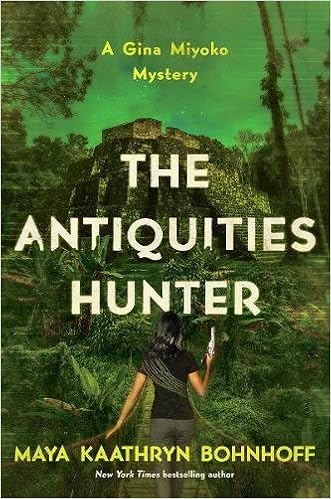
Gina “Tinkerbell” Miyoko is not your typical private eye. Armed with a baby blue Magnum, a Harley blessed with Holy Water by her dramatically disposed mother, and a Japanese mingei tucked in her pocket (a good luck charm from her Sherlock Holmes-obsessed father) Tink spends her time sniffing out delinquent dads in the San Francisco Bay area and honing her detective skills.
But when her best friend Rose, an undercover agent, discovers there’s a stalker on her tail, she hires Tink as a bodyguard. Someone must be trying to intimidate Rose and scare her out of testifying in an upcoming case on looted Anasazi artifacts. But when Tink tries to flush-out the stalker, things take a far more dangerous turn.
Now, with a dead black-market dealer and an injured Rose on her hands, Tink must take her best friend’s place and follow the looters’ trail towards a powerful and lucrative antiquities collector in Cancun, Mexico. Equipped with an ingenious disguise and a teasingly coy persona to match, Tink is determined to find out who is behind the attack on Rose and the illegal trafficking of these priceless artifacts. Along the way, she will find help in the most unlikely of partners…
Deep in the jungle and far from civilization, Tink must decide who she can trust as she tries to unearth the ones responsible behind the pilfering and bloodshed―and still make it out alive.
Antebellum Struggles

Antebellum Struggles is told through the eyes of multiple characters whose lives intertwine as a result of slavery in the deep south. We see their varying opinions, experiences and their individual backgrounds that influence their perceptions of the world at present.
Young Amana, from Martinique, a Caribbean island, was born into slavery and was later shipped to a plantation in Louisiana. Colonel Winters, the plantation owner, struggles in his relationship to his wife, Collette, and seeks to fulfill his lust in an affair. Simultaneously, a doctor takes advantage of being admitted to Colonel Winters’ home under dire circumstances.
Throughout the story good intentions are tested and morals are in constant conflict. There is love against lust, an abolitionist receiving money from a slave owner, and deception for personal gain throughout. The book thus serves as an incredibly graphic detailing of society at a time when power and violence ruled by the crack of a whip.
The author, Dickie Erman, is successful at portraying depth to the actions of a distinct variety of characters. The stylistic choices made by the author allows the reader to glimpse a character’s true intentions. For example, the doctor who tries to turn every situation to his advantage despite it being to the detriment of others; where the reader sees the doctor’s thoughts as he tries to manipulate the Colonel.
Dickie Erman delves into the role of power and hierarchy as a means of controlling others, exploring how different characters use their stature to get what they want. Power and stature play large roles in the story, especially in the carrying out of violence. The array of infringements upon victims in the book are often viewed and justified by the characters causing violence or imposing their power. The reader thus watches the mental gymnastics that the perpetrators use with anguish.
Moreover, with such violence presented in the book it is worth noting that the descriptions are gut-churningly graphic, though appropriate in their realism. Due to the nature of the topic, it is difficult to read, however this is not a negative. This author does not hold back on the details of the conditions on a slave ship, nor haphazard medical procedures. The word choice is bold when referring to people as property and mere flesh, as such it is harrowing to read. It is a disturbingly realistic display of slavery at that time.
For some readers who are not used to the style of narrative that Dickie Erman employs, the switching between character viewpoints may make the story difficult to follow. This is especially true for the flashbacks to various characters’ background stories. However, as the reader follows each account of a character’s experiences, the story never loses its natural flow. The technique is appropriately used in the portrayal of each of the characters’ very distinct viewpoints.
Antebellum Struggles is an engaging book that follows a variety of character arcs all intertwined by a plantation in the deep south. Dickie Erman masterfully switches view point and projects distinct character voices. The events of the novel draw the reader into a disturbingly realistic rendition of life in Louisiana at a time when segregation and slavery were common place. The author manages to disclose the gruesome details of what life was really like at such a difficult time.
Pages: 255 | ASIN: B07DFQLL8Q
Longevity: The Wardens Of Time
Noah Thomas is a scrawny seventh grader who is bullied to the brink in his new town. Friendless, except for sassy tomboy Wendy Sherman, who seems to lend him the confidence he needs to stand up to his oppressors. Upon stumbling into a bookshop one afternoon while on the run from some teenaged tyrants, Noah is hurled into an unexplainable adventure. Noah learns that the bookshop does, in fact, lead to the Akashic Records – a place that holds all spirit lives recorded in tablets of light. With this new found knowledge, Noah begins to grow in wisdom and confidence to face his fears. His biggest challenge comes in the form of five demonic spirits that he accidentally lets loose from a lost tablet. Will Noah succeed with the help of his guardian angel cat he calls Keeper, or will all Hell’s henchman prevail?
Midwife of Normandy
![Midwife of Normandy (Secrets of the Austen Midwives Book 1) by [Penfield, Carole, Lady, A]](https://images-na.ssl-images-amazon.com/images/I/51O0ysGA90L.jpg)
Carole Penfield gives readers a realistic and interesting piece of historical fiction in The Midwife of Normandy. The story opens with Clare, who finds herself in the cargo hold of a ship along with her family. It is the late 1600’s and they are sneaking out of France to England, where Protestants are not persecuted, and she can continue her midwifery practice. We have no idea what preceded her current state of affairs until we are transported back to her youth and the very first day she received her journal. We learn about Clare’s upbringing and the strong tradition of midwifery in her family, along with the history of disapproving husbands. It is not long before Clare herself is ready for training and eventually ready to take over the practice. It is also not long before she acquires a disapproving husband of her own.
Penfield creates a beautiful and flowing story with elements of history, romance, and story-telling brought together by a colorful cast of characters. Clare is a strong female lead, dealing with issues that are timeless. I love that her family has such a passion for helping other women and will stop at nothing to do so. The history behind this story is interesting and lead me to further research, which is one thing I really love about pieces of historical fiction. I thought the author could have included more realistic dialogue to the times, but I understand that just wasn’t the direction she went with this piece.
Her characters are fantastic and add richness to the story, as all good characters do. There are characters with a dark side and those who even it out with some comedy and levity. Penfield is a self-proclaimed lover of Jane Austen and weaves elements of that authors works into her story. She challenges other Austen fans to find little hidden tidbits throughout the story that are Austen-inspired.
The juxtaposition of a personal story of feminine struggle for power and equality with the story of a religious group struggling with the same issue is an interesting one. These are themes that have manifested throughout history and continue to be real struggles so I thought this book felt modern despite its historical setting.
Penfield did a beautiful job with this story. I was entertained and interested throughout and even learned new history! I look forward to reading more books in this series!
Pages: 325 | ASIN: B01M7Q93OO
Mortgaged Goods
![Mortgaged Goods by [Cobcroft, Lorraine]](https://images-na.ssl-images-amazon.com/images/I/51lyObV%2BEgL.jpg)

What is the meaning of success; titles, money, family, happiness? These are the questions Nata and Karl must face as their life makes dramatic changes from their carefully planned out future. Nata is fostered by working class parents Joe & Hetty, Karl comes from the upper-class elite. Nata’s biological father was abusive to both her and her mother, leading her to fear men, and especially any and all sexual contact. Despite her reservations Karl works his way into her heart and they marry with the intent of living full professional lives that does not include a family. Nata however finds out she is pregnant and together they must figure out how to adjust their life goals and ambitions to this new situation. While battling with his ideals about his personal life, Karl must make some choices about his professional career as a lawyer. Knowing what is right and knowing what you can make a difference with are gray areas when you’re a lawyer dealing with the upper-class elite.
On the surface this book starts off with the story of two people from different worlds coming together to make their relationship work through unplanned events, pregnancy. As the story deepens you see beyond the surface struggles or plans changing, you see the deep wounds that childhood sexual abuse brings; you see the residual effects of emotional abuse and withholding of love and support to a child. It changes the world view, it changes what is important in life. Nata and Karl could be anyone you encounter in the professional world. They are focused on their goals but when life turns things upside down, their struggles to connect and find a path forward are relatable. Unplanned pregnancy, changing life goals of prestige or happy home life, can they all be merged? Karl’s professional life is also dealt a staggering blow. He knows the difference between right and wrong but knows fighting against what is wrong in this case is career suicide. He takes the safe way out to save his career, but it nags at him. He continues to try and find balance between right and wrong.
While Karl is trying to find his way, Nata is trying to make peace with her past and the demons that follow her. It is a realistic view into how sexual abuse continues to hurt people well into adult lives and impact their life decisions. When her baby is born early due to a car accident she is thrust into even more challenging emotions, a premature birth, a child that will have lifelong medical needs, a husband that can’t come to terms with a non-perfect child. Lorraine Cobcroft’s ability to tap into those emotions and the mindset of a new mother experiencing them is profound. So often these things are glossed over for other more comfortable plot lines, however Mortgaged Goods puts these deep emotions and controversial topics right into the forefront of the novel, making them key points.
While the novel starts out looking like it will be a ‘lawyer takes on the corrupt upper tiers of society’ type novel, this book is so much more. Mortgaged Goods by Lorraine Cobcroft tackles deep emotional issues, sexual abuse, sexual exploitation, corruption of society, to include law enforcement, judges, and politicians. Through it all though, it is a novel about making a relationship work though the hard times, finding out what is truly important in life, and making the best of what life hands you, even when that is not what you have carefully laid out in your life plans.
Pages: 278 | ASIN: B018ZVWE5O
House of Pain Trailer
Maggie Shelbador is a half-breed succubus with a heart. Though raised inside one of the worst whorehouses in the world, all she wants is to find one man who will love her despite what she is. She dreams of one day being free of her nightmarish life but fears no man will ever truly trust her.
The year is 3515 and most of the world has been destroyed by a combination of natural disasters and man’s neglect. The whole human race faces extinction. To survive, the leaders of the day approach demons for help, not understanding the high price they will be forced to pay. Normally bound by the summoner’s magic, the demons know Maggie is the key to giving them free access to Earth.
Daniel is a widower with a young son. He is out hunting one day when his settlement is attacked and his son abducted. He tracks them to House of Pain, not realizing a trap is being set for him. Though tortured, Daniel refuses to break when they try to force him to prostitute himself—until a beautiful blonde woman is brought into the room, her power stripping away his self-control.
Karma Will Prevail

John Fennell Author Interview
Raven and the Panther follows ‘Raven’ as she relentlessly pursues her uncle’s killers. What served as your inspiration for this thrilling novel?
The inspiration for this book is my wife’s family. The Myth, Bill was a real person. (He’s no longer with us) Barbara Ann (AKA Raven) is actually my wife. I’ve embellished her personality, to fit the character. The inspiration for this series is only limited by my imagination. I was ten years old when I saw my first James Bond Movie, been hooked since.
Raven is an interesting character that I enjoyed watching develop throughout the novel. What were some themes you wanted to capture in her character?
I wanted the reader to know she wasn’t a bad person, she loved her uncle Bill so much, she was willing to become who she was to seek out and terminate his killer. As the story developed, I knew she would succeed, not because I’m the author, she is just as determined in real life. Both my wife Barbara Ann and I have a firm conviction if you stick to your principles, treat everyone the same, be honest in life and help those who deserve it, Karma will prevail and it has, we have lived a blessed life. I focus more on this in the books that follow Raven and the Panther.
I really enjoyed how this novel was action packed and filled with interesting characters. What was your favorite scene to write?
The last chapter, when Raven walked out on the Foundation at her cabin. She knew who ordered her uncles kill, but the Foundation wouldn’t let her terminate him, so she did what I know the REAL Raven would have done-walked. Also, it set up the next book.. Raven Gone Rogue. Barbara Ann is somewhat like the character Raven, dedicated to a cause, focused when needed, but loving, kind and generous. My wife is truly a copy of Raven, just not to the extreme as the character is portrayed.
What is the next book that you are working on and when will it be available?
The next book is Raven Gone Rogue available now.
Raven Anderson, top female agent for The Foundation, has gone rogue. Her longtime lover, Naci Vacara, a direct decedent of the Foundation’s matriarch, desperately tried to convince Raven not to leave the ranks of the agency. His loyalty to The Foundation forced him to put her in his sites. Raven, now the hunted, teamed up with Morgan, one of the most feared agents in the world. Together they developed an unusual relationship, faced one challenge after another until Raven discovered something in her past.
Raven Gone Rogue takes readers on another wild ride, filled with action, adventure, devastation, mystery, romance and wealth. Raven Anderson, a woman who gets what she wants, is on top of her game. A game, the reader secretly would like to imitate.
Author Links: Twitter | Facebook | Website
![Raven and the Panther by [Fennell II, John V]](https://images-na.ssl-images-amazon.com/images/I/51Ijzup9bsL.jpg)
Raven Anderson was raised by her Grandmother and Uncle where she enjoyed the slow-paced country lifestyle until one event changed everything. Her beloved Uncle, a father figure, was unexpectedly and brutally murdered. On her journey to seek revenge, Raven discovered her uncle’s secret life, a world she didn’t even know existed.
Raven’s journey and relentless desire to hunt down her Uncle’s killer put her in the cross-hairs of an organization whose members included people she had known her whole life. Raven and the Panther takes the reader on a wild ride filled with action and adventure, erotic romance and revenge.



 LITERARY TITAN