Blog Archives
Musings of Mannarkoil Professor: Now and then here and there
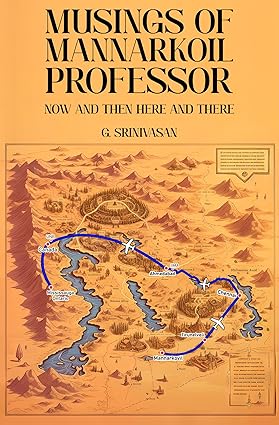

Musings of Mannarkoil Professor is a delightful collection of autobiographical essays by G. Srinivasan, a retired academic who traces his journey from a temple village in Tamil Nadu to a fulfilling professional life in Canada. The book skips across time and place with warmth, humor, and surprising insight, offering personal tales that touch on family, education, cultural identity, and the everyday absurdities of life. From playful musings on spelling and name pronunciation to deeply rooted reflections on migration and belonging, Srinivasan stitches together a life story that feels both intimate and quietly epic.
Reading this book felt like chatting with a wise, well-traveled friend who always has something interesting to say. The author’s recounting of being mistakenly addressed as everything from “Spinivasan” to “Scinivasan,” a result of bureaucratic misinterpretations of South Indian naming conventions, was both humorous and revealing. These anecdotes not only elicited genuine laughter but also prompted reflection on how names encapsulate identity, geography, personal history, and the enduring influence of colonial languages. Particularly memorable was his wry response to those inquiring about the pronunciation of his name: “Please don’t. I am alive.” It is uncommon to encounter a writer who so seamlessly blends self-deprecating wit with insightful commentary.
The childhood recollections are rendered with a poignant nostalgia that remains measured and never overly sentimental. The vividness of his descriptions evokes a tactile sense of the era; one can almost feel the cool surface of a slate or hear the distinctive tickticki of the itinerant barber’s clippers. His attention to detail, whether it is feeding pencil shavings to a peacock feather or applying ivy gourd leaves to a slate for their supposed medicinal properties, imbues everyday moments with remarkable vitality. These memories are layered with emotional nuance, effortlessly shifting the reader from quiet amusement to unexpected poignancy. His account of his mother calmly examining a cracked slate and pronouncing it fit for another year of use encapsulates both the affectionate pragmatism and quiet discipline that characterize life in a large, traditional Indian household.
What stood out most to me was how the author seamlessly connects the dots between the personal and the cultural, especially in the later chapters. His story about selling used notebooks to sweet vendors and then getting those same pages back as food wrappers was not just funny, it was such a vivid snapshot of frugality, circular economy, and childhood ingenuity in small-town India. An intimate knowledge of Tamil Nadu is by no means a prerequisite to appreciating his narrative. His storytelling possesses a rare generosity, inviting and inclusive, it resonates across cultural boundaries.
Musings of Mannarkoil Professor is a lovely, gently funny, and surprisingly profound read. It’s perfect for anyone who enjoys memoirs, especially those filled with culture, wit, and old-school charm. If you’ve ever migrated, struggled to explain your name, or just reminisced about the weird tools of your schooldays, this book is for you. I’d especially recommend it to diaspora readers and South Asians of all ages. Anyone with an appreciation for well-crafted narratives imbued with warmth and humor will find much to admire in this work. Though now retired, the professor’s storytelling remains as compelling and incisive as ever.
Pages: 161 | ASIN : B0F757C98J

Making Sense Of The Insanity Of Moralities

Re-birth tells the compelling story of Anessa’s reincarnation in the intriguing fantasy world of Anfang. What was the inspiration for the setup to your story?
I’ve been a fan of Mythology of almost every variety. As a child I was always intrigued by Lewis Carroll’s Alice in Wonderland and being pulled through to a new world.
Anessa is an intriguing and well-developed character. What were some driving ideals behind your character’s development?
Anessa is a logical view of what might happen to a western person should they be taken at the point of their death and placed on a new planet through divine intervention. She’s lost, confused, and must navigate a new world alone, forging new bonds, making sense of the insanity of moralities that are different from what knew she on Earth.
What were some themes that were important for you to explore in this book?
Our world is on the precipice of some vital changes to personal rights. Anfang represents an exploration of an ideal, and in future volumes I may tinker with how easily it can crumble.
The exception to this question is nobles using marriages to form bonds between families as chess pieces, but that is a component of medieval societies, not of a theme I wanted to explore.
When and where will your book be available?
Re-Birth will be available November 24, 2022, on Amazon in eBook, Paperback (black and white) and Hardback (full color). The eBook is on sale for $4.99 until 1/1/2023. The sale pricing for the paperback and hardback are beyond my control as I’ve already found out.
https://www.amazon.com/dp/B0BHVG5ZB6 – eBook
https://www.amazon.com/dp/1959098004 – Hardback
https://www.amazon.com/dp/1959098101 – Paperback
Author Links: GoodReads | Twitter | Website
For Anessa, death was just the beginning…
Originally from Earth, she finds herself transported to Anfang with one question:
“How did I die?”
Reborn into a family of wealth, privilege and magic, the expectations placed on her clash with her Earthen sensibilities.
As Anessa grows into her newfound place and power, she struggles with the notions of political marriages, inane rituals, and the awareness that her biggest threat may come from within.
Who do you trust when your first life was stolen by your best friend, and your latest sin is living?
Join Anessa on her debut journey in My Own Mythology — Re-Birth; get yours now!
Woo Ae Yi – Author Interview

Profiles of KAD Relations with the Black Community helps readers understand how KAD can be a bridge in the Black Lives Matter movement. Why was this an important book for you to write?
I wrote the answer to that within the book itself, but essentially I didn’t feel that there was anything like it in existence, and I thought there should be.
What were some ideas that were important for you to convey in this book?
The role that Korean adoptees play in anti-racism.
What is a common misconception you feel people have about Korean adoptees (KAD)?
That they’re “not Asian enough.”
What is one thing you hope readers take away from your book?
The importance of practicing anti-racism and the importance of getting adoption-based and/or race-based trauma included in the DSM V.
Author Links: Website | Facebook | GoodReads
This book is divided into three parts: profiles, background history, and a how-to. Korean adoptee, Yi Woo Ae, also added a call to action. She first points out how the relationship between Blacks and Korean adoptees is better than what we see in the media, if it’s in the media at all. The author advocates for the inclusion of adoption-based and race-based trauma into the Diagnostic and Statistical Manual of Mental Disorders (DSM). She shares the importance of acknowledging that trauma, as defined in the DSM, is not currently all-inclusive. Whether we believe we chose our present life or not, we are the bridge between worlds. As a Korean adoptee (or Asian adoptee), we can support the Black Lives Matter movement.
Vexing Stages of Culture Shock

Michael Greco Author Interview
Plum Rains on Happy House follows an American who is trying to turn an Inn into a school but is thwarted by the house’s strange creatures. What was the inspiration behind this unique story?
I live in Japan, and it’s a place I know well. The book’s dedication probably says it all:
This book is for Japan. It’s the place I call home—though it may not want me to. For over 25 years I have grappled with the dos and don’t’s of my host country, destroying the language in conversation, giving up, resuming more study, eventually resigning myself to the boundless plateaus of almost-speech.
And Japan abides. Like a patient steward, it absorbs the frolics and the ribbing, while providing a solacing habitat in which to write and teach and parent and grow.
I came over to Japan in the 80’s and I’ve lived in some pretty seedy guesthouses—what we call gaijin houses. In creating the residents of Happy House, I just mingled the characteristics of a few of the unique people I’ve met over the decades in Tokyo and in Los Angeles. In some cases, I didn’t need to exaggerate at all.
On one level Plum Rains on Happy House is a detective story. A fellow named Harry Ballse invites the protagonist, nicknamed the Ichiban, to Japan. But the residents of Happy House all deny any knowledge of this mysterious Harry Ballse.
Some readers may pick up on the references to the 1973 film The Wicker Man, about a policeman who is lured to a Scottish island to investigate the report of a missing child. It’s a game of deception. The islanders are playing with him. The paganism and the sexual activity the sanctimonious policeman finds so objectionable are simply part of the selection process—to see if he possesses the characteristics to burn in their wicker effigy so that the village will have subsequent successful harvests.
In Plum Rains on Happy House, the Ichiban must undergo his own horrific sacrifice to appease the house. My novel is in many ways a tribute to that remarkable film, and it has the same foundational plot lines, but I’ve laid down a hearty layer of satire and lots of cross-cultural lunacy.
There are some weird and fascinating things happening in this story. Was this an easy outlet for your creativity or was there some effort put into creating these things?
Nothing is easy. If women will forgive me the metaphor, creating Plum Rains on Happy House was like giving birth—it hurt a lot. There were points when I considered giving up because it was just too hard. I’m not a funny person, but I have little trouble dreaming up wacky stories and characters. The residents of Happy House had to be distinctively quirky. I didn’t know how bawdy things were going to become, or how much depravity would creep its way into the story. But once I had the characters they took charge, and I relegated myself to being, more or less, their stenographer.
Dialog was also something I paid close attention to. Of course, sharp dialog is vital in any story, but for this kind of back-and-forth humor to succeed, I felt it really had to have zip. Just like a comedian practices his delivery line, the dialog exchanges had to have real punch. As with most writing, dialog should say a lot , with very little. The communication isn’t in the words being said but in the subtext. Good dialog says it without saying it. One quick example from Chapter One has the resident of Room 3 (nicknamed The Goat) explaining to the new resident about his missing foot:
“I saw you looking at the bottom of my leg.”
“Your foot?”
The Goat scowled. “Obviously, you can see that no longer exists.”
“It’s in Cambodia.”
The Goat went into a cross-eyed fluster. “What is?”
Sometimes readers need to work a bit to understand the exchange, and I think they appreciate that. Dialog is an organic process. It’s the way characters talk in my head, and I think I know how to write them because they are all a part of me. It all works toward satisfying the element of what a good scene often comes down to: one person trying to get something from another.
Mix that in with the baffling idiosyncrasies of Japan and its language, and the vexing stages of culture shock, which frame the Ichiban’s adventure in Happy House, and readers have a lot to juggle, especially those uninitiated to living in other countries. I’m hoping this confusion is a part of the magnetism of the story. On top of that, one should remember the old guesthouse is haunted:
“Happy House is an amoeba everlasting, a floating world—capturing and sealing the self-indulgence of the red-light districts, the bordellos and the fleeting, delightful vulgarity of ancient Japan, an eternal time capsule of the flamboyant and the boorish.”
What do you find is a surprising reaction people have when they read your book?
The book has received mixed reviews. Of the five books I have up on Amazon, Plum Rains on Happy House was the first to receive a customer review of one star—perhaps rightfully so: the reader was “disgusted” by some of the more explicit scenes, and I think that was my fault; the earlier cover gave no indication of the sexual content within, and this poor woman was clearly ambushed. With the one star, I know I’m finally an author, and wear it as a badge of honor.
There are, however, cultural elements in the story that some will not understand: the usage of the various slipper customs inside a house, the daily beating of the futon, the laundry poles, the shockingly steep stairwells, the neighborhood garbage trucks that play cute tunes to let you know they’re coming, the confusion between the colors of blue and green.
The dichotomy of substance versus form also plays an important part in underscoring the tension—in the way one swings a tennis racket, or walks in a swimming pool, or plays baseball, or eats particular dishes: What should predominate—what you are doing or how you are doing it?
On another level, the story examines language acquisition and the role of structure within the learning process. The residents all have their various opinions: As teachers, should English be taught through some kind of lock-step formula, or would one be better off approaching it in a more hands off manner, rather like painting? Everyone seems to have an opinion.
The idea of structure comes to the forefront again when discussing what one character, Sensei, calls the hidden structure of the house, which, like the neighborhood (or any cityscape in Japan) appears as an amorphous sprawl. But look underneath this sprawl and one sees the organism. Sensei says that the randomness, or chaos, embraces a flexible, orderly structure, and he likens the house to an amoeba that has the ability to alter its shape. Similarly, this amoeba can be seen as a microcosm of Japan as a whole.
What are you currently working on and when will it be available?
I’ve finished the first few drafts of a story about Special Needs teens who discover time travel. But the adult teachers at the school find out what’s going on and abuse this ability to travel back into time for their own selfish needs. It turns out the ones with the Special Needs are not the teenagers—who are all somewhere on the Autism spectrum—but the supposed grownups, and it’s up to the teens to save the day. It should be out in autumn.
Thanks for having me!
Author Links: GoodReads | Twitter | Facebook | Website
![Plum Rains on Happy House by [Greco, Michael]](https://images-na.ssl-images-amazon.com/images/I/51Q1wl7Un%2BL.jpg) In Japan, the little inn called Happy House welcomes its guests … unless it’s rainy season. When the “plum rains” arrive, trying times of volatility and decadence begin for everyone.
In Japan, the little inn called Happy House welcomes its guests … unless it’s rainy season. When the “plum rains” arrive, trying times of volatility and decadence begin for everyone.
The American in Room 1, however, is dead-set on turning the derelict Happy House into a burgeoning English school.
The house has other plans, and Room 1’s attempts are thwarted by a freakish creature that lives under the floorboards called “the Crat”.

Mandarin Ducks
![Mandarin Ducks: Kaifeng Chronicles, Book Two by [Campbell, Robert]](https://images-na.ssl-images-amazon.com/images/I/41ugh9XngfL._SY346_.jpg)
In the year 1630, in Hangzhou, China, two families were getting set to join with the marriage of Li Bing and Xiaoyun Wang. Marriage is taken very seriously and there are many traditions that must be observed in order to ensure a prosperous marriage to the couple. Li Bing is the city’s celebrity of sorts as he prepares to take the exams to become an important civil servant for the city. This causes his father to receive many gifts and accolades, as well as resentment. Vice-perfect Wang Zhengqian, father of Xiaoyun, plots to ruin Li Bing’s father, the other vice-perfect Li Gao. Wang is power hungry and wants nothing more than to gain all he can, and cares little who he hurts in the process, his own family included.
Mandarin Ducks is the second book in a trilogy by Robert Campbell. The first novel gives you more background of this community and some the characters so I recommend reading that first, but it’s not required as this book can stand on it’s own. Taking place in the 1600’s of China, it talks about how some of the inhabitants have roots in Jewish culture, and how they have to keep that hidden away. Li Bing has a deep interest in discovering his heritage and Jewish roots but must go in secret to learn more about his past. His grandfather helps him some but is growing old quickly and Li Bing is worried all the past knowledge will be lost. There is a lot of focus on class and the nuances that each rung of society has to observe. I enjoyed reading about how the different classes interacted, and as the story line developed I grew more invested as things become more intricate and layered. The novel has a slow start and builds at a steady pace that never feels rushed and allows you to grow attached to the main characters involved in the plot. The side story of Li Bing learning about his Jewish roots mixed into the scandal between the vice-perfects was well placed and fit seamlessly into things, nothing felt like added filler, everything seemed important to the progression of the story.
I really enjoyed Robert Campbell’s style of writing. The prose is clean and the story is focused. The story expertly builds suspense and develops the characters in a way that you either love or hate them. There is real history encased in the story, making things more believable, and adding extra depth to the plot. I look forward to reading the next installment of this series.
Pages: 133 | ASIN: B07G7GV256
The Dragon of Hidden Treasures
![The Dragon of Hidden Treasures: Book 1 by [Troi, Juliann]](https://images-na.ssl-images-amazon.com/images/I/31XLuT2BurL.jpg)
Kathryn is faced with giving up her dream of being an independent professional woman and putting to use her education in her father’s company, and Ty is a man trapped in a job for the Chinese warlord, Cheng Jiong, wanting nothing more than to be with Kathryn. The ties that bind him, however, may be stronger than he thinks. When Kathryn is kidnapped and Ty finds himself part of the plot to use Kathryn’s position as leverage, Ty and Kathryn strike up an unusual alliance which leaves both of them in danger and both with more to lose than they could ever realize.
I do not know exactly what I expected as I began to read of Kathryn’s education and her father’s plan to marry her off to a man she did not know, but I know this much: Juliann Troi’s writing in The Dragon of Hidden Treasures Book 1 is simply beautiful. When an author writes so fluently in the language of imagery that it makes you forget where you are and who is around you, you know you have met the best of the best.
Kathryn is a force with which to be reckoned. She is beyond her time and is as cunning a character as I have seen in a while. Right out of the gate, Troi had me rooting for Kathryn to overpower her father with her obvious common sense and business savvy. She is a true testament to the fact that women have, for decades, been a force in business whether they were allowed to have their names attached to their work or not. She exemplifies every strong woman striving to be heard and seen in a man’s world.
The budding relationship between Kathryn and Ty is enviable. His love for her is clear from the first words he speaks of her. Though the “stalker-esque” behavior at the outset is a little unsettling, it plays well into the plot and is less of an issue when the reader sees their destiny play out. Again, Troi is an artful writer–plain and simple–making the most basic of actions flow beautifully across the page.
Revelations are an important part of Troi’s writing. As Kathryn and Ty’s story progresses, Kathryn is stunned by Ty’s admissions about his family. Without giving anything away, I can say that I was just as surprised as the key character. Ty has been down quite a harrowing road, and that experience lends itself well to Troi’s plot and is a vital part of the character development. Troi does not lay all her cards on the table and is a master at throwing the reader for the proverbial loop.
Juliann Troi’s historical fiction is an all too accurate portrayal of the struggle women have faced to be heard and to take part in the biggest decisions in business dealings throughout history. Interspersed throughout the romantic tones of the book are tidbits of China’s history peppered with glances into the horrors of war. I look forward to Book 2!
Pages: 584 | ASIN: B079XX8BZM
18 Cranes: Kaifeng Chronicles, Book One
![18 Cranes: Kaifeng Chronicles, Book One by [Campbell, Robert]](https://images-na.ssl-images-amazon.com/images/I/41yNsThvW0L._SY346_.jpg)

For most of his life, Bing has prepared ceaselessly to take the civil servant examinations, with little time for anything beyond the collections of texts that dictate political matters. Passing the exams would be the first step in following his father’s path, and also determine nearly everything else about his future. Finally, the day to begin them has arrived, and Bing faces the grueling challenges before him with understandable anxiety, but also a necessary determination. Outside of the exam compound, however, his focus is frequently drawn to a mysterious dream that recurs almost nightly, as well as a glimpse into history from his beloved grandfather.
In 18 Cranes by Robert Campbell, we’re introduced to Bing, his loved ones, and some of the traditions of village life in 17th century China. With an engaging narrative and colorful descriptions of Bing’s world, 18 Cranes does an excellent job of holding the reader’s attention, even while discussing a subject as mundane as civil servant exams. Despite a lack of any real action, the story never seems stagnant. Of course, there’s more going on than just rigorous testing. Bing is also suddenly plagued by a recurring dream, the meaning of which eludes him. The reader learns a lot about Bing and his relationships with his loved ones over the course of several expertly crafted conversations that examine each part of the dream, which always ends with 18 red-crested cranes ascending into the sky. The number 18 in particular holds special intrigue and multiple explanations are suggested for its meaning. To further the feeling of mystery, toward the end of the story, Grandfather Ai begins to tell Bing about the origins of their family. The short oral history is enough to stoke Bing’s stifled imagination. Restricted by his strict studies, Bing has never had the opportunity to read many legends or works of fiction and his curiosity, although kept under control, nonetheless exists. Grandfather Ai’s revelations also provide an interesting twist for the reader.
The uncertainty of the future is an overarching theme throughout the book and is explored through both tangible avenues, like Bing’s performance in the exams, as well as in deciphering the symbolism of his dream. There is also a considerable emphasis placed on Bing’s age, with repeated mentions that he could be one of the youngest people to ever pass the exams on the first try. Because of this, it reads a good bit like a coming of age story.
18 Cranes is subtitled “Kaifeng Chronicles Book One”, in reference to the village that Bing’s maternal ancestors came from. I’d be excited to read the rest of the series and follow Bing further through the avenues of his life. The abundance of detailed descriptions make it easy to picture the aspects of Bing’s village life, from the shores of West Lake to the flowers in the gardens. This book is an interesting and well written story that moves at a good pace.
Pages: 123 | ASIN: B07C8LC32H
Incredulous Insight

Glenville Ashby Author Interview
The Mystical Qigong Handbook for Good Health details one of the pillars of Traditional Chinese Medicine. Why was this an important book for you to write?
I believe that in our global society we are no longer restricted to one mode of medical care; that we can share and learn from each other. Further, Qigong is an ancient practice that offers incredulous insight into the human body and how it functions. I have utmost respect for tradition and the ancients.
It was nice to find a book that covered a variety of questions average people have about Qigong. What is one question you always get asked about this topic?
Can Qigong cure every disease?
What do you hope readers take away from your book?
That they should know the dynamics of the human body and how much we are connected to the universe; that we are inseparable.
What is the next book that you are working on and when will it be available?
I am working on 100 paths to God, a compilation of published articles that I have written for the Gleaner company, one of the oldest media houses in the western hemisphere.
Author Links: Twitter | Facebook | Website
 Qigong is one of the pillars of Traditional Chinese Medicine (TCM). It involves gentle hand movements, postures, controlled breathing and some visualization. Qigong is widely known to successfully treat a number serious illnesses, promote muscular-skeletal strength, increase circulation and promote overall wellness. The Mystical Qigong Handbook For Good Health offers simple but very effective exercises for all age groups.



 LITERARY TITAN