Blog Archives
It Arose in Dreams

Ruth Finnegan Author Interview
Black Inked Pearl follows Kate, a young Irish girl, as she searches for her lost lover. What was the initial idea behind this story and how did that transform as you were writing the novel?
It began in a dream when I was in New Zealand visiting my daughter and granddaughter who live there. This was, essentially, the first page (and chapter) of the novel when Kate, panicked and feeling she was too young for love runs away desperately as her best childhood friend (I never learn his name) tries for the first time, a teenager to kiss her. That scene, that act, is the foundation for the story as she years later discovers that she as frantically and desperately loves him as she had frantically fled from him years before
I say ‘dream’ as that is the nearest word I can get, vision perhaps they would have called in in the middle Ages. But that word’s a bit misleading. In two ways.
First, it wasn’t exactly a dream in the sense of being, asleep more an experience in that liminal in-between state of being neither awake nor asleep but somehow fully both – the whole novel came in that somehow enchanted enspelled state ( I suppose you might call it ‘inspiration’). I planned nothing, but it was still a chapter a night, written down effortlessly (I don’t even remember doing it! or, by now, what the words were. it surprises me every time – so many times – I reread the book now).
Second, ‘dream’ suggests something visual, But it was more a kind of very intense node of emotion, something very personal to me (in a metaphorical sort of way the whole book is kind of autobiographical – what serious novel is not? – and the second chapter about a small girl experiencing the magical world of Donegal – is directly so.
Then the novel – and Kate – just grew. I came to know the hero well, but wish that my ‘dreams’ had given me his name
Black Inked Pearl is told in a dreamlike, almost stream of consciousness, style of writing. Why did you want to tell the story in this style and what were the challenges?
Well, it arose in dreams and the writing essential came from, and took place in, my unconscious – at least that is the only way I can understand and it. So the style is scarcely surprising, it was little under my deliberate control and almost not at all revised later.
I didn’t know in what style I was writing – the process was almost unconscious – but when it was finished I saw (or rather heard when I read it aloud ih my inner ear as I always do with my writing)that it had the rhythms and sonorities of African and Irish story-telling (my mother was a wondrous story-binder) and that some literary giants (Joyce, Fulkner, Hopkins … many others) had written in similar styles. Poetry is mixed with prose – well in a way, as with its oral resonances (a subject on which I have written in academic contexts, in Oral Poetry for example), it is all poetry, some fully, some ore in a kind of blank verse: all unexpected by me!
Also, the content. Part of what I learned as the story revealed itself to me was that the division between dream and reality is an elusive and perhaps non–existent one.
Problems – well some of my readers have problems with it! Some object because they cannot abide what they see as ‘incorrect’ grammar orthography words, not what they learned in the first form at school – I appreciate that they have tried but think they miss the point (how do they cope with Shakespeare?).
Others including my deeply wise best friend, get a bit lost in the plot from time to time, too full of Celtic mists said one. It’s too late now to amend that (and maybe it is just a necessary feature of the novel – mystic, mysterious – anyway) but I have tried to make things clearer, while not abandoning what has now has now become my signature style, in the related ‘Pearl of the Seas’ and, on the way, The helix pearl’ (the latter the same story but this time as told by the garrulouos ever-sprarklng laughing sea (a very different perspective but equally born in dreams). I wonder what is coming next ..
Oh yes, the unusual spellings were loved by the Garn Press, the lovely publishers, but at the same time gave the copy-editor real problems. Microsoft, can yoy believe it (the cheeky thing) kept automatically ‘correcting’ the ‘wrong’ spellings. In the end they got me to send a special list to add to their ‘glossary’ of all my new spellings and word and abbreviations etc. I thought that would be quick and easy – about fifty cases? Whew, no! They tell me, incredibly, that it was nearly two thousand! Don’t believe it! Ut they ear that’s true. Anyway, hey did a great job whatever.
Kate is an enthralling and curious character. What were the driving ideals behind her characters development throughout the story?
As I say it wasn’t conscious since it all came in dreams. So in a way no ‘driving ideas’.
Still I have noticed some abiding themes , detected, later, in the text, as if looking at someone else’s writing (well in way it’s NOT exactly mine, not t=in the normal way anyway – not of the deliberate, conscious careful academically trained me). /tow especially, the ones `I swoudl like to think readers will take form the novel (and from the movie if it gets made a I hope it one day will)
First as I said earlier is the understanding , that we may pretend or think we do, but that actually we do not really know the difference between reality and dreams. Given the way we have been brought up as children of the scientific revolution, this is an exceedingly difficult idea, is it not – but so important to try to accept, specially now as we become more aware of the lives, and, in a way, precious value of those with dementia. Perhaps it is only through literature and metaphor that we can eventually begin to grasp this.
Second is the thought, revealed near the end, that it is and was indeed right as Kate did, to search for others and try to help them carry their burdens. But that in the end it isourselves we are responsible for, it is our own souls for which we have to answer before (whatever metaphor we prefer here) the last judgement throne. As Kate in the final chapters had to do.
Also, after I had finished the book, I was inspired by the little butterfly that, unknown to me, the publishers had put, with the pearl and the jagged black, on the beautiful cover. ‘Butterfly’ in Greek –elsewhere too I think – is the same word and concept as for the soul, breath, spiritus, life: psyche (as in ‘psychology’, ‘psychiatry’). So the soul – figured as Kate, as every man – flies through the black ink print of the story and at the end settles down on the back cover, life fulfilled story told, with her wings folded.
Kate’s discovery of herself at the end was also, I now see, a kind of discovery of myself as person, as soul.
What are some of your inspirations as a writer that helped shape Black Inked Pearl?
Again, ‘dreams’, my unconscious I suppose. But, as one perceptive reviewer put it, only someone with my background and personality would have had those dreams. So – my life, my loves, my experiences of the resonances and styles and images of great literature, above all Shakespeare, Rumi, Homer and the Bible.
Author Links: Facebook | GoodReads | Twitter | LinkedIn | GarnPress | OpenU
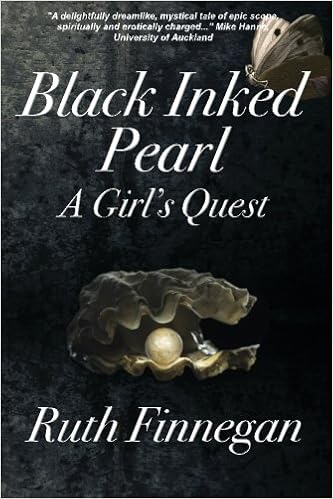
An epic romance about the naive Irish girl Kate and her mysterious lover, whom she rejects in panic and then spends her life seeking. After the opening rejection, Kate recalls her Irish upbringing, her convent education, and her coolly-controlled professional success, before her tsunami-like realisation beside an African river of the emotions she had concealed from herself and that she passionately and consumingly loved the man she had rejected.
Searching for him she visits the kingdom of beasts, a London restaurant, an old people’s home, back to the misty Donegal Sea, the heavenly archives, Eden, and hell, where at agonising cost she saves her dying love. They walk together toward heaven, but at the gates he walks past leaving her behind in the dust. The gates close behind him. He in turn searches for her and at last finds her in the dust, but to his fury (and renewed hurt) he is not ecstatically recognised and thanked. And the gates are still shut.
On a secret back way to heaven guided by a little beetle, Kate repeatedly saves her still scornful love, but at the very last, despite Kate’s fatal inability with numbers and through an ultimate sacrifice, he saves her from the precipice and they reach heaven. Kate finally realises that although her quest for her love was not in vain, in the end she had to find herself – the unexpected pearl.
The novel, born in dreams, is interlaced with the ambiguity between this world and another, and increasingly becomes more poetic, riddling and dreamlike as the story unfolds. The epilogue alludes to the key themes of the novel – the eternity of love and the ambiguity between dream and reality.

The Contemporary Christian Colouring Book
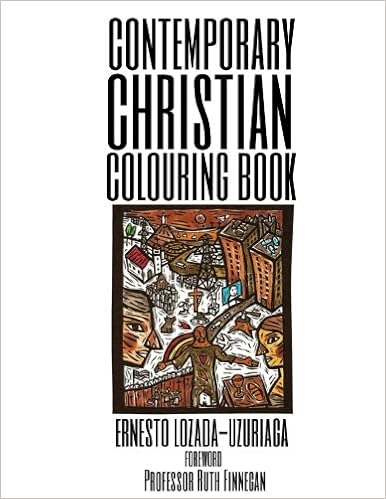

Mindfulness and mediation are creeping into more parts of society. Things that were once meant for children are evolving for adults to enjoy as well. One of these is colouring books. No longer is this pastime reserved strictly for young children. There is a soothing sense that one can derive from colouring an image. It does not require much artistic talent either. Along with this shift to the adult mindset comes The Contemporary Christian Colouring Book by Rev. Ernesto Lozada-Uzuriada. Coupling the peaceful activity with biblical themes and images this book is a perfect gift for the devout. Each image evokes the idea of a stained-glass window one might see inside a church depicting various scenes from the bible. There is some melding of these scenes with modern technology which just serves to remind us that Christ is still present today.
The book begins with a lovely forward from Ruth Finnegan, operator of Living Tree Publishers that has produced this colouring book. In it, she seeks to remind us why we are drawn to art and why we colour. It is the marriage of that simple meditation with something tangible. A brief biography is also given of the artist who designed the pictures, Lozada-Uzuriada himself. The images are carefully crafted to convey the message of a particular scene or passage from the bible in a format that is easily understood. Titles are given to each piece to help the user remember which part of the bible and which story the scene belongs to. The line work is heavy and dark; much like stained glass itself. This is useful for those who colour because it easily defines which sections are contained.
Given that the images impress upon this writer scenes in stained glass windows, it serves to mention that the content of this colouring book is better suited for adults. The expressions of various people within the scenes could be taken as angry, frightening or scary. Young children need to have faith in the beauty and gentleness of the Bible and exposing them to this colouring book without proper context might serve to scare them, rather than inspire them. That aside, this book is a wonderful compilation of some of the more memorable pieces of scripture that one might want to colour and perhaps display in their home. Christ is a central figure in most of the pieces of this book.
With the world’s attention focusing more on mindfulness and meditation for the adults in the world, colouring has become a de-stressor for many. The Contemporary Christian Colouring Book by Rev. Ernesto Lozada-Usuriada is a must-have piece for those of the Christian faith who would like to colour while they meditate. Being able to add a personal touch to such moving and important points of Christian faith allows those who use this book to come closer to the inner workings of their faith. It is nice to see how something as traditional and sacred as someone’s faith can mix and meld with the current needs.
Pages: 46 | ISBN: 1326968165
Totally Unexpected

Harry James Fox Author Interview
The False Prophet is set in a post apocalyptic America and follows Donald of Fisher, our unlikely hero, as he must confront an army raised to conquer the land. What was the inspiration for the setup to this exciting novel?
The question applies to the first novel, The Stonegate Sword as well as The False Prophet although it is not necessary to have read the first book in order to understand the second. The initial idea was to create a character with a world view similar to present-day America and place him in a society with very different values, such as Medieval Europe. I considered a time-travel approach, but then hit on the idea that in the future the world could enter a second Dark Age. So the main character, Donald of Fisher is a lore-man, steeped in the study of the past from an early age. Then circumstances forces him to take up a sword and take on the role of a warrior. The conflict between the evil figure in the west owes a bit to Tolkien and a bit to the prophecies of the last days in Biblical prophecy. I made no attempt to create the details associated with the Antichrist, except that if the imagery in Scriptures is taken literally, it sounds as if the final battles will be fought with antique weapons. I realize that this could be figurative language, but I decided to take it literally, and that implies, again, that a dark age lies in the future.
The story follows two characters, The False Prophet and Donald of Fisher, which I felt were two contrasting characters. What themes did you want to capture while creating your characters?
The story follows the archetypal “hero’s quest.” Don is the hero and must face adversity. The False Prophet is the anti-hero and he does not actually appear in the first novel, being only a rumor, a malignant force driving the forces of evil. In the second novel, he is revealed to be a ruthless despot of the kind with whom we are all familiar. The Prophet’s armies are the driving force behind much of the conflict that Don must face and overcome, though human frailties (his own and those of his companions) are other obstacles in his path.
There were many biblical undertones throughout the novel. Where do you feel you paralleled the Bible and where did you blaze your own path? And how did that help you create an engaging story?
The story of the novel does have some similarities to the Bible in that the Israelites were often raided by their enemies and the kind of weapons were similar. The military tactics I describe are probably not similar to those used in Bible days, although some of the principles are timeless. The use of walled cities reminds one of the Bible and also Medieval Europe. The political situation in the free cities east of the mountains reminds me of Israel during the time of the Judges, when there was no king, and “everyone did what was right in their own eyes.” The apostasy or falling away from the faith is prophesied in the Bible. The rediscovery of lost technology, for example, cannons, is a new path. The idea of a man of sin arising in the last days is found in the Bible.
The False Prophet is the second book in the Stonegate series. Where does book three take readers?
Book three will take place a generation later. The False Prophet was not destroyed, and the evil in the West rises again. It is up to the children of Don, Rachel, Carla and Howard to bring the saga to its final conclusion. Donald, now a middle-aged man, past his prime, attempts to mount an invasion of the West to overthrow the Prophet, but his attempts are met with disunity among his friends and overwhelming might of his foes. As to be expected, the victory depends on help from a totally unexpected quarter.
Author Links: GoodReads | Twitter | Facebook | Website
 This is the sequel to the award-winning Christian fantasy novel, The Stonegate Sword. All the major characters return, Donald, Rachel, Carla, and Philip.
Stonegate remains the key, and Donald returns to that great walled city and his beloved Rachel just as the hosts of enemy are also closing in. Part adventure, part love story, this epic saga covers the vast panorama of New Mexico deserts and Colorado Rockies in a possible future that looks very much like the medieval past. But duty, love, courage, and honor remain and are even more important than ever.
Beautifully Illuminated

Kathryn Berryman Author Interview
Erinland follows 21st century characters as they are catapulted into a 9th Century Viking war. Some fantastic battles and world building ensues. What was your inspiration for the setup to this fascinating novel?
Actually, my inspiration came from the Irish side of the conflict. When visiting Ireland some years ago we visited Trinity College in Dublin. Displayed in a glass case is the Book of Kells. It is a beautifully illuminated ancient manuscript with vivid colours and characters depicting stories from the four Gospels of the bible. The Book of Kells is believed to have been written around the year 800 in a monastery in Iona. After a Viking raid on the monastery, the surviving monks took refuge in a new monastery at Kells, taking their treasures with them. The meticulous attention to detail and its beauty resonated with me, so I did some digging into Irish history and the Viking presence in Ireland. This finally lead me to Amy and Richard and the writing of Erinland.
Erinland provides much in the way of Viking history. Did you do a lot of research to maintain accuracy of the subject?
Yes, I certainly did do a lot of research into both Irish and Viking (Norse) histories and mythologies. I learned a lot about their ways and beliefs and found it absolutely fascinating!
I understand this is a your debut novel. What a fantastic start! What made you start writing?
I’ve always dabbled a little with writing. I enjoy getting lost in the ‘writing space’ and hopefully creating something entertaining for the reader but for Erinland, the catalyst was seeing the Book of Kells first hand.
What is the next book that you are working on and when will it be available?
I am currently working on a sequel to Erinland. It should be available mid 2018.
Author Links: GoodReads | Twitter | Facebook | Website
![Erinland by [Berryman, Kathryn]](https://images-na.ssl-images-amazon.com/images/I/51UdZq1p5OL.jpg)
Two troubled young adults find themselves key players in a deadly game that spans the 21st century and the Viking Age.
Amy, finding it difficult to ‘fit in’, becomes increasingly obsessed with the virtual reality game Erinland. The VR characters and the mist of Erin begin to invade Amy’s dreams and her waking moments. She finds herself drawn into Erinland in 9th century Ireland. Amy becomes part of this mystical world as she joins in the struggle to defeat the Viking raiders.
Richard has a complicated home life and feels he doesn’t belong anywhere. A series of events finds him desperate and living on the streets, where he finds himself dragged into 9th century Norway by a Viking warrior. Richard finds acceptance with the Vikings and joins them on a colonisation raid to Ireland.
The False Prophet

The False Prophet, by Harry James Fox, is set in a post-apocalyptic America where a plague wiped out a large majority of its inhabitants. The remaining populace, left angry and bitter, instigated wars and caused even more deaths while seeking retribution from various groups of people. With all remnants of modern civilization long gone, their society was essentially thrown back into the dark ages. At the opening of the book, the son of a mysterious prophet named Hiram Abaddon now seeks to continue his father’s legacy of dominion over any that do not support him.
The book has Biblical references with the main opposition to Abbadon (the False Prophet) consisting of Christians. The story plays out like one would imagine the tribulation as discussed in the Bible, with Abbadon seemingly synonymous with the Antichrist. One man, Donald of Fisher, along with a group of comrades, sets off to gain support in the fight against The False Prophet. The book is definitely picks up speed as the story progresses; the first half is slow to build and relatively uneventful but does well to setup the rest of the story. In this way it reminds me of Game of Thrones, in that it was a lot of information upfront, but once you were caught up, you were hooked. When news reaches Prophet City that there is an uprising, the story line really picks up and keeps you on the edge of your seat. Right from his introduction in the story, The False Prophet’s character is intriguing and easy to hate. Which is a perfect setup and a stark contrast to Donald of Fisher. The fact that the False Prophet is easy to dislike and connect with as an enemy really helped to keep my interest piqued. Although I felt like Donald’s character could of used more depth, it could easily be that I wanted this depth because his character was also so intriguing and begged to be explored.
Personally, I love the Biblical undertones of the story and the fact that a lot of the chapters open with a Bible verse helped to give insight into the chapter’s direction. I also like that the Biblical alignment is less obvious than in some other books that have attempted to use a similar setting or premise. Because of how it is done, I think this book will be more appealing to the general public than to a very specific niche. Overall, I find The False Prophet to be a fascinating and entertaining story. I can’t wait for the next one!
Pages: 368 | ASIN: B01N6PZUU0
Fantastical Battles

Yolanda Ramos Author Interview
The Seventh Sentinel takes readers on an incredible modern day journey where the purpose of angels is still alive and well as they commune between man and God. What was the inspiration for the idea behind this entertaining story?
I’ve always been intensely fascinated by angels. According to the Bible and other ancient manuscripts angels are powerful, highly intelligent beings commanded by God to serve man. Being an avid reader, I grabbed up any books featuring angels but they were always portrayed as the bad guys and demons as the good guys, which rattled me. So I decided to write a novel where the opposite is true and based on as many historical facts as I could find about them. I wanted to show angels interacting with humans in a good way, in the age old fight between good and evil with epic fantastical battles, great tragedies and moments of joy.
Cristiano is raised in an orphanage and has no apparent past. I felt that his character was well developed. What was the ideals that drove character development in this story?
I felt that the world the characters live in is very intricate yet subtly built. What was your approach to world building in The Seventh Sentinel?
I researched how many levels of Heavens there are from a variety of sources. Some say there are nine, some say five and some seven. Who really knows? I settled on seven because it fit the title of my book. Seven archangels, seven sentinels, seven continents and seven Heavens. Most of the descriptions of the Heavens are inspired from the Bible and The Book of Enoch. Then I had to figure out a way for my hero to fight in the spirit realm, and every hero has to have a weakness or several weaknesses, right? That’s where transmutation came in, which left Cristiano’s body open for attack in the physical realm, and hence the need for paladins.
Everything and everyone has a history, known or unknown and I love stories that include orders like the Templars, St Johns, The Golden Fleece and many others. There are so many stories with the Templars, so I went instead with the once famous Order of Calatrava, in Spain, which turns out, had links with the Knights Templars, and threw in the ancient Celts for added mystery.
What is the next book that you are working on and when will it be available?
I’m working on the third book in the series (no title yet) and hope to have it out by the end of the year. Due to serious illness last year I’m way behind schedule and trying hard to catch up. I’ve just finished my short story, titled the Igigi Chronicles, which is going through a round of beta reading as we speak. This tale is a spin-off from False Gods, the second book in the Sentinel Series, featuring the Eljo and all manner of mythical beings set in ancient Sumer and modern times.
Author Links: GoodReads | Twitter | Facebook | Website
“Moments before the destruction of Jerusalem in 70 A.D., the seven Archangels remove powerful, ancient artefacts from the Jewish temple. These are given into the safekeeping of seven men. Throughout the ages, these men and their descendants become known as the Seven Sentinels.
In medieval times, the Seven Sentinels formed various military Orders as a cover for their activities. Today, of the Seven Sentinels, two are dead and two have turned rogue, which means only three remain to carry out their roles.
A war rages between Heaven and Earth. It is up to the newly empowered Seventh Sentinel to stop the rogues and Fallen Ones, from using these artefacts to gain control of the souls of mankind. Can the Seventh Sentinel endure?”
The Shadow Of The Almighty

Sharon D. Moore Author Interview
Hidden in Plain Sight follows Jason White as he discovers a devastating family secret about the identity of his biological father. This is an intriguing setup to a well-developed novel. What was the inspiration that made you want to write this book?
The inspiration was a reoccurring dream I had for over a year starting in 2001. I quite literally had the dream every single night, sometimes multiple times per night. It was very disturbing not just because of the imagery but also because of HOW I experienced the dream. As I went through the mental movie each night I would become a character. For example, one night I would be Jason. I would have all of Jason’s thoughts and memories from birth to present. I would think like Jason and see things the way Jason saw them. Not only that but I would dream the exact same dream with the exact same dialogue but from Jason’s perspective. The next night I may go to bed and become Lucy in the dream!
The dreams were so incredibly vivid that when I awoke it would take a few seconds for me to come back into myself again. I experienced phantom pain and the emotional residue of the character as I regained consciousness. I honestly thought I was cracking up! Long story short I tried and failed to journal the dream in a notebook. I sat down at the computer and began to type it out instead. Months later I finished and had over two million words. It was a story! I knew the name was Under The Shadow Of The Almighty because it deals with living in the shadow of the ‘almighty’ celebrity types but also living under the Shadow of an Almighty God as outlined in Psalm 91 (Bible). I was advised that I had a series on my hands and needed to break the book down into smaller books. The first installment is Hidden In Plain Sight.
I thought you did a great job drawing the reader into the culture surrounding the life of the families that make these super churches function. Is there any moral or idea that you hope readers take away from the story?
I would like the readers to realize that religious leaders are people too with families and lives to live. Leaders have histories and not all of them are pretty. I want people to develop a compassion for leaders rather than being so quick to tear them down. At the same time I also want people to understand that no person is worthy of a pedestal. Respect is one thing but worshipping a person is another. We live in a church culture that has created rock stars out of their leaders. Even if the leader is a good, honest person, the rock star mentality is dysfunctional and often corrupts sparking a sense of entitlement.
Mega churches are essentially large corporations and due to the size of the membership need to be run as such to make sure every ‘I’ is dotted and every ‘T’ crossed. That being stated, some neglect the faith aspect in favor of the dollar which causes situations like Bishop Stewart. Others neglect the business side in favor of faith which often results in IRS charges, church foreclosures and other financial embarrassments. As with everything else, there needs to be a balance.
I also need for people to realize that just because someone calls themselves a pastor, bishop (or whatever), does not mean they are called to that role. It also does not mean they are honest, good, operate in integrity, etc. Too many churches are led by Quincy Stewart-types. It is obvious to the naked eye but the members choose to remain blind to it or if they see the shenanigans, they makes excuses because it is easier to ignore than to confront.
I felt that Jason White was a complex character. What were some of the trials that you felt were important to highlight the characters development?
Ah, yes. Jason. It was important to understand the slights Jason experienced in his childhood with regard to his sister’s fathers and the majority of his external family. He was unwanted and they had no problems telling and showing him how they felt. An impoverished childhood with an oft absent mother who worked three jobs put a very large chip on his shoulder. That chip caused him to also strive to be the best which he accomplished thanks to educational intervention from his aunt. Then his mother’s sudden lifestyle switch had her turning to God when he was a preteen. That change rubbed Jason the wrong way. It made anything dealing with faith a turn off for him because he saw it as a intrusion into his life that took more than it gave. All of those things also speak to Jason’s misogyny in the form of using women as a means to an end. It also speaks to his resentment of men in authority / father figures.
What is the next book that you are working on and when will that be published?
I am currently working on the second (yet unnamed) installment in the Under The Shadow Of The Almighty Series. Although it was written 14-15 years ago, it requires a lot of clean up. Now that I have been through the publishing process once I am viewing it with fresh eyes and a better understanding of what it takes to tell a story. I have no idea when it will be released I hope it will be out at least by this time next year but that all depends on how long it takes me to complete it as well as my publisher’s timeline.
Author Links: GoodReads | Twitter | Facebook | Website
When Philly-born playboy, Jason White, discovers a devastating family secret about the identity of his biological father, he launches an angry quest to find and confront the man. A lengthy investigation into his father, a prominent pastor of a large church in North Carolina, spurs a quick, covert, out-of-town visit to the pastor s church on Easter Sunday. Will Jason follow through on his desire to destroy the man he believes left him alone and in poverty? In Raleigh, North Carolina, the greedy and lecherous Bishop Quincy Stewart’s less than discreet history of deceit and all around messiness is threatened with exposure when he loses control over his manufactured persona. A chance encounter and life-changing lunch unlocks the chains holding Stewart s wife, Lucy, hostage and sets the stage for a much needed shift in her life. In a desperate act to break his wife s spirit and force her into compliance, Bishop Stewart does the unthinkable. Will he go down for his horrific actions? Will Lucy ever be set free from the pain he has caused her? The Camelot-like existence of popular and honorable Bishop James Collins becomes shrouded in an indefinable dark cloud when his wife, Victoria, invites an unstable element into their lives. Will Bishop Collins overcome being blindsided by the ugly truths he s forced to face or will his life and ministry be forever changed?
Not Alone

Not Alone is a modern retelling of the biblical story of Job, in which a man’s faith in God is tested by having everything but his life taken from him – his family murdered, his crops burnt, livestock slaughtered, and his physical self covered in boils and sores. Not Alone brings this story into a modern-day setting with Joe Moretti as Job. Joe, with his wife and five children, is mostly content with his life and hopes he is a good person. However, unbeknownst to him, there is a war being waged for his soul between the highest of angels and the lowest of demons. Joe suffers similarly to Job, and has most everything ripped from him. He and his wife must suffer immense pains to see if humanity and faith itself can survive anything.
The novel has a lot going for it, but it’s held back in many regards. There is an intelligent sincere voice in this novel, but there are many spelling and grammar errors. Many of the scenes are thought provoking, but there are jumps between narration that cause the reader to stop and ask what is happening. The overall pacing hinders otherwise great character development – the jumps in dialogue and setting cause far too much friction to enjoy the areas of the book where the flow moves the reader well. The story really draws you in with the depth of characters and tense scenes, but there is a lack of focus – the book will take its time to describe the visuals of the various angels and demons in the war for Joe’s soul, but then rush through other crucial scenes. A good example of this is when the news of his business being nearly destroyed hits Joe the same time as he is told that his five children have been viciously slaughtered. The whole scene flies by, with the police telling Joe that his children have been murdered in a ritualistic killing and then leaving moments later, with the whole exchange coming off nearly robotic in its utter lack of emotion from either party involved.
While the various descriptions help the reader visualize the setting and characters of the story, I often felt that the focus was on the wrong subjects, for example: pausing to inform the reader how tall every single fantastical entity they meet is really hinders the book. I often found myself engrossed in this novel and Joe’s life being torn apart, but I was often thrown off by common terms used in incorrect ways, like saying ‘beamer’ in non-speech text without capitalization to indicate a BMW, or misspelling the main female character of the original Star Wars (it should be Leia, not Leah, it could be that I’m too much of a nerd to even notice this). Not Alone is brimming with potential, there is nothing in here that a good editor cannot fix, so that this novel can be the truly great novel that I know it can be.
Not Alone is a re-skin of a morality tale from the Good Book; a conglomerate of descriptions; a hope by the author to show how much faith and understanding in a higher power can be pushed to the breaking point, only to bounce back. The author has a fantastic understanding of Christianity and how it can help people.
Pages: 242 | ISBN: 1633063194


 LITERARY TITAN