Blog Archives
The Cost of Remembering

The Symbol: Awakening follows a fierce prosecutor dedicated to combating violence against women who, along with her allies, fights to dismantle systemic oppression and bring justice to survivors. What was the inspiration for the setup of your story?
The Symbol: Awakening was born from real-life pain. As a Brazilian attorney, I worked for years supporting women who survived gender-based violence. I carried their stories with me, their silenced voices, their broken systems, and their quiet resilience. Eventually, those truths demanded a fictional home. The futuristic Council is a metaphor for the institutions that failed them. Louise is a mirror: she’s a prosecutor trying to do the right thing in a world that punishes those who dare to speak.
It’s not just a dystopia. It’s a cry for justice.
What were some of the trials that you felt were important to highlight Louise’s development and shape her into the woman she is now?
Louise’s development is rooted in trauma and contradiction. I wanted to show a woman who fights for justice but is also broken by the system she serves.
She loses her mother to domestic violence. She carries a symbol of resistance (the button) since childhood. She trusts the law, then watches it collapse under silence and control. Her most important trials are emotional: learning to trust again, to remember who she is, and to embrace her voice even if it puts her in danger.
Her strength is not in being fearless. It’s in being terrified and still choosing to act.
What were some themes that were important for you to explore in this book?
There are many layers, but five themes are central:
• Systemic violence against women
• Institutional silence and complicity
• The cost of remembering (trauma)
• The complexity of justice
• Hope as resistance
The book also explores power through language, memory, and surveillance. Who gets to tell the truth? Who gets believed? What happens when silence becomes law?
I wanted to write about pain, but more than that, about transformation through pain.
Where does the story go in the next book, and where do you see it going in the future?
In Book II, Louise will no longer work within the system; she will rise against it. She becomes the public voice of a growing rebellion, but that comes with consequences. Enemies will rise from both sides. The movement she inspired begins to fracture.
The second book is about navigating power without becoming what you fought against.
Author Links: GoodReads | Website | Instagram | Amazon
Since childhood, Louise has carried a button inherited from her mother, a silent symbol of resistance against tyranny and violence against women. The book follows her journey through pain, discovery, and courage as she investigates crimes, exposes the Council’s lies, and confronts deep human dilemmas. Alongside allies like Emma, Joe, and Sam — the latter a mysterious man torn between his past and a chance for redemption — Louise finds herself at the center of a plot involving conspiracies, assassinations, and the darkest secrets of power.
Unprocessed Grief

Severed Sacredness is your memoir sharing the story of your daughter’s long, grueling journey of survival and recovery and the power that hope and faith played during this challenging time. Why was this an important book for you to write?
Because of a promise. The depth of pain and the massive amounts of story and miracle were being held inside of me. A wide sweep of online research left me unable to find anyone with a story like hers with the depth of injury that she had suffered in hopes to show recovery was possible with quality of life. I had promised God if our daughter recovered with any kind of quality of life I would write the story for the ONE person who was searching for HOPE and couldn’t find it. I kept my promise and wrote her story. What I discovered while I was writing was also important. I had a great amount of unprocessed grief due to being in the throes of full-time caring and intensive rehabilitation I never had the time to grieve all the loss that comes with a devastating trauma. As I wrote the book I grieved as if it was happening all over again. After writing the full manuscript I came to the realization that I had emptied all of my story and grief onto the pages of the book which was so freeing. The spaces that once held the grief and stories were now empty and the story was now safe and preserved. It was such a gift to find friendship with my grief and to no longer hide it or ignore it. I have found a beautiful balance of all that we have endured and survived which has now prepared me to step into another unexpected role of public speaking to share hope and faith with many of the stories and tools I have gained through this life journey.
I appreciated the candid nature with which you told your story. What was the hardest thing for you to write about?
Placing myself back into the moments of such devastation and having to feel the horrific pain of seeing Jessie injured so critically with such gross disfigurement of her beautiful head and the remembering of all that she lost in that one moment of impact. Reliving all those moments of when her life hung in the balance and having to navigate her care with such intentional focus over and over again. Seeing the normalcy of lives go on when hers was literally cut off at the root but she still lived with such agonizing injuries with no easy answers or quick fixes. LONG JOURNEY OF RECOVERY.
What were some ideas that were important for you to share in this book?
To never never give up hope. To stay in the moment when in crisis. To take the next right step. To know that God will send help. That you are never alone. With God ALL THINGS are possible. To show how to navigate healthcare in ways that can advocate for your beloved one.
What do you hope is one thing readers take away from your story?
That no matter how devastating and hopeless life looks and feels, there is hope. There is always hope.
Author Links: GoodReads | Instagram | X (Twitter) | Facebook | Website | YouTube | Amazon
When fifteen-year-old Jessie Boone collided with an aspen tree 700 hundred miles away from home, no one was sure she would survive or what quality of life she would have if she did. A massive traumatic brain injury devastated her brain and body, and brought her parents to their knees in shock and grief. The only certainty was their faith in their Creator who, unbeknownst to them, had already placed the right people on the ski slopes, in the hospitals, and in the community that wrapped their arms and resources around this wounded child and family.
Severed Sacredness is the raw account of a mother’s journey through forty days of terror and anguish in acute crisis, eighteen months of grueling rehabilitation from a mute spastic quadriplegic state, and thirteen years of slow reclamations of capacities, life-threatening regressions, and cycles of grief and grace.
Even in the darkest forests, we are not alone.
If your beloved’s life hangs in the balance, or you are a friend looking for ways to support someone facing the unimaginable, this book is a medicine of hope for anguished souls, a map for chaotic minds navigating the healthcare system, and a field guide for finding or creating sacred moments of provision and presence in the midst of the severed and suffering.
A shoot will come up from the stump of Jesse; from his roots, a Branch will bear fruit. Isaiah 11:1
Sharing Good Things

Sow Seeds of Wisdom is a poetry and prose collection that serves as a call to action for readers, urging them to share their innate knowledge for the collective growth of society. What inspired this collection of poems and writings?
When I started writing my second book, Scatter Seeds of Kindness, I didn’t have a name for the book but as I was reading through the poems, I started to notice the theme of kindness emerging, so that book named itself. The same thing happened with my third book, Gather Seeds of Hope when I noticed the theme of hope that kept appearing in many of the poems. So when I started to write this book, Sow Seeds of Wisdom, I wanted to keep with the theme of sharing good things in life, like kindness and hope. So I asked myself what other good things could be shared, and I thought about knowledge and wisdom. What better gift is there than to be able to share your life experiences and what you have learned, which could possibly help someone out in a similar situation, or just give someone some hope and inspiration? Not every poem or prose has to do with finding wisdom in every situation, but many do. I think there is a lesson to be learned or shared in most of the writings in this book. Even the fun “The Morning After” has a lesson of drinking too much the night before. So the theme of this book was more intentional and deliberate than the last two in the same series.
What was one of the hardest parts of this collection for you to write?
Just finding the wisdom, or the lesson, in each poem. Sometimes it was obvious and other times I had to look a bit deeper within myself or into the world around me to find the lesson or the wisdom. Other times I drew on my own past experiences, so some got a bit personal which is a little outside my comfort zone. The other challenging part was just putting out a book about spreading wisdom when I can sometimes be a bit of a silly person. I was not sure friends and family who know me best would take me seriously. I can be self-deprecating sometimes. I am clumsy (I trip over my own two feet), or I open my mouth and something really silly comes out. But every now and then I have some wisdom to impart, and I hope that shines through in this book.
What do you hope is one thing readers take away from Sow Seeds of Wisdom?
That everyone, no matter how young or old, has something to share in the way of knowledge. Sometimes the older people brush aside the younger generation because they think they are flighty and unfocused, but now that I am diving into more technology via YouTube and social media, I rely on their vast knowledge and how they can figure stuff out so quickly. And the younger generation sometimes views the older folks as stuck in their ways and rigid, but there is so much that generation can teach; history, money tips, working on older cars, etc. I wrote about this in the last poem in the book, Wisdom…Pass It On, about how we can all learn from each other if we would put our preconceived notions or limiting beliefs aside.
What is the next book that you are working on, and when can your fans expect it to be out?
I am taking a little break this summer after putting out four books in four years. But I just recently started working on some new stuff so hopefully within a year or so. I am really just taking my time to see what evolves and what theme the next book will bring forth.
Author Links: GoodReads | Facebook | Website | Amazon
Told in her usual lighthearted, slightly self-deprecating manner, the author shares wisdom through both prose and poetry on such topics as common sense, betrayal, things we keep hidden—or choose not to reveal, things we hold onto long after we should have let them go, and spirituality, among many other topics. Sometimes deep and profound; sometimes lighthearted and humorous; the poems in Sow Seeds of Wisdom always provide fresh insights for the reader to learn from and ponder.
An Emotional Journey

The Stories We Cannot Tell follows two pregnant women who are forced to make difficult choices in life and the bond they form as they navigate this point in their life. What was the inspiration for the setup of your story?
Getting pregnant and staying pregnant is such an emotional journey for a lot of women. I wrote this book so hopefully, women going through infertility or making a choice not to continue a pregnancy will feel less shame than society has made them feel. I didn’t have an easy time getting pregnant, and I had many friends going through hell to have a child and not a lot of these women shared their stories. I wrote this book before Roe Vs. Wade was overturned, something I never thought was a possibility in our country. I’m hoping the readers, no matter what their views on this topic are, realize that what’s right for them, may not be right for everyone, and having compassion and empathy is all most women in these situations want.
Was the character’s backstory something you always had, or did it develop as you were writing?
I had written a lot of the backstory for each of the women before I started writing the book. I wanted to get to know their quirks and personalities ahead of time, so I could incorporate them into who they are and the individual journey that they were going through. That being said, there were things that came out in the dialogue or in their stories as the writing of the book went on.
What were some themes that were important for you to explore in this book?
The themes that were important for me to explore were friendship, loss, love, family, and hope. I also wanted to explore how a woman views her pregnancy issues differently than a male partner, and when something happens to the baby, how his pain is just as genuine, but he may express it in a different way.
What is the next book you are working on, and when can your fans expect it to be out?
I’m just beginning my next book so I’m not sure yet when it will be out. It’s the story of three sisters who go on a journey together to figure out what happened to their mother and end up finding things about their past they never knew.
Author Links: GoodReads | Instagram | Twitter | Facebook | Website
Faith, Hope, and Other Verse


Faith, Hope, and Other Verse is author Thomas Frackenpohl’s interpretation of the wonders the world has bestowed around his life, bound across several dozen short poems in this thought-provoking book.
Frackenpohl’s writing is reflective. An obvious theme across the numerous pieces is the somber opening tone. It generally brings with it a degree of melancholy that provokes the reader to evaluate their own personal circumstances and to uptake the lessons on the page that correlate with the theme of each verse. These, however, end on an uplifting note with an overall message that life is difficult at the best of times – all we owe to ourselves is to serve our souls kindly. Schoolings on the purpose of life, values, and morals alongside virtues are the foundations of this piece of work.
Overall, the structure of these verses results in scenic, quick reads that achieve the claims in the author’s note. Frackenpohl’s writing could have benefitted from being divided into sections with sub-themes for a greater reading experience and optimal impact.
The imagery has been achieved by showing the progressive aspect of the poem’s topic through a series of repeated verbs. The verse Possibilities is structured in such a way that forces the reader to acknowledge that opportunities will not be created without exploring or thinking outside the box. It fashions an urgency that something is happening that will leave the reader behind if they do not act immediately. The push for mental action encourages a revaluation of the reader’s present way of living towards a revolutionized purpose with capabilities ripe for the taking.
Faith, Hope, and Other Verse by Thomas Frackenpohl is the perfect read for those who are dabbling into introspection. With an overall well-rounded summary of life experiences, it is not overly heavy or complex and will suit a broad audience.
Pages: 116 | ASIN : B096T3J7BS

How to Live a Life of Hope
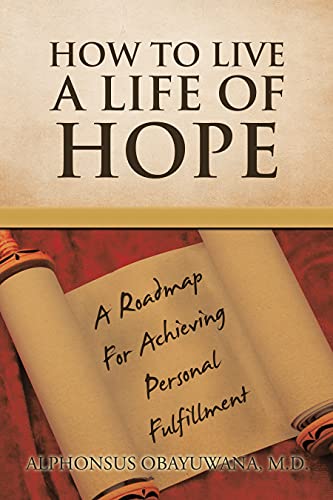

Unlike many self help book authors, Alphonsus Obayuwana does not just sell you hope, he shows you how you can navigate the difficult paths of life with ease. Reading How to Live a Life of Hope: A Roadmap for Achieving Personal Fulfillment is a gift you can give to yourself because the content in the book is refreshing. The author talks about succeeding in careers, building personal relationships, growing as an individual and building communities among other things.
The advice in the book is practical. As a reader, you will find logic in the steps that are described. I appreciate the author for talking about both the successes and challenges that human beings face. The author does not write about utopia, he instead tackles real issues and explains how one can live a fulfilling and happy life. The content in the book is serious but the author manages to add a little humor every once in a while. I enjoyed the light moments where the author shared a pun or funny jokes even when talking about grave issues. The content is not plain nor does the author get boring at any point. The topics are well articulated and the reader finds pure joy when reading.
How to Live a Life of Hope: A Roadmap for Achieving Personal Fulfillment by Alphonsus Obayuwana is the ideal book if you have lost hope or are still trying o figure out which path to take. This book is for everyone, teens, college students, young adults, adults in all stages of their careers, and even senior citizens. This book is a must read for people that enjoy motivational content, reading about human realities and reading life changing stories.
Pages: 134 | ASIN : B091TDR8CZ

Unconventional
![Unconventional by [Hebert, J. J.]](https://images-na.ssl-images-amazon.com/images/I/516eVZWa2-L.jpg)
James Frost is an aspiring writer with huge plans, but life seems to have things laid out quite differently for him. Rejection letter after rejection letter, James begins to lose confidence, becomes increasingly filled with fury, and sees no way out of his destiny as a school janitor. His father’s offhand attitude about James’s future does nothing to help his morale. Then, James meets Leigh–a woman who could not be more different from him if she tried. A devout Christian always seeing the positive side in trying situations, Leigh brings about changes in James and sends him careening down a drastically different path of emotions and a newfound faith in Jesus Christ.
James and Leigh both shoulder great burdens and are destined to have found one another at this specific moment in both their lives. Hebert paints a grim picture of the life Leigh endures as a woman with overbearing parents who manipulate everything from her love-life to her own self worth. James, with all of his issues, is as much a blessing to Leigh as she is to him.
Hebert addresses warped body images in a realistic and tasteful manner as he highlights the relationship between Leigh and her mother. In addition, he draws James into the dynamic by having him gently override the damage created by Leigh’s mother. Nowhere is this more poignant than when James, in no uncertain terms, explains to Leigh that she is speaking her mother’s words and not her own. Everyone needs a James in his/her life–he an amazing voice of reason.
James is an amazing character on many levels. Hebert has gifted readers with a champion of free thinking while molding a character who is broken and in need of love and faith. As a reader, I was touched on more than one occasion by the descriptions of James’s poor health, his financial struggles, and his staggering lack of self confidence. Hebert certainly gives readers a main character for which they can both cry and cheer.
I was more than impressed with the turn of events in which James becomes a giver of strength and a builder of self-confidence. It is quite a stark difference from the outset of the book wherein James’s feelings are scattered and he’s falling toward depression. Meeting Leigh is just the tip of the iceberg; meeting Meranda completes the change begun by Leigh.
Hebert’s book is an unconventional literary approach to expressing Christianity. Readers do not often find text professing faith in Jesus Christ written in the form of a novel. Each of the stories surrounding James Frost’s life tug at the readers heart and doesn’t stop. James and Leigh are memorable and relatable. Hebert’s in-depth look into James Frost’s transformation is a testament to faith, love, and hope.
Pages: 334 | ASIN: B002QHVW1G
Journey to Osm: The Blue Unicorns Tale

Journey to Osm follows the story of Blue, a young unicorn with a big destiny. Blue is part of a tribe of unicorns going extinct under the harsh rule of an evil sorcerer. A prophecy foretells that Blue will save them but when he is born without metal in his horn, and thus without magic, all hope is lost. When Blue comes of age at 12, he is faced with destiny but how can a magicless unicorn have any hope of saving his tribe?
The book is a fun and unique YA fantasy novel. I really loved the unicorn-centric view of the story. Unicorns are often left out or less significant in fantasy stories, and I think this is a waste of a fun and interesting creature. Author Sybrina Durant furthers this by taking an intriguing twist and really exploring the magic of the unicorns as well as what unicorn civilization looks like. I really loved the world she created with the metal symbol of magic and the hierarchy that creates and the different powers that the magical unicorns possess. With an evil sorcerer, a prophecy, a fight against good and evil, this all adds up to an imaginative and exciting fantasy world.
The plot of the book is that of the underdog character finding strength against evil. Blue is a very sympathetic character through this journey as he is young, sweet, and very strong-willed. From the very beginning of the book you can see how hurt he is that he doesn’t think he can save his people, reciting his mantra ‘No Metal, No Magic.’ But even with this, he does not give up. He trains hard even when he thinks there is no chance. This self-determination in the café of certain failure really endeared Blue to me as a character. Silubhra was also a character that I grew very fond of as she was so compassionate and kind. There are a lot of characters in the story, but I think the author did a good job of making them unique and interesting and I liked how we get to see multiple perspectives.
This book is an exciting fantasy story. Filled with adventure, magic, love, loss, hope, action, and destiny. The story came together well and kept me engaged in the plot from beginning to end. The book is a great read, particularly for young adult readers who love fantasy stories.
Pages: 353 | ASIN: B07LDKX25N



 LITERARY TITAN