Blog Archives
It Arose in Dreams

Ruth Finnegan Author Interview
Black Inked Pearl follows Kate, a young Irish girl, as she searches for her lost lover. What was the initial idea behind this story and how did that transform as you were writing the novel?
It began in a dream when I was in New Zealand visiting my daughter and granddaughter who live there. This was, essentially, the first page (and chapter) of the novel when Kate, panicked and feeling she was too young for love runs away desperately as her best childhood friend (I never learn his name) tries for the first time, a teenager to kiss her. That scene, that act, is the foundation for the story as she years later discovers that she as frantically and desperately loves him as she had frantically fled from him years before
I say ‘dream’ as that is the nearest word I can get, vision perhaps they would have called in in the middle Ages. But that word’s a bit misleading. In two ways.
First, it wasn’t exactly a dream in the sense of being, asleep more an experience in that liminal in-between state of being neither awake nor asleep but somehow fully both – the whole novel came in that somehow enchanted enspelled state ( I suppose you might call it ‘inspiration’). I planned nothing, but it was still a chapter a night, written down effortlessly (I don’t even remember doing it! or, by now, what the words were. it surprises me every time – so many times – I reread the book now).
Second, ‘dream’ suggests something visual, But it was more a kind of very intense node of emotion, something very personal to me (in a metaphorical sort of way the whole book is kind of autobiographical – what serious novel is not? – and the second chapter about a small girl experiencing the magical world of Donegal – is directly so.
Then the novel – and Kate – just grew. I came to know the hero well, but wish that my ‘dreams’ had given me his name
Black Inked Pearl is told in a dreamlike, almost stream of consciousness, style of writing. Why did you want to tell the story in this style and what were the challenges?
Well, it arose in dreams and the writing essential came from, and took place in, my unconscious – at least that is the only way I can understand and it. So the style is scarcely surprising, it was little under my deliberate control and almost not at all revised later.
I didn’t know in what style I was writing – the process was almost unconscious – but when it was finished I saw (or rather heard when I read it aloud ih my inner ear as I always do with my writing)that it had the rhythms and sonorities of African and Irish story-telling (my mother was a wondrous story-binder) and that some literary giants (Joyce, Fulkner, Hopkins … many others) had written in similar styles. Poetry is mixed with prose – well in a way, as with its oral resonances (a subject on which I have written in academic contexts, in Oral Poetry for example), it is all poetry, some fully, some ore in a kind of blank verse: all unexpected by me!
Also, the content. Part of what I learned as the story revealed itself to me was that the division between dream and reality is an elusive and perhaps non–existent one.
Problems – well some of my readers have problems with it! Some object because they cannot abide what they see as ‘incorrect’ grammar orthography words, not what they learned in the first form at school – I appreciate that they have tried but think they miss the point (how do they cope with Shakespeare?).
Others including my deeply wise best friend, get a bit lost in the plot from time to time, too full of Celtic mists said one. It’s too late now to amend that (and maybe it is just a necessary feature of the novel – mystic, mysterious – anyway) but I have tried to make things clearer, while not abandoning what has now has now become my signature style, in the related ‘Pearl of the Seas’ and, on the way, The helix pearl’ (the latter the same story but this time as told by the garrulouos ever-sprarklng laughing sea (a very different perspective but equally born in dreams). I wonder what is coming next ..
Oh yes, the unusual spellings were loved by the Garn Press, the lovely publishers, but at the same time gave the copy-editor real problems. Microsoft, can yoy believe it (the cheeky thing) kept automatically ‘correcting’ the ‘wrong’ spellings. In the end they got me to send a special list to add to their ‘glossary’ of all my new spellings and word and abbreviations etc. I thought that would be quick and easy – about fifty cases? Whew, no! They tell me, incredibly, that it was nearly two thousand! Don’t believe it! Ut they ear that’s true. Anyway, hey did a great job whatever.
Kate is an enthralling and curious character. What were the driving ideals behind her characters development throughout the story?
As I say it wasn’t conscious since it all came in dreams. So in a way no ‘driving ideas’.
Still I have noticed some abiding themes , detected, later, in the text, as if looking at someone else’s writing (well in way it’s NOT exactly mine, not t=in the normal way anyway – not of the deliberate, conscious careful academically trained me). /tow especially, the ones `I swoudl like to think readers will take form the novel (and from the movie if it gets made a I hope it one day will)
First as I said earlier is the understanding , that we may pretend or think we do, but that actually we do not really know the difference between reality and dreams. Given the way we have been brought up as children of the scientific revolution, this is an exceedingly difficult idea, is it not – but so important to try to accept, specially now as we become more aware of the lives, and, in a way, precious value of those with dementia. Perhaps it is only through literature and metaphor that we can eventually begin to grasp this.
Second is the thought, revealed near the end, that it is and was indeed right as Kate did, to search for others and try to help them carry their burdens. But that in the end it isourselves we are responsible for, it is our own souls for which we have to answer before (whatever metaphor we prefer here) the last judgement throne. As Kate in the final chapters had to do.
Also, after I had finished the book, I was inspired by the little butterfly that, unknown to me, the publishers had put, with the pearl and the jagged black, on the beautiful cover. ‘Butterfly’ in Greek –elsewhere too I think – is the same word and concept as for the soul, breath, spiritus, life: psyche (as in ‘psychology’, ‘psychiatry’). So the soul – figured as Kate, as every man – flies through the black ink print of the story and at the end settles down on the back cover, life fulfilled story told, with her wings folded.
Kate’s discovery of herself at the end was also, I now see, a kind of discovery of myself as person, as soul.
What are some of your inspirations as a writer that helped shape Black Inked Pearl?
Again, ‘dreams’, my unconscious I suppose. But, as one perceptive reviewer put it, only someone with my background and personality would have had those dreams. So – my life, my loves, my experiences of the resonances and styles and images of great literature, above all Shakespeare, Rumi, Homer and the Bible.
Author Links: Facebook | GoodReads | Twitter | LinkedIn | GarnPress | OpenU

An epic romance about the naive Irish girl Kate and her mysterious lover, whom she rejects in panic and then spends her life seeking. After the opening rejection, Kate recalls her Irish upbringing, her convent education, and her coolly-controlled professional success, before her tsunami-like realisation beside an African river of the emotions she had concealed from herself and that she passionately and consumingly loved the man she had rejected.
Searching for him she visits the kingdom of beasts, a London restaurant, an old people’s home, back to the misty Donegal Sea, the heavenly archives, Eden, and hell, where at agonising cost she saves her dying love. They walk together toward heaven, but at the gates he walks past leaving her behind in the dust. The gates close behind him. He in turn searches for her and at last finds her in the dust, but to his fury (and renewed hurt) he is not ecstatically recognised and thanked. And the gates are still shut.
On a secret back way to heaven guided by a little beetle, Kate repeatedly saves her still scornful love, but at the very last, despite Kate’s fatal inability with numbers and through an ultimate sacrifice, he saves her from the precipice and they reach heaven. Kate finally realises that although her quest for her love was not in vain, in the end she had to find herself – the unexpected pearl.
The novel, born in dreams, is interlaced with the ambiguity between this world and another, and increasingly becomes more poetic, riddling and dreamlike as the story unfolds. The epilogue alludes to the key themes of the novel – the eternity of love and the ambiguity between dream and reality.

Look for the Hidden
Ruth Finnegan Author Interview
Entrancement is a collection of essays from educated professionals with different viewpoints on the topics of dreaming, trancing and the collective unconscious. What inspired you to write this book and bring all these different fields together?
Two things I suppose.
First of all, my own extended experiences over several years of a kind of heightened consciousness in dreaming, ‘musicking’ and of, somehow, communicating with others both near and far away outside time and space. This is described in the first chapter (my own) of the book: ‘There’ (an essay which earned an award from New Millennium writing).
Second I was further inspired by following this up in wider reading and discovering that not only in anthropology (my own discipline) are such things starting to be seriously studied as something of here and now, not just of supposedly strange folk far away or long ago, but also in innovative, if as yet unconventional, scientific thinking. Remarkable. There are now huge numbers of best-selling books by hard-nosed scientists inspired by Einsteinian thinking and, for example, quark theory on, for example, telepathy, dreaming, the consciousness of the universe, life after death and communication – long known and accepted – between dead and living.
The book begins with your own experience on trancing. What is ‘trancing’ and how did that experience happen?
Too long to answer properly here – read the account in the first chapter.
‘Trancing’ is a good concept and nearest to what I and others have experienced. It does however give a somewhat too explicit and, as it were, contrived and deliberate impression. Better to say the experience of somehow being outside time and space and seeing more clearly than in ordinary life’ (though it is there too, hidden).
One major problem indeed (discussed in the concluding chapter) is the absence of an accepted terminology to describe such things.
You bring together experts from many different fields in this book. Were they as enthusiastic about this book as you are?
YES. Both in taking up my initial invitation, in responding to it in their own terms, in the writing and, now, in receiving the finished volume.
What do you hope readers will take away from this book?
Look for the hidden in your own everyday life, find the extraordinary in the ordinary and vice versa: in music, in dreaming, in the miraculous workings of the great world around us. Open your mind – so easily closed by the undoubted but limited insights of the scientific revolution – to what is beyond.
Author Links: Facebook | GoodReads | Twitter | LinkedIn | GarnPress | OpenU
 This powerful, ground-breaking study of dreaming, death, music, and shared consciousness brings together a staggering number of fields to explore what we know about dreaming and its interactions with other forms of consciousness. Setting a humanistic, evidence-based context, Ruth Finnegan engages with anthropology, ethnomusicology, sociology, psychology, parapsychology, cognitive science, and more, building a strikingly diverse base of evidence and analysis with which to treat a subject that is all too often taken lightly. Entrancement will quickly prove indispensable for anyone studying these altered states of consciousness and what we can know about how they work and what they do for our minds, bodies, and selves.
Black Inked Pearl: A Girl’s Quest


An epic tale spun from erratic thoughts placed into text and delivered to the world. That is the sense that readers will get from Black Inked Pearl A Girl’s Quest by Ruth Finnegan. Our protagonist, Kate, is searching for something. She is on a journey through years and lifetimes as she seeks out this piece that is required to complete her. We see this world through her eyes, her thoughts and her experiences. The tale is epic not only in page count, but in content as well. We know that Kate has lost something, that she is searching for this thing, but we don’t know exactly what it is. We are left with speculation and can only turn the next page to find out if she has achieved her goal. With songs, poetry and influences of dreams long past, this tale is one that is begging to be heard.
The way this book is written, with its dream-like prose and fractured sentences, allows this epic fantasy novel to be told in a stream of consciousness style of writing. The thoughts are thrown at the reader: fast and unforgiving. At first glance, the reader may think that our protagonist, Kate, has simply gone mad and the first chapters are from her point of view. However, the entire book reads that way and, if you are not paying close attention, you may get lost. Readers are quickly taken from scene to scene and thought to thought with barely a lull. Perfect for readers who like to be fully engaged in a story.
The words are very beautiful. The poetry both original and borrowed lends a mystical air to the story. If you view the entire book as a sort of waking-dream, it begins to make sense. This writing style is wonderful for conveying emotions and we can get a better sense of how Kate is feeling as she continues her search. The blending of a warped reality with a warped sense of fantasy lends well to the thought of this being a dream-like state that Kate has found herself in.
A whirlwind of a read is what you’ll find between the covers of Black Inked Pearl A Girl’s Quest by Ruth Finnegan. The mystical sense of the book is intriguing. This is a book recommended to be finished in one sitting as you may find it hard to pull away. The dream-like madness that seems to grip the pages make for an exciting read, but this can also be overwhelming. This may be a book suited to seasoned readers who are looking for a dreamlike story of epic proportions.
Pages: 286 | ASIN: B0158VRF26
Entrancement: The Consciousness of Dreaming, Music and the World
If you’ve ever wondered where your mind goes in those moments when you’re not quite awake or when you’ve been staring out the window for just a tad too long, you will find some clues to an answer in Ruth Finnegan’s Entrancement. This collection of essays from educated professionals will expose you to different viewpoints on the topics of dreaming, trancing and the collective unconscious. Fashioned the same way a textbook might be, readers will gain insight into various hypotheses on what happens to our minds when we enter these states. Exploring the world from a slight occultist view, readers are privy to personal stories from professionals in the field of the social sciences who have backed up their personal experiences with data and sources. Investigate how music and dreaming contribute to artistic expression; identify your own personal cues and what might draw you into a trance.
Finnegan begins with her own personal experience with trancing. During her sections at the beginning and the end of the book she uses language that is friendly for non-academic readers. The same can be said for all of those who have contributed to this piece. By using common language, Finnegan has opened up the potentials for her audience. Anyone who is interested in this topic will find useful information within its pages.
There are some typos in the book which were distracting in such a highly educated piece. But the errors are few and can be easily forgotten. The presentation of the book leaves a little to be desired. The table of contents could use some formatting and the pages between essays could have been laid out better. These are all minor things, but they impact the reader experience.
It is interesting to read a collection of essays on a somewhat supernatural topic that is rife with research. For someone who is studying psychology or the other social sciences, Entrancement by Ruth Finnegan would be an excellent resource piece to read. The abilities of the mind have been studied for decades and we are no closer to unraveling the secrets now than we were in the beginning. If you’re a beginner doing preliminary readings or research on this topic, you will find this book useful. The content is not only useful, but the suggested readings in the back open up a whole library of future readings. For those who hunger for more information, who want to explore this world and our place in it, this is a delightful bonus.
Pages: 288 | ASIN: B06XVD9WKM
Obsessed with the Idea

Robin Christophersen Author Interview
The Passer follows Eleanor on the one year anniversary of her boyfriend’s death as new powers awaken inside her and she is visited by other worldly beings. What was the inspiration for the setup to this thrilling novel?
In June 2009, I was readying to go on stage during a performance of The Three Musketeers when an idea for a story flashed in my mind. That night before I went to bed, I recorded my thoughts in a notebook for a series of three stories, put it in the drawer of my nightstand and forgot about it. A year later I came across the same notebook and happened upon the page containing my three sentence synopsis. The subject matter dealt with death, loss and grieving expressed through a supernatural lens. I’m not entirely sure what prompted my somber thoughts, especially since I had not experienced the loss of a loved one in quite some time, but even as I read my words I had written a year earlier, something deep within me yearned to tell this story.
By the end of the summer of 2010, I was obsessed with the idea of a woman who develops supernatural abilities that have been dormant within her since birth and how these powers are triggered by the tragic loss of a loved one. In October of that year, after returning from a vacation in Northern California- what would turn out to be the setting for The Passer – I made the decision to write the book. For the remainder of the year I delved into some old favorite subjects-Greek, Roman and Celtic mythology- as well as Mysticism and the teachings of Esoteric Wisdom throughout the ages. All this fueled my desire to sing a song about death and grieving and in February of 2011 I began in earnest the first draft of The Passer.
Eleanor is an intriguing character. She is an accomplished actress and a professor as well. What were the driving ideals that drove the character’s development throughout the story?
I have had many readers tell me they admire Eleanor, both for her accomplishments and her struggle against a transformation that is beyond her control. Also, there are those who find her undeveloped and whining at times, mainly in regards to her ever-suffering devotion to her deceased boyfriend, as well as her head-scratching romance with her brutish, former husband. Eleanor harbors all these characteristics by design. Without revealing too much about her ultimate destiny, she will continue to develop, grow and surprise us (hopefully in a delightfully shocking way) by the end of the series.
Regarding Eleanor’s dual profession, that is based on two individuals who are/were (one is now sadly deceased) both university professors and active performers in their given fields. The one who most closely represents Eleanor is a gifted Shakespearean actress I had the pleasure of performing with in A Midsummer Night’s Dream who at the time was about to receive her doctorate in theater.
I felt that Eleanor’s powers were subtle and built rather dramatically. What was the inspiration for her powers and how did you keep it believable in the story?
From the moment the story was conceived I knew it would have a supernatural element driving the plot. As Eleanor took shape in my mind, her struggle to cope with her loss unearthed these abilities she had no idea she possessed. As she travels through her journey of discovery we are there with her, which helps to keep it real. The continuing acceleration of Eleanor’s powers is a key element that will play out through the entire series and will drive the plot to its final conclusion.
What is the next book that you are working on and when will it be available?
We are currently editing the second installment of The Passer series, Ghostworld, which is scheduled to release in fall 2017. The story will begin where it left off at the end of The Passer.
There are two other projects underway. The first is Why I Love You The Passer Series, titled The Order.
Also in the works is The Magical Series based on Eleanor Bouchard’s sister Josephine Bouchard. Josephine returns to Ohio to live in her childhood home, only to discover that it is sitting on top of a supernatural fault that is brimming with activity.
The Amazing Amelia Monroe Series follows the precocious six-year old girl from The Passer as she matures in her powers while learning the truth about her deceased mother and biological father’s past.
Author Links: GoodReads | Facebook | Twitter
 Eleanor Bouchard wants her life back.
After a year of desperately mourning her deceased boyfriend, Dr. Eleanor Bouchard, a theater professor and acclaimed Shakespearean actress, is ready to move past the despair that nearly destroyed her. But, on the anniversary of his death she is summoned by a frightening apparition with a message:
Help him believe…
As she attempts to unravel her ghostly messenger’s meaning, she begins to experience harrowing visions of a missing woman and discovers she possesses otherworldly powers that have been lying dormant within her, waiting for her to awaken.
While Eleanor struggles against her emerging powers, Daniel Archer, her former love, has troubles of his own. His wife has suffered a tragic death and now the famous actor, along with his precocious step-daughter, Amelia, seeks sanctuary in Eleanor’s secluded home in River Mist, California-whether she wants him there or not.
As their lives intertwine, Eleanor discovers a fateful connection to Daniel and Amelia and suspects that the haunting events that brought them together quite possibly were destined to be.
The University of Corporeal and Ethereal Studies

Upon entering the book, The University of Corporeal and Ethereal Studies, the reader is immediately greeted with an acceptance letter. Wolfgang Edwards uses this as a sort of introductory to foreshadow what is to come: you are literally stepping out of our own reality and into this new one and this letter serves to summarize that. What follows is the collections and stories of various students and characters who attend this university. Set in a fictional, sometimes bizarre, universe, Edwards explores various facets of the supernatural, blending fantasy with characters who have very human traits.
I think an interesting way to categorize this book is like taking Harry Potter to the next level. You sort of get that feel because of the setting that it’s in. It’s not magic per say, but exploring otherworldly things, some of which I was unfamiliar with before learning about it. So that’s really the closest way to describe it, although it goes far beyond that. I learned a lot because certain things piqued my interest which I honestly have never heard about before. The book is intriguing and I became more interested the more I read. One such example was a chapter titled ‘The Oneironaut’ which is based off a concept called oneironautics. I learned that this is the concept of lucid dreaming, or being able to control your dream, whether it is trying to wake up from a dream or make something happen within the dream.
The actual story is divided up into a number of different perspectives from each character. Some had more relatable stories and more developed characters than others; some were truly fantastic. It reads like a dark adventure of disconnected people that the author is able to draw together for a bigger purpose – much bigger, and much more dangerous. Throughout the various chapters, we learn of different schools within the University, from which the different characters attend. There’s the School of Coin, School of Metallurgy, School of Engineering, etc. Each school is headed by a dean; and one sticks out in particular. Dean Merkea – an unpleasant man with an ugly, tattered demon dog who even urinates on a character’s shoe at one point. My favorite chapter, Prisoner from Beyond, ties together Dean Merkea, a curator, and unravels the launch of a very unique exhibit at a museum.
Despite its setting, the author manages to piece together a few solid pieces of insight every so often that can be just as intriguing as the story. One such example was of Arakatzeko, a character who can be related to someone like Socrates today: deceased, but full of wisdom. As Araktzeko is studied, we learn alongside the characters: “the true rulers of the royal palace were the cats, who were said to live through every change in royal families without incident”. Such tangible reliefs are welcome and help humanize an otherwise crazy setting.
As the book progresses, you get a feeling it’s heading towards something – just not sure what. The unique stories of each of the characters has surely got something for everybody, admittedly some more than others. It is guaranteed to stay fresh and new until the very end, which may leave you wishing that the author could’ve just kept going.
Pages: 720 | ASIN: B01MUAKPM3
Cassie’s Marvelous Music Lessons


Cassie’s Marvelous Music Lessons is a charming children’s story that is about a lively little puppy dog and her love for music. Cassie, the dog, finds herself in a studio that is filled with upbeat tunes that fill her heart and soul and leave her little tail tapping to the beat. A lady, by the name of Mrs Applebaum, is the cause for such beautiful rhythms and soon Cassie realises that her passion for music and teaching must be heard! However, Mrs Applebaum struggles to understand Cassie’s dreams and desires and together they must come to an understanding through the language of music.
Cassie’s Marvelous Music Lessons, written by Sheri Poe-Pape is a delightful children’s story about a family’s favourite pet- an excitable pup by the name of Cassie. Cassie is a lover of the beat, and with her musical ear, she is eager to transfer her passion into teaching. Beautifully written, this story will put a smile on your face as you vividly imagine the little pup tapping away to the beat of the music, desperately trying to show that she too could potentially be a teacher one day.
Perfect for the young ones, this short story will fire up their imagination as they begin to wonder what secret talents their beloved family pet could secretly possess. I found myself wondering if my little puppy dog was actually trying to tell me that she too could possibly be a musical genius beneath that big furry coat! I love how Sheri Poe-Pape puts into perspective how your pup may be trying to communicate and leaves you questioning what your pup might be saying between their barks, growls and howls. Cassie’s vibrant personality and determined nature will help show children that your dreams are certainly possible- as long as you are persistent!
You can almost hear the music being played in the studio as you read the songs which have quirky titles such as “A Starry Night Howl”. Between these furry tunes, you will find Cassie desperate to communicate with her owner through the rata-tatt-tatting of her furry tail and the howling of her passionate bark. The themes within this story could also apply to people attempting to speak to each other through different languages and how music could be used as the universal way to converse with each other.
Overall Cassie’s Marvelous Music Lessons will serve as a heartwarming reminder that it is important to never judge a book by its cover (or by its fur coat!) and the only limits are the limits you put on yourself. As it is family orientated, Cassie’s Marvelous Music Lessons would serve as the perfect bedtime story or for a child learning to read short stories. Sheri Poe-Pape’s uplifting style of writing leaves you feeling joyful and inspired to fulfill your goals and pursue your dreams- no matter how big they may be!
I would recommend this for children who enjoy amusing short stories involving little furry friends!
Pages: 32 | ASIN: B017THEOAI
One Smoking Hot Fairy Tail
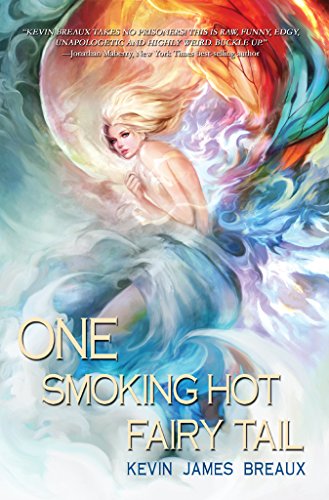

The media loves a good story, and what better than one of a sexy model, party girl, drama queen, and spoiled brat? That is Sabrina London, or at least that was Sabrina London. Now the starlet has settled down, quit drugs, gotten her life together, and is ready to move on. If only her family hadn’t disowned her, oh and did I mention she is a Fairy? Keven James Breaux has created another world filled with magic, ancient history, and modern drama. One Smoking Hot Fairy Tail is about more than just fairy’s, it has vampires, the undead, shapeshifters, and other magical beings. Sabrina’s dream of settling into a new normal and moving on with her life is interrupted when the creator of a new nicotine addiction drug, DUST, pursues her in an attempt to cut off her fairy wings. With the help of her otherworldly friends and one human Sabrina must attempt to stop Alexander Kintner.
Kevin Breaux sets the novel in Los Angeles, not too far into the modern future. Sabrina is a socialite with her bodyguard and friend Mira living in luxury, but she is unhappy. Her father disowned her after a video of her breaking into a laboratory and having sex with her boyfriend and vampire Cade made the media rounds. Vampires and fairies are supposed to be mortal enemies but love knows this not. Sabrina is still deeply in love with Cade. Sabrina’s other good friend is Moselle; Moselle is part of the ancient undead. The human involved in this unlikely group is Jackson, he works for Moselle’s father in advertising and he falls in love with Moselle, she feels the same way, their love is also forbidden under the traditions of the otherworld’s. The relationship dynamics of all the characters are complex and while the love stories are secondary to the action plot of dismantling Alexander Kintner’s DUST operation they are useful in learning the history and culture surrounding the otherworldly.
One of the great things about this novel, is the history. Breaux manages to weave into his story line ancient Egyptian mythology and facts. There is great detail presented into how the otherworldly are created and it is explained in a manner that is fluid to the story line so you don’t feel like you are reading a dissertation in the middle of your novel. It is told through personal experience of the characters and given a strong emotional component not just a sterile list of how to instructions. You really get to know the characters through these flashback memories and they advance the story line as well so you can better understand why some of the characters respond as they do. Breaux brings the reader into their world, he presents the information as deeply hidden secrets in the world of the otherworldly and emphasizes the dangers of this information getting out into the hands of mortal humans.
One Smoking Hot Fairy Tail is an engaging book that will leave the reader turning the pages to see what happens next. Kevin Breaux is able to tap into the reader’s emotions to draw them in and give them a real connection to the characters. Jackson the human in all this is relatable to many. His reactions as he finds out more and more about his new friends is believable. Breaux ends this novel with a cliff hanger leaving the reader to wait for the next installment to see how things continue. I think this is going to be a great series for Breaux.
Pages: 319 | ASIN: B01EB65RJM