Blog Archives
The Raid on Troy


The Raid on Troy, written by Murray Lee Eiland JR, is the seventh book in the Orfeo Saga. It follows two brothers, Memnon and Menas as they rise to power from the chains of slavery. Determined to taste the gold of Troy, the brothers assemble their lives so they are in a position of power to take the city. Telemon is drawn into the plans after a prophecy about the kidnapping of his daughter Elena is fulfilled. The battle lines are drawn as each player in the war game draws their sharpest weapons and assembles their greatest armies to fulfill their own dreams and desires.
This epic adventure begins with a slave boy Memnon attempting to escape the perils of slavery caused by an early capture from the Therans. Memnon’s previous family life is all but a distant memory and for now, all he knows is slavery and hierarchies of power. The brutality that he has experienced in his life has meant that kindness has seeped away from his soul, leaving a dangerous man with nothing left to lose. He is inherently a leader who fearlessly takes control of perilous situations. This allows him to develop a following of men who are eager to drop the chains of slavery too. Together they begin to rebuild their lives, raiding villages and meeting with bandits who help them acquire food and weapons.
Menas, Memnon’s brother, is also an escaped slave and eager to live a life beyond being a pawn of the Therans. Menas soon involves himself with the Spartans, where he becomes a “fixture in the local politics of Sparta”. The two brothers rise to power in an epic tale of action, revenge, lust, and influence. You will admire their ability to rise to power and success as they take what they believe is rightfully theirs, having no mercy for those who dare to cross them.
The Raid on Troy has several storylines that are interweaving together as you progress through the novel. We have Orfeo who enters the plot line as an admirable and successful leader who has a beautiful wife Clarice, Telemon and Estra with their daughter Elena and the brothers Menas and Memnon who all take the leading roles in this twist of Greek mythology. There are similar aspects to the traditional mythology story, however, Murray Lee Eiland JR curates this version to be an almost historical version of events, leaving the reader to feel connected to the characters and the plot line.
Murray Lee Eiland JR writes with a legendary force that will have the reader engaged from start to finish. The chapters are short and fast-paced, allowing the plot line to develop quickly whilst covering vast amounts of time. However, there is still an incredible transformation in the character development as you watch the characters grow in both power and ambition. I would recommend this to anyone who enjoys an epic battle mixed with the rise of power and fortune.
Pages: 300 | ASIN: B06ZYK6M2Z

A Question of Religion, War, or Alienation

James W. George Author Interview
The Prophet and The Witch continues the story of Israel Brewster who is now a disgraced outcast when King Philip’s War begins. This is an intriguing setup to a novel that is high in social commentary. What was your goal when writing this novel and do you feel you’ve achieved it?
Regarding my goal, I initially wanted to write an engaging, historically accurate novel that would highlight a fascinating era that the casual reader was not familiar with. I don’t think this era gets nearly the attention it deserves, and I hope that changes in the near future. Hopefully, the book educates its readers as well as entertains them. So, yes, I think I’ve achieved my goal.
Regarding the social commentary, I think different readers will derive different messages from the book, and that’s terrific. Ultimately, I hope the novel stands as a tale of courage, love, and friendship in the face of evil and violence.
Israel Brewster continues to be an exceptionally developed character. What was your inspiration for his emotional turmoil through the story?
Thank you for the compliment. I’m not sure there was any particular inspiration; I think there’s a little Israel Brewster in all of us. Whether it’s a question of religion, war, or alienation, I think everyone feels deeply conflicted at some point in their lives. What are the things, and who are the people that genuinely deserve our loyalty? More importantly, what makes us persevere in the face of unbearable pain, and what compels us to do the right thing? I guess, to paraphrase Faulkner, writers like to portray the human heart in conflict with itself.
As a reader, it is difficult to pick a side in this battle. How did you balance the story to offer a contrasting yet similar worldview for the characters?
It’s certainly not my intent that anyone pick sides in the conflict. I think the story is balanced by presenting the common elements inherent among both the English and the Wampanoag. There are virtues among both sides like faith, love, loyalty, courage, and family. Conversely, some characters on each side are prone to violence, hatred, and ignorance. So, I hope it is really a tale of love and brotherhood versus evil and wickedness.
Ultimately, I can only hope to present a factual novel and let the reader draw their own conclusions. King Philip’s War was one of the most astounding and tragic chapters in American history, and it doesn’t deserve to be ignored and forgotten.
I understand this is the second book in a possible trilogy. Where do you see the story going in book three?
I can see us moving about fifteen years into the future. There was yet another fascinating war in New England during that time, and the remarkable Benjamin Church played a major role in that conflict as well. And evidently, in 1692, there was some kind of kerfuffle in Salem that got everyone all excited.
Author Links: GoodReads | Amazon
 Puritans. Quakers. Pirates. Mohawks. Witches. And a brutal war…
If you thought New England was dull in the 1670s, get ready for a history lesson.
In the critically acclaimed “My Father’s Kingdom,” debut author James W. George transported his readers to 1671 New England, and the world of Reverend Israel Brewster. It was a world of faith, virtue, and love, but it was also a world of treachery, hatred, and murder.
Four years later, Brewster is a disgraced outcast, residing in Providence and working as a humble cooper. Despite his best efforts, war could not be averted, and now, “King Philip’s War” has begun.
The rebellion is led by Metacomet, known as “King Philip” to the English colonists. He is the tormented son of the great Massasoit, and leader of the Wampanoag nation. Once the most reliable of Plymouth Colony’s allies, they are now the bitterest of enemies. Meanwhile, Metacomet’s mysterious counselor, Linto, despises this war and will do anything to end the bloodshed.
Meticulously researched, “The Prophet and the Witch” is a tale of hope and brotherhood in the face of evil and violence. It features the remarkable cast of fictional and historical characters from book one, including Josiah Winslow, Linto, Increase Mather, Constance Wilder, and Jeremiah Barron. Additionally, new characters such as America’s first ranger, Captain Benjamin Church, bring this chapter of history to life like never before.
The Prophet and the Witch
The Prophet and The Witch by James W. George is a historical fiction book, continuing on from the first book, My Father’s Kingdom. The year is 1675, and four years have passed since readers joined popular characters such as Brewster and Linto in New England. The signs of war have been steadily brewing since, with so many individuals struggling to hold the peace. Inevitably, all efforts have proved futile, and the battle now begins between the English and the Indians. This is one of the most gruesome wars many will be privy to, but one which numerous people are determined to end, preventing further bloodshed and restoring peace to both sides.
The Prophet and The Witch is divided into three parts, covering the summer of 1675 to the summer of 1676. Within each section, the chapters are short and focused on some wonderfully developed individual characters as they contend with the implications of this war.
I was genuinely shocked at the obvious association between war and religion in this account. A huge proportion of the story focuses on the beliefs of the men fighting, highlighting how their personal religious understandings act as an explanation of why war is a necessity. The English see things, such as the turbulent weather, as the wrath of God’s displeasure, but then condemn what they see as mere pagan superstitions of the Indian tribes. However, if they were to reflect, they would soon see more similarities than differences in that both sides look for signs, albeit just of a different type!
As a reader, it is difficult to pick a side of this battle. The English Christians rely on the word of God, trusting they are doing his work in ridding a blasphemous tribe who butcher innocent civilians. Yet, to the Indians, the English and their own actions are similarly threatening! The reader never fully feels they can condemn either side, for each are doing what they see as their duty to survive. The question of religion therefore lingers throughout the book, quietly encouraging you to question whether man or God is responsible for this creation of war…
Israel Brewster and Linto are firm favourites throughout the story. Their portrayal is refreshing and their actions commendable, in an otherwise fraught and harrowing period. These two are both the savours of the story for me personally as they question man’s motives and speak out when they feel an injustice is occurring.
For those who haven’t read the first book, there is an extensive summary at the beginning of book two, instantly bringing readers up-to-date with the action so far. You never feel like you are at a disadvantage because of this.
The Prophet and The Witch is expertly written and instantly engaging from the first few pages. An exceptionally drawn historical fiction account. I was captivated by this very well-structured book, and would recommend as one of the more intellectual of reads.
Pages: 375 | ASIN: B0755QL6CR
Rich in History

S Jackson & A Raymond Author Interview
Shadow and Friends Celebrate Ellsworth, KS 150th Birthday is a lovely children’s story that gives the history of the town of Ellsworth Kansas. Why was this an important book for you to write?
When your town is having a 150th birthday, and your town is rich in history, then that history needs to be included your children’s picture book. The huge four day celebration also included re-enactments, 150 prime longhorns, a cattle drive, two day rodeo, and much more. An adult commemorative book was in the works, so we thought one for kids should be done as well, leaving out the blood, death, and salacious parts. The kids loved it. So did the tens of thousands of people who traveled to this town from across the USA and overseas.
What kind of research did you have to do to maintain the accuracy of the history?
I used extensive curate material from the historical society for the parts and dates I wasn’t sure of.
Do you think it’s important for children to learn the history of their city or town?
Of course it is. One’s heritage is important, and children need to know where they come from, their roots.
Author Links: Twitter | Facebook | Website
 “Shadow and Friends Celebrate Ellsworth, KS, 150th Birthday” is a wonderful and fun children’s book that both children and adults will enjoy. The story hits the targeted age range of 4-8. The painted illustrations provided are a delight, and my grandchildren loved them. Who would have thought to write a book using dogs and squirrels as friends, and the old west thrown in? This book is perfect for home, schools, and libraries. I highly recommend this book. Susan Vance, Author and Realtor In this children’s picture book and seventh book in our ‘Shadow and Friends Series’, Shadow and Friends Celebrate Ellsworth, KS, 150th Birthday, two dogs and a family of squirrels decide to help Ellsworth celebrate the 150th birthday of the town’s history. This book coincides with the actual 150th birthday of Ellsworth in the summer of 2017. Illustrations are found on each page, most of them painted. Big Whitey tells the history of Ellsworth, and Fort Harker, with historical buildings, notable landmarks, and scenes painted by the author. At the end of this story, Little Whitey asks his father if they can re-enact the old west, dress like cowboys, and do a pretend cattle drive just like Ellsworth, KS. The squirrels dress in cowboy and cowgirl gear, and they even have a chuck wagon cook. They herd longhorn cattle, sing the state song of Kansas, and have lots of fun during their re-enactment. At the end of the story, they enjoyed a barn dance, celebrated the 150th birthday of Ellsworth, and Uncle Stubby took pictures and ‘selfies’. Children will love seeing the old west come alive with two dogs and a family of squirrels dressed in western attire, and using a small amount of cowboy slang. This delightful and funny book for children, targeted at ages 4-8, is easy to read and perfect for home or classroom. The story illustrates how cattle drives worked, the long dusty trails, life in the old west, and illustrations that produce pure imagination in children. Note: Actual gunfights and ‘adult type’ history were left out in this wild western history of Ellsworth, KS.
Mademoiselle Alice: A Novel
A deeply evocative story inspired by real events: the love affair between two unforgettable people—Gustave Eiffel, the builder of the Eiffel Tower, and Alice Guy Blaché, a pioneer in the art of cinema. Mademoiselle Alice steps out of the shadows into the reader’s mind as an endlessly intriguing and entirely relatable young woman.
Told through Alice’s eyes, we get to know her, her family, and Monsieur Eiffel. Eiffel is not looking to fall in love—he is a widower who has everything—wit, wealth, fame, and brilliance. He was a friend of Alice’s father who died when she was seventeen, and the story she tells of falling in love with him is funny and emotionally intimate.
Alice and Eiffel forge an enduring romantic and intellectual bond. But while she wants to marry him, he refuses because he is so much older than she is. Out of her desire to have a family, she marries a handsome Englishman and travels to the United States, where she works with D. W. Griffith and then opens her own film studio. Some of her emotional experiences find expression in the scenarios she writes for film. Her relationship with Monsieur Eiffel continues on in her mind and leads to some surprising developments. Mademoiselle Alice tells us much about women’s lives during the silent film era in France and the United States. Combining a biographer’s knowledge of her subject with the novelist’s gift for narrative, Janelle Dietrick has crafted a novel that will capture the interest of every reader.
Shadow and Friends Celebrate Ellsworth, KS 150th Birthday
 “In this children’s picture book and seventh book in our ‘Shadow and Friends Series’, Shadow and Friends Celebrate Ellsworth, KS, 150th Birthday, two dogs and a family of squirrels decide to help Ellsworth celebrate the 150th birthday of the town’s history. This book coincides with the actual 150th birthday of Ellsworth in the summer of 2017. Illustrations are found on each page, most of them painted. Big Whitey tells the history of Ellsworth, and Fort Harker, with historical buildings, notable landmarks, and scenes painted by the author. At the end of this story, Little Whitey asks his father if they can re-enact the old west, dress like cowboys, and do a pretend cattle drive just like Ellsworth, KS. The squirrels dress in cowboy and cowgirl gear, and they even have a chuck wagon cook. They herd longhorn cattle, sing the state song of Kansas, and have lots of fun during their re-enactment. At the end of the story, they enjoyed a barn dance, celebrated the 150th birthday of Ellsworth, and Uncle Stubby took pictures and ‘selfies’. Children will love seeing the old west come alive with two dogs and a family of squirrels dressed in western attire, and using a small amount of cowboy slang. This delightful and funny book for children, targeted at ages 4-8, is easy to read and perfect for home or classroom. The story illustrates how cattle drives worked, the long dusty trails, life in the old west, and illustrations that produce pure imagination in children. Note: Actual gunfights and ‘adult type’ history were left out in this wild western history of Ellsworth, KS.”
Pages: 39 | ASIN: B072TPMDRH
Why, Anyway, Do We Quote?

Ruth Finnegan Author Interview
Quoting was something I didn’t even think about until I read Why Do We Quote. What made you realize quoting would be such a rich topic for a book?
Nor did most people!
Not sure. It just crept up on me and once I’d got started colleagues were very very puzzled -well in a way I was too – about what on earth there was to say about quoting. Onced it was published it was published everyoed said they’d been interested in quoting it all along!,
To elaborate, and as I explain in the Preface, until this book somehow crept under my guard I hadn’t thought I was much interested in quoting or quotation: something to be deployed with care in some settings, no doubt, but not a thing to be investigated. Certainly I had learned to use quote marks at school and later to wield quotations in academic writing, and had become aware of copyright obligations and the current concerns about plagiarism and about unauthorised words floating free on the web. I was also vaguely aware that words and voices from elsewhere ran through what I said, I read them in books, recognised them in formal speeches, heard them in conversation. But I had just come to accept this as part of common practice, not anything to be really noticed, far less to arouse particular curiosity.
As I thought about it, I realised how little I knew about quoting and quotation. What does it mean, this strange human propensity to repeat chunks of text from elsewhere and to echo others’ voices? How does it work and where did it come from? Does it matter? Why, anyway, do we quote?
I started by reflecting more carefully on my own experience and was startled by how quoting permeated my world. And then I wondered how others were using, or not using, quotation both nearby and in far away times and places. On some aspects I found a vast and fascinating literature. But there seemed no single account that directly tackled my questions about just what ‘quotation’ and ‘quoting’ were, how we had got to where we now are, and how in practice these had been used and conceptualised. This led me to considering how people here and now actually use quotation (in practice, that is, not just according to the grammar books) and also, going on from that, whether we might understand these present practices better by exploring something of their background and whether the problems currently causing concern belong just to the 20th and 21st centuries, or perhaps have longer roots.
And then? Well, I just couldn’t help writing It! Took longer than I expected, with part of the fun being finding illustrations (yes IMAGES are part of the story). I’d say it is my best academic book, perhaps alog with Communicating to which is it in a way linked (I leave out my novels like Black Inked Pearl).
Did you learn anything that surprised you about quoting while you prepared this book?
YES, and was amazed: about (many) people’s ACTUAL perspectives be on quoting -regarding it as a way of ‘showing’ off: showing off the quoter’s supposedly superior learning or status, putting you down. I was stunned. As an academic had always assumed that (properly attributed) quotation was unquestionably a Good Thing. It would never never have occurred to me without the extensive comments from the wonderful ‘Mass-Observation’ writers (results of this and other enquiries conducted and housed under the auspices of the University of Sussex (www.massobs.org.uk/).
With this book you shed new light on ideas such as ‘imitation’, ‘allusion’, ‘authorship’, ‘originality’ and ‘plagiarism’. How has quoting changed those ideas?
Mainly I think that I now realise how these concepts shade into each other and overlap (there is a stunning diagram at the start by Mark Cain showing this – and more) . Also how they are ALL socially managed and controlled in some way, and how the telling-off for ‘plagiarism’ of students and other ‘subordinate’ individuals is partly an exercise of power. We all in a way plagiarise (ourselves among others) when – almost all of the time – we in some way allude or quote. This was a real revelation to me. Also how invisibly pervasive all these practices, and similar ones, are in our speaking and writing.
There is a lot drawn from anthropology and cultural history. Is there any one event in history that affected quoting dramatically? Or did it all happen slowly over time?
Slowly and over time I think. Quoting and quotations have been there from the very very beginning – though it’s true that some individuals and sources get quoted more than others ( or have attributed to them things they DIDN’T actually say) , like George Washington, Goethe, Disraeli, the Bible. People quote Shakespeare all the time, often without realising that it IS a quote, the words just a special ring to them – isn’t that one of the points of quoting.
And did you know that the first piece of sustained writing, four thousand or ore years ago, was a cuneiform collection of – yes – of quotations (there’s a picture of it in the book)
Author Links: Facebook | GoodReads | Twitter | LinkedIn | GarnPress | Open University
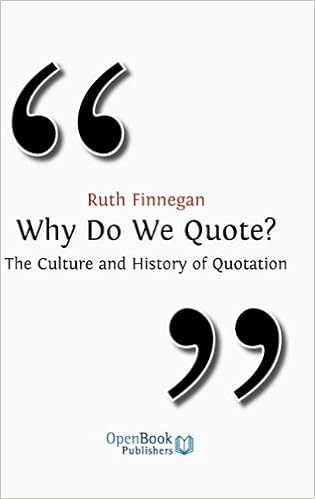 Quoting is all around us. But do we really know what it means? How do people actually quote today, and how did our present systems come about? This book brings together a down-to-earth account of contemporary quoting with an examination of the comparative and historical background that lies behind it and the characteristic way that quoting links past and present, the far and the near. Drawing from anthropology, cultural history, folklore, cultural studies, sociolinguistics, literary studies and the ethnography of speaking, Ruth Finnegan’s fascinating study sets our present conventions into cross cultural and historical perspective. She traces the curious history of quotation marks, examines the long tradition of quotation collections with their remarkable cycling across the centuries, and explores the uses of quotation in literary, visual and oral traditions. The book tracks the changing defi nitions and control of quoting over the millennia and in doing so throws new light on ideas such as ‘imitation’, ‘allusion’, ‘authorship’, ‘originality’ and ‘plagiarism’.
Steel, Blood & Fire


Dark, gritty, and altogether brutal, Steel, Blood and Fire is an archetypal dark fantasy novel. In the first chapter, one of the main character’s hands and feet are amputated, and the story continues in similar fashion from there onward. The setting is fantasy grounded in muddy reality, although there is a vein of consequential magic that adds a little sorcery to this otherwise swords-based world. If you’re familiar with Game of Thrones then you’re familiar with Allen Betchelder’s style; multiple character perspectives, inter-weaved story lines, and a healthy dose of murder. It’s a fantastic modern-style medieval fantasy, and a definite read for any fan of the genre.
When I began Steel, Blood and Fire, my first thought was, “Wow, this is a lot like Game of Thrones.” Then I began to think, “Or is it more of a Witcher book?” As I continued through the novel, I began to decide it was a blend of both. By the end, I thought that perhaps it was its own thing.
The book isn’t afraid to touch on the brutal. In fact, it seems to revel in it. Blood flows freely; rape is the buzzword of the day. It’s a mature novel for sure although it doesn’t quite cross the line, but regularly toes it. A lesser author would have toppled their novel over into prurient pulp.
The writing is well-executed, with the author’s own voice clearly shining through. There is one trap that Allen Betchelder tends to fall into, and that’s the ‘fear of said’. Every other sentence seems to find a new synonym – characters question, murmur, mutter, bellow, but words are never just ‘said’. It’s awkward to read, and tends to draw you out of conversations that should flow naturally.
In any perspective-hopping plot, characters are one of the most important factors. Fortunately, Steel, Blood and Fire features a strong and memorable, if slightly generic, cast. They come off as slightly one-dimensional, particularly towards the start of the novel, and the inclusion of a comedy group of village bumpkins – who of course meet with terrible fates – struck me as being an attempt at generating some frisson with the grim background. Other than those minor niggles, the diversity and depth of the cast begins to truly shine through around the midway point; from here onward they become much more than the sum of their parts.
Despite my above criticisms, I really did enjoy the story, and it quickly became engaging only a few pages in. If you’re a fan of the genre, particularly Game of Thrones-esque fantasy, you’ll certainly enjoy Betchelder’s offering.
Pages: 548 | ASIN: B00AW53RMQ



 LITERARY TITAN