Blog Archives
Corporate Comedy


Corporate Comedy by Thobias is a crazy funny yet totally believable account of one man’s life in India’s corporate sector. His experiences that made up his professional career are so entirely funny and entertaining, you may not want to read this book in public. In some ways this book is extremely ridiculous in the things that take place in the corporate world. These people are frustrating and yet laughable. They seem like characters from a movie! Yet the whole point is the story of a man who climbs the corporate ladder and his experiences. It’s a profession many think would be a great one, but the realities of what this man went through makes the reader see it all in a brand new light.
While this book is longer than some, it moves quickly. The story line flows smoothly and keeps moving at a quick pace. I like to laugh so it doesn’t take much, but I found myself laughing inappropriately loud and a bit embarrassingly, to be honest. I got some seriously weird looks from my own flesh and blood, I can only imagine if I would have been trying to read this somewhere more public, like the bus or at the park! I wouldn’t have been able to help myself. I ended up reading this book in one quick weekend.
Corporate Comedy by Thobias can be considered a comedy biography burrito. It’s both things all wrapped up in a warm outer shell. I truly felt myself feeling sorry for those in the corporate sector that are the middle man. Those that end up having to travel and be away from their loved ones. I used to think all that traveling would be fun, but in a way this book made me see it in another light. I am not quite sure how these people can manage to do it all.
I loved the descriptions of some of the locations and characters. They weren’t too wordy and overwhelming as some books do but are good enough that you can really visualize the character or location. I also loved how you would find yourself cheering for the main character. When he gets to the point where he stands up for himself I found myself rooting for him to really say how he feels! These people are so ridiculous at times I almost couldn’t deal with all of it!
It may be set in India but the situations and interactions could be in any corporate building located around the world. I really think that I will start seeing those busy men and women in a whole different light than before. It’s no wonder these people seem like totally unrelatable people by the time they reach a higher up position. If you enjoy quirky workplace comedies then you will absolutely enjoy Corporate Comedy. It’s hilarious and truly enjoyable from the start.
Pages: 246 | ASIN: B06Y12NZFG

Tied to the Trident

Balaji Mohan Author Interview
God’s Phonetics: Unlocking the Mysteries of the Universe’s Origins follows a teenage boy who has dreams of becoming a scientist and discovering a theory that will unlock the mystery of the universe’s origins. What was your inspiration for this story?
It was in the year 2008; I came across two interesting verses from the Bible that spoke about languages – One verse explained that God confused people with languages. The other gave me an idea that God created everything with the help of ‘word’…
It built my curiosity and I started looking for a clue in other religions and interestingly I found that even Hinduism, which is considered one of the oldest religions in the world, had also explained something similar to this idea. The drum that is seen tied to the trident of ‘Lord Shiva’ symbolizes sound and creation. The ‘Damru’ plays a significant role in the creation of universe and languages.
This new learning from different religions had inspired me a lot to look at the universe and creation from a different perspective.
Though I never had an intention to write a book about it, I had always wanted to share these new thoughts with someone but nobody showed any interest in listening to me.
When I shared my thoughts with my wife recently in June 2017, using my story telling skills; she immediately gave me an idea to write this and publish it as a book.
It was really a huge step for me and I was very nervous to write a book because I have neither read anovel nor have I written one.
Behind every successful man there is a woman and I am no exception. Her constant motivation and encouragement has definitely helped me a lot in successfully bringing all my thoughts into a book and has also given me a new identity as an author today.
Bavyesh is an interesting and well developed character. What were the driving ideals behind the characters development throughout the story?
Bavyesh is not only an interesting character in the story but also in my personal life. In Hinduism, it is believed that a deceased father will be born again in the same family exactly after a year.
Miraculously, it happened exactly in the same fashion and Bavyesh was born a year later after my father’s demise, which makes him very special to me.
Further, I am a devotee of Lord Shiva hence I named the child Bavyesh; which again means ‘Lord Shiva’ and we strongly believe that he could either be a reincarnation of my deceased father or Lord Shiva himself.
I really wanted to thank him for coming into my life and give him a gift and decided to write a short story having Bavyesh as the protagonist. This made me give a lot of importance and meaning to this character throughout the story.
What is the next story that you are writing and when will it be available?
I am intending to write the final chapter of this book and have it ready by Jan 2018.
Author Links: GoodReads | NotionPress
 Bavyesh, an eighteen-year-old boy, discovers the hidden secrets of the universe from an ancient book that he finds in a cave when on vacation. This enigmatic book helps him produce a unified theory that explains all the mysteries of the universe’s origins and goes beyond the understanding of mankind. It puzzles the entire scientific community and opens the door to new possibilities.
God’s Phonetics: Unlocking the Mysteries of the Universe’s Origins
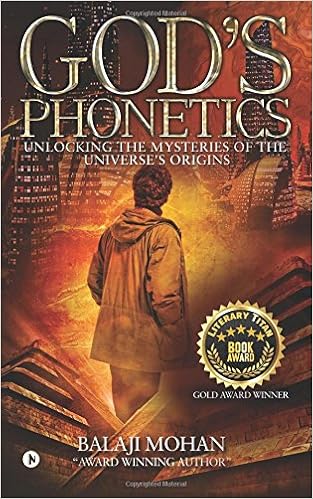
God’s Phonetics: Unlocking the Mysteries of the Universe’s Origins, written by Balaji Mohan, follows a teenage boy, Bavyesh, who has dreams of becoming a scientist and discovering a theory that will unlock the mystery of the universe’s origins. Mr. Kamal, Bavyesh’s teacher, is determined to help Bavyesh on his endeavors as they work together to uncover the secrets of the world. Through the linguistics of language, the duo will join forces on a mission that will have them flying through space and time.
Will Bavyesh be able to uncover the secrets of the universe and pull off the experiment of the century?
God’s Phonetics: Unlocking the Mysteries of the Universe’s Origins kick-starts the story with simple lessons between a student and teacher. It then quickly becomes a thrilling action novel with adventures into space and discoveries that could end mankind forever. We are also treated with tastes of Indian culture sprinkled throughout the story as traditional Indian meals and cultural practices are weaved into the plot.
The essence of philosophy and spirituality is prominent throughout the book as Bavyesh reveals a deeper level of thinking regarding his ideas about life and the world. This is unlike other novels I’ve read about the beginning of the universe with its innovative ideologies that include phonetics as a major clue to the universe. At times the story almost felt non-fiction as it went to great lengths to describe galaxies and religion.
God’s Phonetics: Unlocking the Mysteries of the Universe’s Originsis no ordinary story. It’s unpredictable, filled with twists and turns that you would least expect. At first, I thought the story was going to follow a traditional storyline, however, I was drawn in by its unusual events punctuated by a shocking ending. There is also a technology element to the novel with machines and inventions that are described so accurately that you could believe that they were real.
There is a beautiful friendship between Mr. Kamal and Bavyesh as they bond together over their mutual interest in the wonders of the universe. I enjoyed learning about the two friends; watching the dynamic between them switch as the teacher becomes the student. It’s a reminder that we can learn from youth and their curious minds. Bavyesh’s parents, Neha and Kumar also have a relationship to be admired, beginning the novel with a family relationship that will put a smile on your face.
The way the novel is written is almost poetic, as the author describes each moment with a beautiful simplicity. There are hints of symbolism trickled throughout the story, including theories on the number seven and Bavyesh’s name which means “Lord of the Worlds, Lord Shiva, Intelligent, and All-Knowing”. The plot pushes the reader to consider the universe and what other life may exist in the world beyond our own.
I would rate this novel a 5/5 and would recommend this to anyone who enjoys a story that explores the philosophy of the universe whilst dabbling in a dash of action, friendship, and spirituality.
Pages: 112 | ISBN: 1948032414
A Journey That Can Take A Lifetime

Deborah Dolan Hunt Author Interview
Same Inside, Different Outside is a wonderful children’s book that teaches biology and promotes diversity. Why do you think this is an important message to teach children?
I’m a nursing professor and one of the courses I teach is on Culture and Cultural Concepts which has certainly changed my worldview. I thought I had a good understanding of the various cultures and their beliefs and practices, however, one of the big lessons I learned was that becoming culturally competent is a journey that can take a lifetime. This made me realize that we need to teach children at a very young age to celebrate their uniqueness yet understand how in many ways we are all very similar. As a nurse, I also believe that children need to learn about the inside and outside of their bodies and although some of the concepts may be difficult for a younger child it is never too early to start introducing concepts that can be built upon as they complete their educational journeys.
I loved the pictures in this book. What was the art direction like?
Thanks, I loved the pictures, too. I worked very closely with my illustrator. Initially, I placed notations throughout the manuscript detailing my ideas for the illustrations and where they should be placed. Xavier, of course, used his creative and artistic abilities to bring the illustrations to life. It was fun to collaborate with him on this project and we really worked well together. Final edits were completed based on the input of the Waldorf Publishing team which certainly strengthened the book.
What do you hope young readers take away from your story?
First, and foremost I hope the readers enjoy the story and want to read it over and over again. Secondly, I hope they begin to understand that although we are unique and look different on the outside we are also very similar, especially on the inside. Lastly, I hope they begin to understand how some of the major parts of their bodies work. And that skeletons are really not scary and are somewhat like superheroes because they protect all of our insides.
Will you be writing more kids books that tackle other social issues?
Yes, although I’m currently working on the second pug book I’m also in the early developmental stages of inviting the readers back to Emma’s kindergarten class where I will address other social issues that help children to understand that although in some ways we are very similar it’s okay to be different.
Author Links: GoodReads | Twitter | Facebook | Website | Instagram
 Today is a very exciting day for Emma’s kindergarten class. Emma, Robert, and the rest of the student’s don t understand how they can all look so different on the outside, but look very similar on the inside. So Dr. Shaw is coming to visit, and she’s bringing Mr. Bones, who is a real life-size skeleton. Mr. Bones is going to help Dr. Shaw teach her lesson about the human body. Dr. Shaw has also brought a cool body screening machine with her so the children can see what their insides look like.
Why, Anyway, Do We Quote?

Ruth Finnegan Author Interview
Quoting was something I didn’t even think about until I read Why Do We Quote. What made you realize quoting would be such a rich topic for a book?
Nor did most people!
Not sure. It just crept up on me and once I’d got started colleagues were very very puzzled -well in a way I was too – about what on earth there was to say about quoting. Onced it was published it was published everyoed said they’d been interested in quoting it all along!,
To elaborate, and as I explain in the Preface, until this book somehow crept under my guard I hadn’t thought I was much interested in quoting or quotation: something to be deployed with care in some settings, no doubt, but not a thing to be investigated. Certainly I had learned to use quote marks at school and later to wield quotations in academic writing, and had become aware of copyright obligations and the current concerns about plagiarism and about unauthorised words floating free on the web. I was also vaguely aware that words and voices from elsewhere ran through what I said, I read them in books, recognised them in formal speeches, heard them in conversation. But I had just come to accept this as part of common practice, not anything to be really noticed, far less to arouse particular curiosity.
As I thought about it, I realised how little I knew about quoting and quotation. What does it mean, this strange human propensity to repeat chunks of text from elsewhere and to echo others’ voices? How does it work and where did it come from? Does it matter? Why, anyway, do we quote?
I started by reflecting more carefully on my own experience and was startled by how quoting permeated my world. And then I wondered how others were using, or not using, quotation both nearby and in far away times and places. On some aspects I found a vast and fascinating literature. But there seemed no single account that directly tackled my questions about just what ‘quotation’ and ‘quoting’ were, how we had got to where we now are, and how in practice these had been used and conceptualised. This led me to considering how people here and now actually use quotation (in practice, that is, not just according to the grammar books) and also, going on from that, whether we might understand these present practices better by exploring something of their background and whether the problems currently causing concern belong just to the 20th and 21st centuries, or perhaps have longer roots.
And then? Well, I just couldn’t help writing It! Took longer than I expected, with part of the fun being finding illustrations (yes IMAGES are part of the story). I’d say it is my best academic book, perhaps alog with Communicating to which is it in a way linked (I leave out my novels like Black Inked Pearl).
Did you learn anything that surprised you about quoting while you prepared this book?
YES, and was amazed: about (many) people’s ACTUAL perspectives be on quoting -regarding it as a way of ‘showing’ off: showing off the quoter’s supposedly superior learning or status, putting you down. I was stunned. As an academic had always assumed that (properly attributed) quotation was unquestionably a Good Thing. It would never never have occurred to me without the extensive comments from the wonderful ‘Mass-Observation’ writers (results of this and other enquiries conducted and housed under the auspices of the University of Sussex (www.massobs.org.uk/).
With this book you shed new light on ideas such as ‘imitation’, ‘allusion’, ‘authorship’, ‘originality’ and ‘plagiarism’. How has quoting changed those ideas?
Mainly I think that I now realise how these concepts shade into each other and overlap (there is a stunning diagram at the start by Mark Cain showing this – and more) . Also how they are ALL socially managed and controlled in some way, and how the telling-off for ‘plagiarism’ of students and other ‘subordinate’ individuals is partly an exercise of power. We all in a way plagiarise (ourselves among others) when – almost all of the time – we in some way allude or quote. This was a real revelation to me. Also how invisibly pervasive all these practices, and similar ones, are in our speaking and writing.
There is a lot drawn from anthropology and cultural history. Is there any one event in history that affected quoting dramatically? Or did it all happen slowly over time?
Slowly and over time I think. Quoting and quotations have been there from the very very beginning – though it’s true that some individuals and sources get quoted more than others ( or have attributed to them things they DIDN’T actually say) , like George Washington, Goethe, Disraeli, the Bible. People quote Shakespeare all the time, often without realising that it IS a quote, the words just a special ring to them – isn’t that one of the points of quoting.
And did you know that the first piece of sustained writing, four thousand or ore years ago, was a cuneiform collection of – yes – of quotations (there’s a picture of it in the book)
Author Links: Facebook | GoodReads | Twitter | LinkedIn | GarnPress | Open University
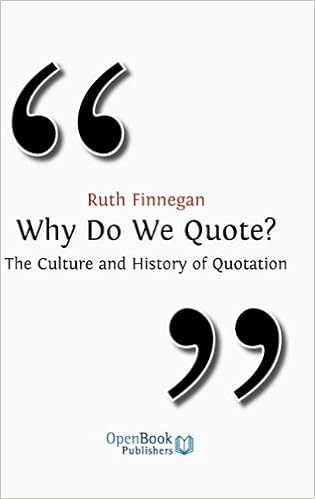 Quoting is all around us. But do we really know what it means? How do people actually quote today, and how did our present systems come about? This book brings together a down-to-earth account of contemporary quoting with an examination of the comparative and historical background that lies behind it and the characteristic way that quoting links past and present, the far and the near. Drawing from anthropology, cultural history, folklore, cultural studies, sociolinguistics, literary studies and the ethnography of speaking, Ruth Finnegan’s fascinating study sets our present conventions into cross cultural and historical perspective. She traces the curious history of quotation marks, examines the long tradition of quotation collections with their remarkable cycling across the centuries, and explores the uses of quotation in literary, visual and oral traditions. The book tracks the changing defi nitions and control of quoting over the millennia and in doing so throws new light on ideas such as ‘imitation’, ‘allusion’, ‘authorship’, ‘originality’ and ‘plagiarism’.
A Complex Culture

Sheila Flaherty Author Interview
East of Mecca is beautifully written and addresses a subject that is rarely discussed. Why did you want to write about Middle Eastern culture?
I lived in Saudi Arabia for a year when my husband accepted a job with Aramco Oil Company. We lived on a company compound called Ras Tanura, located on the shores of the Persian Gulf. Within the compound were beautiful, white, sandy beaches, and flat, desert terrain filled with exotic, thorny scrubs. The sun rose every morning over the sea and set each evening over the desert. Both events were in stunning Technicolor!
Throughout my year in Saudi, I was exposed to camels, Bedouin markets, delicious food, beautiful art, jewelry, and architecture, and haunting Middle Eastern music. I even learned to belly dance!
Although we lived on the company compound, I quickly discovered the male-dominated, fundamentalist Islamic Kingdom’s rules for ex-patriot women were not so different than those for Saudi women…loose, modest clothing, driving or riding bicycles off the compound is forbidden, as is leaving the compound unless accompanied by your husband or in Aramco approved transportation.
My first day in Saudi, I was fingerprinted, photographed holding a placard with my husband’s ID number, and my passport was confiscated by Aramco. It would only be relinquished to my husband after he had applied for an exit-visa and it had been approved. I had my first panic attack when I realized I couldn’t just get a cab to the airport, board a plane, and go home.
In one day, I lost both my identity and my freedom.
As an American Clinical Psychologist not affiliated with Aramco, I had other women from the compound (American, European, Saudi and other Arab women) literally knocking on my door for counseling. I practiced secretly and illicitly (without a work-permit) the entire year I was in Saudi.
Off the compound, restrictions against women were much more apparent. Ruled by sharia law, Saudi women are required to be covered head-to-toe in black long-sleeved, ankle length cloaks called abayas, hijabs (headscarves), and face-masks called niqabs. All these were then covered with veils that render women completely invisible. Religious police called matawain patrol the streets of villages and cities arbitrarily deciding whether or not a woman (Saudi or Western) is properly dressed and properly behaved. Unless restaurants have screened off “family” sections, women are not allowed inside.
It was in Saudi, through my work with other women, where I learned firsthand about oppression and some of the other appalling conditions Saudi women face, including being under complete control of their husbands, fathers, or other males in their family, lack of personal autonomy, being forbidden to drive, honor violence, arranged marriage, child marriages…all in addition to the rigid clothing restrictions…being totally cloaked in black, even in sweltering weather.
The Middle East is a complex culture, rich in contrasts. And yet, little is written about the treatment of women in Saudi. Inspired by my own experiences and those of the women I worked with, writing East of Mecca became my passion project. I wanted to convey the exotic and the beautiful, while respectfully educating Western readers on the appalling conditions of women living under sharia law. I wanted to take readers beneath the veils that make Saudi women “invisible” and give them faces. I wanted to give a voice to those women forbidden to speak for themselves. My greatest hope is that education can lead to advocacy and action toward change.
Sarah is a fascinating character and a strong woman in her own right. What were the driving ideals behind the character’s development throughout the story?
Sarah is, first of all, devoted to her husband and children. And, with a social work background and aspirations to be a Clinical Psychologist, Sarah is a caregiver by profession and by nature. However, like most Americans, she is naïve to the experiences of others in totally different cultures. Initially, she views life in Saudi Arabia as a wise financial investment and a grand adventure. Throughout the story, with all she personally experiences and witnesses happening to other women in Saudi, especially through her relationship with Yasmeen, Sarah becomes an advocate for human rights on a much more personal level.
I truly enjoyed Yasmeen’s character and thought she brought depth and nuance to an intriguing culture. What was the inspiration for the relationship Sarah and Yasmeen have?
While it’s easy to have sympathy for people in other cultures, or those who are different from us, empathy is achieved by the ability to understand and share the feelings of another…from their perspective. To actually feel what they are feeling. My goal in creating Yasmeen’s character was to have my readers truly know her as a person, not just a face hidden behind a veil. I want them to experience her personality and empathetically relate to her joys and her struggles. The deep friendship Sarah and Yasmeen share, shows how they…and women everywhere…are the same, no matter how different their cultures might be.
What is the next book that you are working on and when will it be available?
I am currently working on my second novel. Orchard Road is about a Clinical Psychologist, with a very dark past, who is triggered into violence by one of her patients. The time and setting is both current day Chicago, and Singapore in the 1970’s. Since I’m still in the midst of writing, I don’t know when it’ll be published, but I’m hoping it will be available within the next two years.
Author Links: GoodReads | Twitter | Facebook | Website
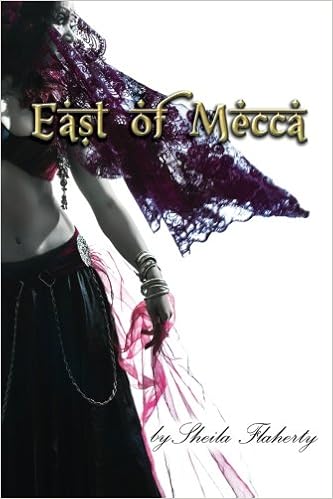 This moving and unforgettable novel, East of Mecca, tells a timely, harrowing, and heartbreaking story of love and betrayal, the transcendent power of sisterhood, and the ultimate price of oppression. Driven by financial desperation, Sarah and Max Hayes are seduced by promises of a glamorous expatriate lifestyle in Saudi Arabia. Sarah surrenders her career when Max accepts a prestigious job with Ocmara Oil Company and they relocate their family to the shores of the Persian Gulf. Locked inside the heavily-guarded Ocmara compound, Sarah becomes invisible within the male-dominated, fundamentalist, Islamic Kingdom, which is governed by sharia law. Gradually, she is drawn into a clandestine, illicit friendship with Yasmeen, a Muslim Saudi woman. Together they find freedom beneath the veils and behind the walls of the Saudi women’s quarters—until inconceivable events force Sarah to make life-or-death decisions. Told with riveting authenticity and exquisite detail, East of Mecca explores gender apartheid through the abuse of absolute power with an elegant balance of cultural nuance and moral inquiry. Long after you have turned the last page, you will be haunted by the vivid characters and powerful scenes illuminating this tour de force.
Voodoo is not a Bunch of Hocus-Pocus

Danny Estes Author Interview
Charlotte is a woman of mysterious origins who is seeking revenge on the one who locked her away. How did you decide what the starting point was for you in Charlotte’s Soul?
In truth I was working on another story, dealing with a healer in a magical realm when my mind drifted off. The stories of the witch hunts in Salem came up. I’d seen many documentaries concerning that time period, thus I began to wonder. What would a true witch do. Could I write an interesting story? I considered starting points in that time period but nothing clicked for me. It wasn’t until I considered modern times that I felt a connection. Still, something was missing. I began asking what if? What if? That’s when Charlotte began to come alive. As for a starting point, I like to start off with my characters having to deal with situations that reveals something about the person.
The novel is filled with subtle yet powerful descriptions of voodoo and witchcraft. What research did you undertake to ensure you got all the details right?
From early on as a child Witchcraft has been talked-about, written about and made in to tv shows. In my mind they all held the same theme, the ability to alter reality by understanding nature is a force which can be tapped. Thus using this knowledge I built up Charlotte’s abilities. Voodoo on the other hand has not been a part of my world, yet I’d heard stories about it. Being unsure of any true facts, I began searching the Internet to understand it’s origins. The more sites I came across the more I learned voodoo is not a bunch of hocus-pocus, it’s a respected religion in many cultures.
I found that Charlotte was a balance between femininity, passion and a strong will. What obstacles did you feel were important in the story for Charlotte’s character development?
To develop Charlotte, I considered how she must feel being a 17th century woman thrust into our society. To give her balance to cope, I paired her off with detective Matt Huston, a modern man with his own demons. I felt with the two butting heads, she would have a foundation to build a life in our time period.
Will Charlotte’s Soul be part of a series? If so, where does the next story go? If not, where do you imagine it could go?
I did leave room to write another story with her and in fact, I’ve the making for a beginning to book 2. Presently however, she has been delegated to remain on hold as another story has caught my interest. In time I’m hopeful she’ll get dusted off and put back in action.
Author Links: GoodReads | Facebook | Website
![Charlotte's Soul by [Estes, Danny C]](https://images-na.ssl-images-amazon.com/images/I/51cKWWf9x-L.jpg) Charlotte Goodfield, a witch imprisoned since the 17th century, escapes in modern times and enlists the help of a New York City detective and an ATF agent to find her half-brother. He stole the magic amulet that holds half her soul—and she wants it back. Charlotte wades through NYC’s underbelly, searching for answers and discovering other horrors.
Charlotte Goodfield, a witch imprisoned since the 17th century, escapes in modern times and enlists the help of a New York City detective and an ATF agent to find her half-brother. He stole the magic amulet that holds half her soul—and she wants it back. Charlotte wades through NYC’s underbelly, searching for answers and discovering other horrors.
While her amulet has been with her brother, that half of her soul became drenched in evil; contacting it strengthens her magic but doing so raises a daemon within her that doesn’t care about playing by the rules.
Bad men are fair game. And she’s met a lot of bad men.
Evolve like a Butterfly: A Metamorphic Approach to Leadership


Evolve Like A Butterfly – A Metamorphic Approach to Leadership by Mayur Ramgir covers a broad spectrum of areas relevant to the task of a leader. Supported by illustrations and quotes, advice is given on risk taking, adapting to change, accepting feedback and good communication. It also looks at the conditions in which innovation, incubation and prototyping can occur. Ramgir reveals the secrets to motivating others whilst continuing on a path of self-development, and shares tips on creating a legacy through leadership succession.
The book can be read cover to cover or dipped into as a reference guide for specific advice.
The author engages the reader with a warm and welcoming tone from the start. He then describes his mother’s own leadership journey and invites us to consider the definition of a leader before we move on to more complex considerations. It is a useful resource for anyone starting out in leadership or those wishing to transition to a more ethical approach.
The butterfly metaphor is used initially to good effect, although it is not evenly referenced throughout, it is revived at later points and thus not lost entirely.
Hidden in the book are useful nuggets of advice which may not be found in your average book on leadership in business from a mainstream perspective. Ramgir emphasizes the importance of remaining connected empathetically to the work force so that there is less chance that this bond is severed in times of change or difficulty. He also looks at what areas of self development might be needed for a good leader; and points out how important it is to learn from one’s own failures whilst forging an individual path.
The author suggests that ‘character’ is vital in order to lead an organisation or team through crises and adversity. However, he does not really flesh out what he means by the term which readers may understand in slightly different ways, in particular across cultural divides. Perhaps ‘tenacity’ or ‘staying power’ would be suitable descriptors of the qualities he intends to present.
Ramgir does not shy away from offering solutions to challenging issues such as the potential pitfalls of moving from being a member of a peer group to leading those peers; or managing the ups and downs of different points in the business cycle and consideration of the timing of risk taking.
While some sections seem to repeat themes such as communication and motivation, the additional detail reiterates the importance of these key skills in different contexts.
This is a useful reader for students and established leaders in business as well as those concerned with social good; it is relevant across the private, third and public sectors.
This book is an inspiring read and goes far in providing sound advice to current and emerging leaders. It is a recommended read for anyone passionate about safeguarding the future of the organisation and people with whom they work.
Pages: 250 | ISBN: 154428585X



 LITERARY TITAN